

Audio By Carbonatix
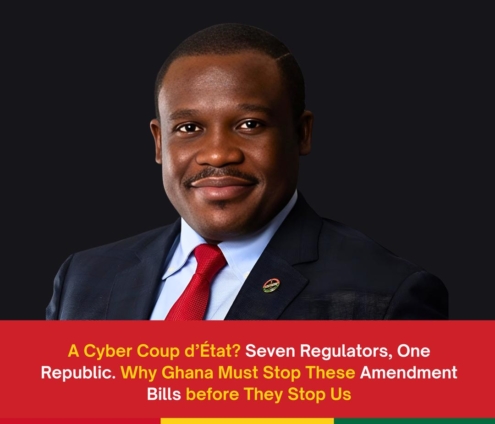
There is something stirring quietly in the corridors of our Republic. A revolution not of tanks and bayonets, but of legal clauses and agency mandates. It arrives wrapped in good intentions and stamped with urgency.
It speaks the language of artificial intelligence, data harmonisation, cybersecurity, innovation, and digital literacy.
On paper, Ghana is modernising. In reality, something far more dangerous is taking shape.
While citizens worry about electricity, livelihoods, and the rising cost of living, Parliament is being handed a maze of draft laws so complex that even seasoned experts struggle to map the exits.
Behind the gloss of digital transformation lies a Frankenstein architecture of power: multiple technocratic agencies all claiming authority over the same technologies, the same data, the same future.
Who controls AI?
Three separate bills each answer: “Me.”
Who governs data?
Two different regulators each respond: “I do.”
Who holds power over security and innovation?
Four institutions step forward at once.
In this legislative chaos, technology itself becomes a jurisdictional battlefield.
Ghana is building a many-headed digital regulator. A creature with seven mouths issuing directives and zero ears to listen. A beast guaranteed to confuse innovators, suffocate start-ups, and scare investors into silence.
A bureaucracy so layered that no one will ever be sure whether a digital pioneer must seek permission from the Data Protection Commission, the Cybersecurity Authority, NITA, the National Communications Authority, a new Emerging Technologies Agency, or an institute yet to be built.
We are sleepwalking into paralysis.
Instead of one clear national strategy for technology, Ghana is creating a fortune-draining competition between state bodies. Instead of efficiency, conflict. Instead of progress, a procedural traffic jam.
And the price will be paid by the young people we claim to empower. Imagine a brilliant Ghanaian engineer designing a tool that could change agriculture or health care. Before she writes a single line of code, she must navigate licensing, ethics approvals, data permissions, cybersecurity certification, and innovation oversight.
Each step required by a different regulator with a different rulebook. Delay becomes a business model. Compliance becomes a punishment. Vision dies.
In whose interest is that?
There is a lesson Ghana keeps failing to learn. When institutions fight for power instead of purpose, citizens suffer. When technocrats build empires instead of systems, democracy pays. When the Executive multiplies agencies without clear supremacy or coordination, accountability disappears.
Yes, we need strong data protection. Yes, we must secure our critical infrastructure. Yes, we must prepare for AI, quantum, and the digital economy. This is not a call to abandon the future. It is a call to design it with coherence and democratic intelligence.
The question is simple: Will Ghana own her digital future… or be owned by the confusion she creates?
We deserve one transparent, streamlined, accountable framework.
Not seven fiefdoms fighting for relevance.
We deserve innovation supported by clarity, not smothered by contradiction.
We deserve technology governed by rights and freedom, not by opacity and overlapping mandates.
We must pause. Review. Consolidate. Amend. Build wisely. Our policymakers must defend the interests of citizens and innovators, not the expansion of regulatory turf.
A digital republic cannot be built on legislative chaos.
Ghana’s future will be determined by the laws we pass today. The question each MP must answer is unavoidably personal and profoundly patriotic:
When tomorrow’s Ghana is automated, interconnected, and intelligent, will the sons and daughters of this nation find room to invent, to build, to question and to thrive? Or will they be trapped in a labyrinth of agencies more powerful than Parliament itself?
The future has arrived at our doorstep, asking: Who is really in charge here?
We must ensure the answer is: The Ghanaian people.
Latest Stories
-
Africa’s youth bulge a ‘defining moment’ that requires urgent action – NYA CEO Osman Ayariga
6 minutes -
No looming power crisis; Ghana’s electricity supply remains stable – Energy Ministry PRO insists
21 minutes -
Mahama should reset his stance on LGBTQ -Clinton Baffour
27 minutes -
Rising sachet water costs should spark a bigger conversation on plastic waste
31 minutes -
Two-week ceasefire takes effect as US and Iran prepare for talks in Pakistan
34 minutes -
Dr. Amoakohene debunks claims Sewua and other Agenda 111 hospitals are ready for operationalisation
42 minutes -
AMA rolls out new shift system for street sweepers to improve sanitation
45 minutes -
Focus on capacity, not connections in Damang lease decision – Paa Kwesi Schandorf
56 minutes -
Teen defender Eric Mensah undergoes trial at Malaga CF after standout ROC Cup display
57 minutes -
Journalism out loud: Why silence is no longer an option
58 minutes -
NYA boss identifies unemployability as Africa’s core youth challenge
1 hour -
5,000 miners stranded in Ahafo-Ano North as alleged NAIMOS operatives take over site
1 hour -
GMTFcare rollout begins at Komfo Anokye Teaching Hospital to transform patient support
1 hour -
Leicester lose appeal against points deduction
1 hour -
Telecel hosts Women 100 Power Connect 2026 on reciprocity in leadership
1 hour