

Audio By Carbonatix
The Akenten Appiah-Menka University of Skills Training and Entrepreneurial Development (AAMUSTED), Kumasi campus, was filled with emotion, urgency, and a call to action as students gathered for a lecture on Ghana’s growing environmental crisis.
Held in a lecture hall of 105 students, the event drew hundreds of students of BSc Social Studies eager to understand the dangerous effects of galamsey, the illegal small-scale mining practice threatening Ghana’s land, water, and people.
Led by environmental lecturer Dr. Simon Boateng, the lecture peeled back the layers of a national disaster that continues to unfold.
The university, known for its strong academic foundation in entrepreneurship and accounting, also promotes ethical leadership and real-world problem-solving. And the course, environmental issues in Ghana was a clear example of that commitment.
Dr. Boateng showed evidence of how galamsey is affecting waterbodies among others. Through disturbing videos, he brought the crisis into the lecture room: rivers turned brown and poisoned, elderly patients lying in hospital beds, their bodies failing from exposure to toxic water. The mood was somber.
One student, struggling to hold back tears, stood and asked a question that got everyone thinking: “How do we stop galamsey?”
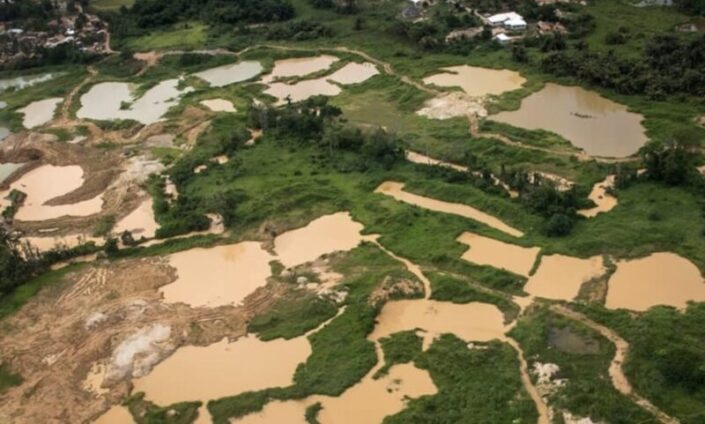
According to a report from the Centre for Remote Sensing and Geographic Information Services (CERSGIS), more than 670 square kilometers of land nearly the size of Singapore has been destroyed by illegal mining. Rivers once full of life are now choked with chemicals like mercury, arsenic, and lead.
These polluted waters are the same ones used daily by rural communities for drinking, farming, and cooking. The damage goes beyond nature, it is killing livelihoods and costing lives. “Our crops are dying, and people are getting sick because of dirty water,” said Nadia Salu, a student lamented.
Dr. Simon explained that Ghana’s environmental issues didn’t start today. The roots stretch back to colonial times, when natural resources were extracted with little concern for environmental consequences. Fast-forward to today, and rivers like the Pra, once used by colonial governors for their final baths, are now so polluted they are unrecognizable.
Key issues covered in the lecture included deforestation, afforestation, land degradation, air and water pollution, and flooding. Dr. Simon explained that floods can happen naturally like from melting icebergs, but many in Ghana are man-made, caused by clogged drains filled with refuse.
He asked, “Did you know some people still drink from the same pond as animals?” The silence that followed said it all.
Student Daniel Asamoah asked a question many were thinking: “How do we fix this?” Dr. Boateng laid out several strategies. First, create employment opportunities in mining communities to prevent the youth from joining illegal operations.
Next, support responsible mining, formalize artisanal mining licenses, and invest in local economies. He stressed that community involvement and policy reform were key, as well as using technology to monitor illegal mining and offering healthcare and support to affected communities.
“Environmental problems are everyone’s problem,” he said. “We need all hands on deck.”
For many, the experience was life-changing. “I never realized the impact of galamsey till I saw that 60-year-old man in the hospital,” said this writer, Fasila Alhassan. “What if it was my mom?”
“Dr. Simon’s passion for conservation is inspiring,” said Herrietta Ziem, another student. “I’m motivated to make a difference.”
Kwame Frimpong added, “The lecture was informative and interactive. The real-life videos made the problems feel so real.”
The session ended with questions and answers, where students asked thoughtful questions and shared ideas.
Dr. Boateng challenged the students to take action. Their assignment: visit local communities, interview the elderly about environmental changes, and bring back pictures and videos for discussion during the next lecture.
Latest Stories
-
Gramps Morgan names Ghanaian business leader Monalisa Effah as Ghana-Jamaica Homecoming Ambassador
8 seconds -
CAF President urges faith in African football despite AFCON 2025 issues
19 minutes -
AFCON U-17: Black Starlets’ aim is to win trophy – Head Coach Prosper Ogum
23 minutes -
ENFA expands access to global capital for Ghanaian SMEs
31 minutes -
Beyond security: Why mobile payment fraud has become a customer experience crisis
32 minutes -
Former Effia MP demands full disclosure of Truedare AI deal, warns of ‘hidden risks’
57 minutes -
Joseph Cudjoe raises alarm over potential revenue loss in Truedare AI Customs deal
57 minutes -
Video: Awoshie-Anyaa Highway: Years of fatal crashes caused by faulty traffic lights
1 hour -
No financial transactions with Ghana Card yet, says NIA
1 hour -
Former Netherlands Fire Chief engages GNFS Tema Command on capacity building
1 hour -
Finance Ministry defends Publican AI rollout amid stakeholder concerns
1 hour -
Police arrest 5 in Asankrangwa robbery; cash and guns retrieved
1 hour -
Why I joined NPP – Jeneral Ntatia
1 hour -
Three UDS students remanded over alleged armed robbery
1 hour -
Kudus Mohammed at risk of missing World Cup 2026 after fresh injury blow
1 hour