

Audio By Carbonatix
The inaction of police personnel during the recent parliamentary rerun election in Ablekuma North on Friday, July 11, has drawn sharp condemnation from former Senior Presidential Aide, Dr. Tony Aidoo.
Speaking today on JoyNews, Dr. Aidoo expressed disappointment and posed critical questions about the conduct of the police, linking it to a broader societal issue of lawlessness and a potential erosion of public trust.
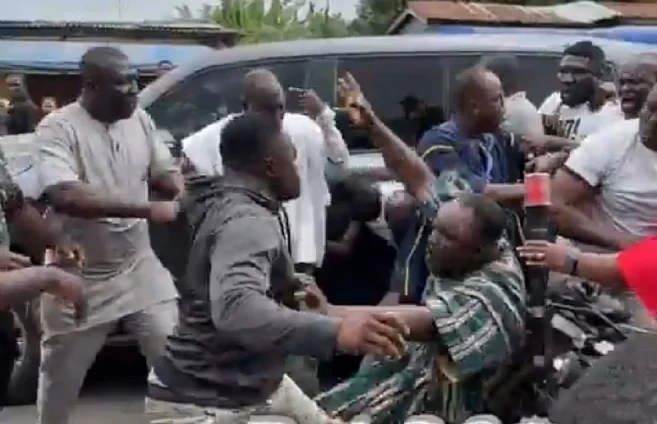
The Ablekuma North rerun was marred by widespread reports of violence, intimidation, and physical assaults, despite a visible security presence.
Journalists covering the event, including Kwabena Agyekum Banahene of EIB Network, Salomey Martey of Multimedia Group, and Vida Wiafe of Amansan TV, were physically attacked.
Political figures, such as former Fisheries Minister Mavis Hawa Koomson, were also allegedly assaulted amidst chaotic scenes at polling centres like St. Peter's Methodist Church.
Dr. Aidoo, reflecting on these incidents, questioned the apparent passivity of law enforcement.
"You say that the police were standing by doing nothing. Yeah. I wonder why," he stated. He then raised a critical question that he noted had not been put to the Interior Minister, Montaka, during his recent media appearance: "Whether the indolence or apathy of the police during that incident was the result of directives given to them or because of the cultural phenomenon which I call secophancy."
By "secophancy", Dr. Aidoo implied a subservient or deferential attitude where police personnel might stand down due to the political nature of an incident, fearing repercussions or acting on undeclared directives. He stressed the grave consequences of such behaviour for public confidence: "You cannot get the trust of citizens if you behave like that."
Election violence?
Dr. Aidoo's critique taps into a long-standing concern in Ghana's democratic process: the effectiveness and impartiality of security agencies, particularly the police, in managing election-related violence.
Despite Ghana's reputation as a stable democracy in West Africa, successive general elections have been marred by violent incidents, often perpetrated by political party vigilante groups.
- 2020 General Elections: These elections saw at least eight fatalities directly linked to electoral violence, with numerous injuries and instances of ballot box snatching and intimidation. The police response in many of these cases was widely criticized for being slow or ineffective.
- December 2024 General Elections: Even more recently, the December 2024 polls recorded at least six deaths attributed to election-related violence, perpetuating the worrying trend.
- Political Interference: Civil society organizations and governance experts have consistently pointed to alleged political interference as a key factor hindering the Ghana Police Service's operational independence. This often manifests as delays in responding to disturbances, selective enforcement of the law, or a reluctance to prosecute politically connected perpetrators.
- Lack of Accountability: A pervasive issue is the low rate of prosecution and conviction for electoral violence offenders. Even when arrests are made, many cases languish or are dropped, contributing to a culture of impunity that emboldens perpetrators. The Vigilantism and Related Offences Act 2019 (Act 999), enacted to curb party militias, has struggled with effective implementation and prosecution.
Dr. Aidoo broadly painted a picture of a society where lawlessness is becoming normalized.
"And like I said earlier, our society seems to be characterised by increasing lawlessness. Every facet of our activity is governed by self-interest and disobedience of the law." This wider observation suggests that the police's apparent inaction in Ablekuma North might be symptomatic of deeper systemic issues in Ghana's governance and rule of law.
The failure of police to decisively tackle violence in electoral hotspots not only endangers citizens and journalists but also undermines the credibility of the electoral process itself. It discourages voter participation, particularly among vulnerable populations, and tarnishes Ghana's international image as a beacon of democracy. As the nation prepares for future electoral contests, Dr. Aidoo's pointed questions serve as a critical reminder of the urgent need for police reform, accountability, and genuine operational independence to safeguard the integrity of Ghana's democratic future.
Latest Stories
-
US Army veteran charged with leaking classified information to journalist
44 minutes -
Dr. Dre joins Forbes billionaires list as second-richest hip-hop artist with $1 billion fortune
46 minutes -
Trump administration cannot nix legal status of 5,000 Ethiopians, US judge rules
55 minutes -
Libya announces new oil and gas discoveries with three major energy companies
1 hour -
Oil rises as investors remain wary US-Iran ceasefire will open supply flow
1 hour -
Police arrest suspect over church threat video
3 hours -
Eight appear in court as police intensify crackdown on illicit drugs in Tamale
3 hours -
Motorist remanded in custody for hitting four-year-old girl
4 hours -
Mobile money vendor robbed at Ziope
4 hours -
Benin’s Finance Minister Wadagni seeks his own mandate in election
4 hours -
GNFS retrieves body of unidentified man from Asylum Down drain
4 hours -
CAF’s Motsepe to visit both Senegal and Morocco amid AFCON fallout
4 hours -
Edmond Boateng takes up secretary role at Honorary Consular Corps of Ghana
4 hours -
Armed men kill 20 and abduct others in northwestern Nigeria villages
5 hours -
Gambia appoints British barrister to prosecute gruesome Jammeh-era crimes
5 hours