

Audio By Carbonatix
The Association of Chartered Certified Accountants (ACCA) has reinforced its commitment to equipping finance professionals with future-ready skills by hosting ACCA Orbit 2025, a summit focused on the role of artificial intelligence (AI) in shaping the accountancy profession. The event, held at the UPSA Auditorium under the theme ‘AI and the Future of Work’, brought together industry experts, business leaders, and technology professionals to discuss AI’s impact on finance and the evolving responsibilities of accountants.
In his opening remarks, Col. Nobel Carl Doe Dei-Alose, Chairperson of ACCA Ghana, emphasised the urgency for accountants to develop AI competencies to remain relevant. He warned that those who fail to adapt risk being left behind as AI becomes increasingly integrated into financial processes. “We need to support understanding towards engagements in functions that we should be prepared to handle. As we move forward, you will notice that you cannot avoid them,” he stated.
He further cautioned that professionals who do not grasp the fundamentals of the evolving business environment may struggle to reconcile traditional knowledge with modern industry demands.
A panel discussion on ‘Will AI Take My Job?’ addressed concerns about automation replacing accountants. Panelists highlighted AI’s role as an enabler rather than a disruptor, stating that the profession is shifting from data processing to advisory functions.
Akwasi Adu Boahene, CEO of Fidelity Securities, underscored the need for accountants to embrace this transformation, stating, “The future of accountancy is no longer about just reporting numbers but about deriving strategic value from them. Those who can interpret financial data to inform business decisions will remain indispensable.”

While he reasoned that AI would lead to enhanced accuracy and consequently trust in output of professionals, he, however, cautioned against the potential biases. “Trust and accuracy are the foundations of accounting. AI, when properly implemented, can enhance trust by improving data analysis and reducing human error but there must be governance structures in place to ensure AI is used responsibly. Without proper oversight, AI could be misused, eroding the very trust it seeks to build,” he explained.
Winifred Opoku-Baffour, Assistant Vice President, Rewards and Governance Lead at Absa Bank highlighted AI’s potential to enhance efficiency while cautioning against fears of job losses. “It is normal for people to be afraid, but that fear comes from a misunderstanding of AI’s capabilities. AI cannot replace fundamental accounting skills. Instead, it will help us be more efficient. The key is to embrace it as an enabler, not a threat,” she argued. She emphasised the importance of upskilling, particularly in soft skills, to remain relevant in an evolving area.
Norbert Dziwornu, Managing Partner at StartOA, reinforced this perspective, stating, “AI is improving decision-making. We don’t have to be scared; rather, we should know how to leverage these tools to our best advantage.” He encouraged professionals to embrace AI-driven efficiencies while maintaining ethical oversight.
Throughout the summit, speakers stressed three critical areas for professionals seeking to integrate AI into their work: lifelong learning and intellectual curiosity, enhancing analytical and advisory skills, and prioritising ethical considerations to ensure responsible decision-making.
Gloria Boye Doku, Vice Chairperson of the ACCA Network Panel, reiterated ACCA’s commitment to educating professionals and students on AI’s evolving role. “There is always this fear that AI is coming to replace us, but through our speakers and panel, we have been informed that AI is here to augment what we are already doing,” she said. She also highlighted ACCA’s continuous efforts to expose finance professionals to emerging technological trends through such initiatives.
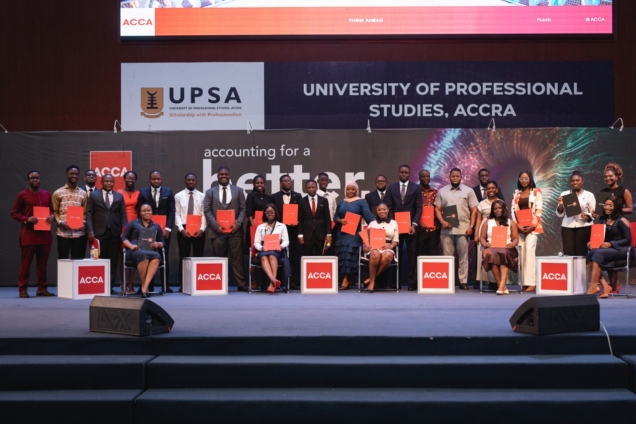
The summit also featured a career fair, offering employability and digital skills training. Participants engaged in masterclasses covering blockchain, cryptocurrency, and opportunities in the gig economy. Additionally, 50 top-performing ACCA candidates in taxation, audit and assurance, financial management, and other disciplines were recognised for their achievements in Ghana and internationally.
Latest Stories
-
Iran war lands ‘triple blow’ to flood-ravaged Sri Lankans
23 minutes -
Gunmen kill at least 11 people at Afghanistan picnic spot
36 minutes -
Woman, 25, in court for stealing baby at Bogoso
37 minutes -
Trump unveils giant gold-accented victory arch design for US capital
40 minutes -
We spoke to the man making viral Lego-style AI videos for Iran. Experts say it’s powerful propaganda
45 minutes -
Hungarians vote in big numbers on whether to end Orbán rule and elect rival
46 minutes -
At least 30 feared dead in crush at Haitian tourist site
46 minutes -
Boxing: Abdul Ahmed wins WBA Africa Cruiserwight title after dispatching Nigeria’s Eradeye
60 minutes -
Nearly 2,000 displaced, schools damaged as windstorm wreaks havoc in Gushegu
1 hour -
Ghana’s Derrick Kohn to work under Marie-Louise Eta as she becomes first woman to coach men’s Bundesliga team
1 hour -
Accra Open Championships conclude with strong performances ahead of African Championships
1 hour -
Ghana to begin camping with 12 athletes after Accra Open Championships – Bawa Fuseni
2 hours -
Anthony Joshua declines showdown with Tyson Fury but admits they ‘probably’ clash next
2 hours -
Tyson Fury dominates Makhmudov, calls out Joshua next
2 hours -
I have supported highway authority financially to fix roads in my constituency – A Plus
3 hours