

Audio By Carbonatix
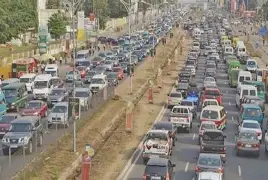
The Ghana Private Road Transport Union (GPRTU) has attributed the public transport crisis in Accra largely to heavy traffic congestion in the capital during peak morning and evening hours.
The Union said the persistent gridlock was preventing commercial drivers from completing multiple journeys and returning to transport terminals on time, contributing to long queues and delays experienced by commuters at the major terminals.
In an interview with the Ghana News Agency, Nana Nimako Asiamah, the National Chairman of the GPRTU, rejected suggestions that commercial drivers had created “artificial” shortages to justify fare increases.
“As far as the GPRTU is concerned, we are not creating any artificial scarcity. The problem is that the traffic in Accra is affecting the transport business,” he said.
“The situation is worse in the mornings and evenings because drivers are not able to return to the stations on time to pick up more passengers.”
Nana Asiamah’s comments come amid recent government concerns that unlawful practices by some private transport operators had worsened transportation challenges in Accra.
The Minister of Government Communications, Felix Kwakye Ofosu, had noted that some drivers were deliberately creating artificial shortages, especially during peak periods.
That was to compel commuters to pay higher fares despite reductions in fuel prices and an agreed 15 percent cut in approved transport fares, he said.
Mr Ofosu cited examples of drivers avoiding designated terminals and instead roaming urban centres in search of passengers willing to pay more, describing the behaviour as unlawful and pledging the government’s resolve to take action against those involved.
In response, Nana Asiamah corroborated the government’s concerns, saying the GPRTU had been notified of such acts and assured that the Union would sanction any member found culpable.
He, however, indicated that because of the lack of proper identification on some vehicles, it was difficult to determine which of the offending drivers were members of the Union, especially when some of them belonged to other transport bodies.
He urged the Government to work with the Union to develop a system to facilitate the identification of each bus to aid enforcement.
“We are ready to meet the Government and work together with other transport unions to find a solution to the challenges,” Nana Asiamah said.
Latest Stories
-
I broke my virginity at the age of 26 after university – Richard Abbey Jnr.
39 minutes -
Sacked for fees, saved by faith: The untold story of Forty Under 40 Awards founder Richard Abbey Jnr
1 hour -
GCB Bank surges GH¢0.45, ETI gains GH¢0.06 as GSE ends week higher
2 hours -
Two teens jailed 55 years for robbery
2 hours -
UDS demands apology for MPhil student wrongly branded as Tamale robber
3 hours -
“We don’t sell fish!” – Tema Shipyard CEO hits back over dead fish discovery
3 hours -
Sam George defends anti-LGBTQ+ Bill as ‘national priority’ amid debate over gov’t focus
4 hours -
Artemis II astronauts safely back on Earth after trip around moon
4 hours -
Sam George unveils massive 1,150-cell site rollout to end network woes
4 hours -
This Saturday on Prime Insight: Fuel levy suspension, LGBTQ+ legislation, and Damang Mine controversy
5 hours -
Struggling Real suffer title blow with Girona draw
5 hours -
Mahama nominates Pamela Graham as Auditor-General
6 hours -
The five big sticking points in US-Iran talks
6 hours -
Melania Trump’s speech propels Epstein crisis back to forefront
7 hours -
What everyone should know about C-sections
7 hours