

Audio By Carbonatix
The US Supreme Court has ruled that race can no longer be considered as a factor in university admissions.
The landmark ruling upends decades-old US policies on so-called affirmative action, also known as positive discrimination.
It is one of the most contentious issues in US education.
Affirmative action first made its way into policy in the 1960s, and has been defended as a measure to increase diversity.
US President Joe Biden said he "strongly" disagreed with Thursday's much-anticipated decision.
"We cannot let this decision be the last word," he said. "Discrimination still exists in America."
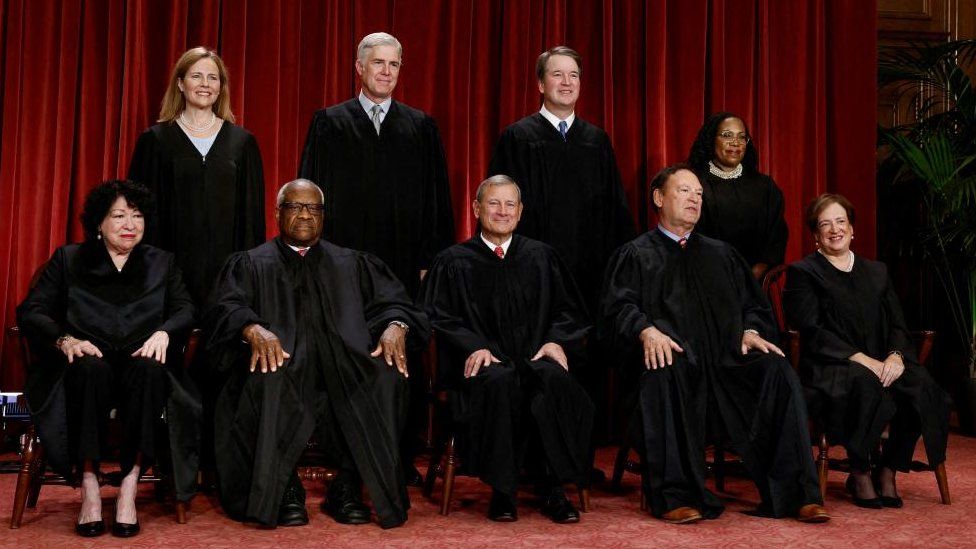
"This is not a normal court," he added of the nine justices, who are ideologically split between six conservatives and three liberals.
Education Secretary Miguel Cardona told BBC News that the court "took away a very important tool that university leaders used to ensure diversity on campus".
"However what it didn't take away is the intent to ensure that our colleges are made up of beautifully diverse students, much like our country is," he continued, adding that the White House will issue guidance to universities with instruction on how to legally maintain diversity.
The ruling covered two cases involving admissions at Harvard and the University of North Carolina (UNC). The court ruled 6-3 against UNC and 6-2 against Harvard.
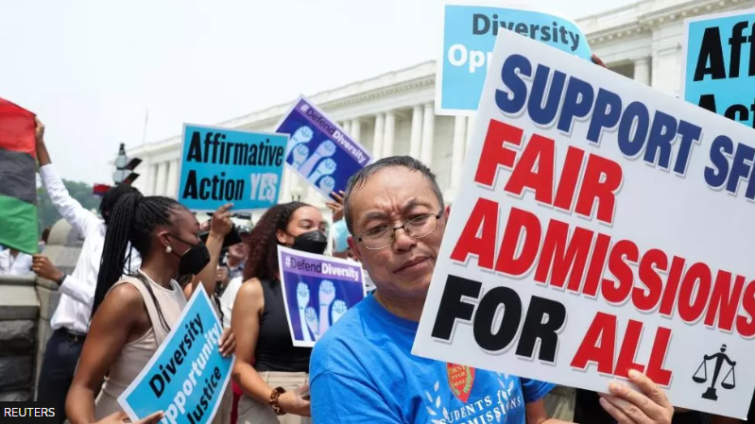
The justices sided with an organisation called Students for Fair Admissions, founded by legal activist Edward Blum.
The group argued before the court last October that Harvard's race-conscious admissions policy violated Title VI of the 1964 Civil Rights Act, which bars discrimination based on race, colour or national origin.
Chief Justice John Roberts wrote: "Many universities have for too long wrongly concluded that the touchstone of an individual's identity is not challenges bested, skills built, or lessons learned, but the color of their skin."
His majority opinion said UNC and Harvard's policies were "well intentioned".
And the decision noted that universities should not be prohibited from considering an applicant's "discussion of how race affects his or her life".
But Justice Roberts wrote: "Harvard's admissions process rests on the pernicious stereotype that 'a black student can usually bring something that a white person cannot offer.'"
Justice Clarence Thomas, the nation's second black justice and a conservative who has long called for an end to affirmative action, agreed.
He wrote that such programmes were "patently unconstitutional".
"Universities' self-proclaimed righteousness does not afford them license to discriminate on the basis of race," he said.
Among the liberal justices who dissented was Ketanji Brown Jackson, the first black woman appointed to the court. She said the decision was "truly a tragedy for us all".
"With let-them-eat-cake obliviousness, today, the majority pulls the ripcord and announces 'colorblindness for all' by legal fiat," she wrote.
Another dissenting liberal justice, Sonia Sotomayor, said the ruling "cements a superficial rule of colorblindness as a constitutional principle in an endemically segregated society".
But Justice Roberts argued that the dissenting justices had ignored parts of the law that they did not like.
"Most troubling of all is what the dissent must make these omissions to defend: a judiciary that picks winners and losers based on the color of their skin," he wrote.
Mr Blum, the founder of Students for Fair Admission, celebrated his group's success in the blockbuster ruling.
He called it "the beginning of the restoration of the colorblind legal covenant that binds together our multi-racial, multi-ethnic nation".
"These discriminatory admission practices undermined the integrity of our country's civil rights laws," he said.
Yukong Zhao, president of the Asian American Coalition for Education, told the BBC he welcomed the ruling.
His group argued that affirmative action had negatively affected Asian American students' odds of enrolment at elite schools.
"This decision will preserve meritocracy, which is the bedrock of the American dream.," Mr Zhao said outside the court.
Others criticised the ruling.
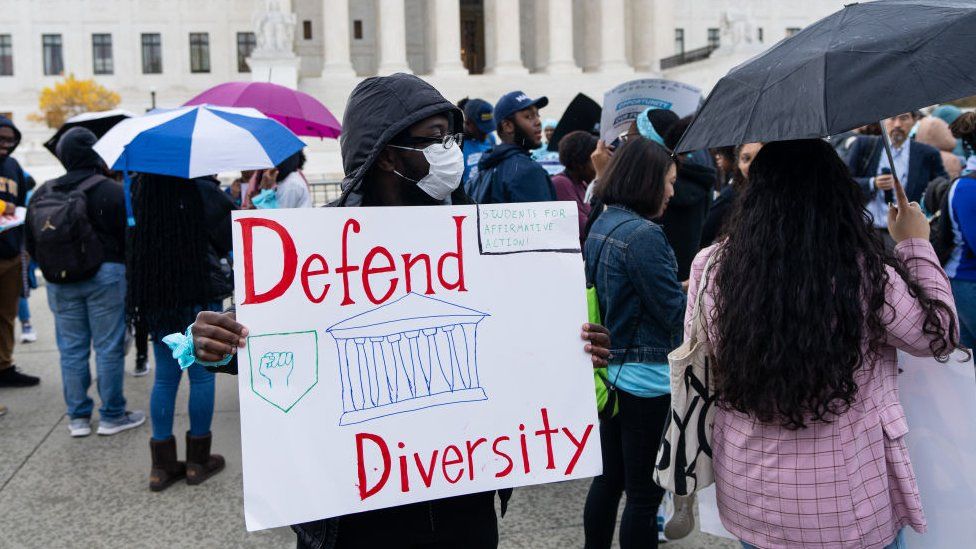
Angie Gabeau, the president of the Harvard Black Students Association, told the BBC she was "very discouraged" by the decision.
Ms Gabeau, who is 21 and entering her final year at Harvard, says she believes her race "100% played a factor in my application", including through an application essay.
She worries that "students that are affected by their race in this country will now feel obligated to trauma-dump in their applications to show how race is affecting their lives".
In a statement, Harvard president Lawrence Bacow said that while the Ivy League college "will certainly comply with the court's decision", it would continue to incorporate "people of many backgrounds, perspectives, and lived experiences".
UNC Chancellor Kevin Guskiewicz said that while it is not the outcome that the university "hoped for", it will review the decision and "take any necessary steps to comply with the law".
Former US President Donald Trump, the current Republican frontrunner for next year's election, hailed the decision as a "great day".
Americans with "extraordinary ability and everything else necessary for success" are "finally being rewarded", he said on social media.
The Supreme Court has twice backed affirmative action programmes at US universities, most recently in 2016.
Nine US states already have bans on race-based college admissions in place: Arizona, California, Florida, Georgia, Oklahoma, New Hampshire, Michigan, Nebraska and Washington.
In California, voters rejected a 2020 ballot measure to bring back affirmative action, 24 years after it was banned.
The conservative-dominated Supreme Court enraged many US liberals last year when it voted to overturn Roe v Wade, a 1973 ruling that granted women abortion rights.
Several more recent rulings, however, have been cheered by the political left, including one on Native American child welfare and three others on election laws in Alabama, Louisiana and North Carolina.
Latest Stories
-
Aggrieved cocoa farmers urge Parliament intervention
19 seconds -
Ghana launches first maternal mental health policy
3 minutes -
Mahama issues three calls to action at One Health Summit
9 minutes -
KNUST secures $2.3m funding for research activities
13 minutes -
Ayigboe residents fear disaster as ECG delays repairs on live faulty cables
18 minutes -
PIAC urges investment as oil production falls
21 minutes -
Trump says US military to stay around Iran; threatens action if Tehran fails to comply with deal
1 hour -
Only 6% insured locally – Prof. Gyampo exposes cracks in import regime
1 hour -
Thousands of containers lost at sea – GSA’s Prof Gyampo warns importers are exposed to risk
2 hours -
Keep the money in Ghana – Gov’t enforces local cargo insurance
2 hours -
US Army veteran charged with leaking classified information to journalist
2 hours -
Dr Dre joins Forbes billionaires list as second-richest hip-hop artist with $1 billion fortune
2 hours -
Trump administration cannot nix legal status of 5,000 Ethiopians, US judge rules
2 hours -
Libya announces new oil and gas discoveries with three major energy companies
3 hours -
Oil rises as investors remain wary US-Iran ceasefire will open supply flow
3 hours