

Audio By Carbonatix
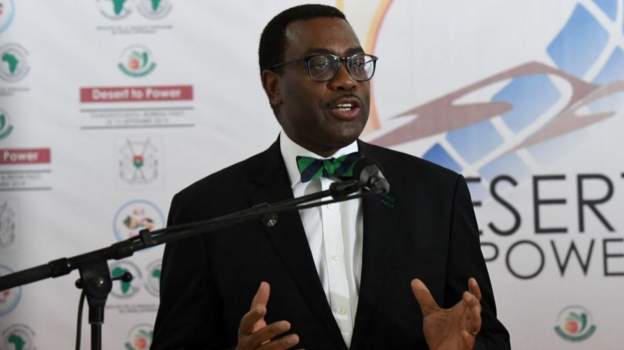
African Development Bank Group President, Dr Akinwumi Adesina says “Africa must prepare for the inevitability of a global food crisis.” He was speaking about Africa’s priorities, as a guest at the Atlantic Council’s Africa Center on Friday.
Fielding questions from the Council’s Africa Center Chair, Ambassador Rama Yade; Senior Fellow Aubrey Hruby; and Washington/UN correspondent for Jeune Afrique and The Africa Report, Julian Pecquet, the Bank chief called for an increased sense of urgency amid what he described as a once-in-a-century convergence of global challenges for Africa.
According to Dr. Adesina, the continent’s most vulnerable countries had been hit hardest by conflict, climate change and the Covid-19 pandemic, which had upended economic and development progress in Africa. He said Africa, with the lowest GDP growth rates, had lost as many as 30 million jobs on account of the pandemic.
Speaking about the impact of the Russia-Ukraine war, Dr. Adesina expressed sympathy for the people of Ukraine, describing their suffering as unimaginable.
He said the war’s ramifications spread far beyond Ukraine to other parts of the world, including Africa.
He explained that Russia and Ukraine supply 30% of global wheat exports, the price of which has surged by almost 50% globally, reaching identical levels as during the 2008 global food crisis.
He added that fertilizer prices had tripled, and energy prices had increased, all fueling inflation.
Dr. Adesina warned that the tripling costs of fertilizer, rising energy prices, and rising costs of food baskets, could worsen in Africa in the coming months.
He noted that 90% of Russia’s $4 billion exports to Africa in 2020 was made up of wheat; and 48% of Ukraine’s near $3 billion exports to the continent was made of wheat and 31% of maize.
Dr. Adesina cautioned that to fend off a food crisis, Africa must rapidly expand its food production.
“The African Development Bank is already active in mitigating the effects of a food crisis through the African Food Crisis Response and Emergency Facility – a dedicated facility being considered by the Bank to provide African countries with the resources needed to raise local food production and procure fertilizer.”
“My basic principle,” Adesina said, “is that Africa should not be begging. We must solve our own challenges ourselves without depending on others…” , he added.
The Bank chief spoke about early successes through the Bank’s innovative flagship initiative, Technologies for African Agricultural Transformation (TAAT) programme, a programme operating across nine food commodities in more than 30 African countries.
Dr. Adesina said TAAT has helped to rapidly boost food production at scale on the continent, including the production of wheat, rice and other cereal crops: “we are putting our money where our mouth is. We are producing more and more of our own food. Our Africa Emergency Food Production Plan will produce 38 million metric tons of food.”
TAAT has already delivered heat-tolerant varieties of wheat to 1.8 million farmers in seven countries.
According to Dr. Adesina, heat-tolerant varieties were now being planted across hundreds of thousands of hectares in Ethiopia and Sudan, with extraordinary results.
In Ethiopia, where the government has put the TAAT program to work in a 200,000-hectare lowland irrigated wheat program, farmers are reporting yields of 4.5 to five times per hectare.
He said TAAT’s climate-smart seeds were also thriving in Sudan, which recorded its largest wheat harvest ever – 1.1 million tons of wheat – in the 2019-2020 season.
He added that TAAT came to the rescue during the drought in southern Africa in 2018 and 2019, deploying heat-tolerant maize varieties which were cultivated by 5.2 million households on 841 thousand hectares.
As a result, he said, farmers survived the drought in Zimbabwe, Malawi and Zambia, allowing maize production to expand by 631,000 metric tons to a value of $107 million.
Dr. Adesina also spoke about the urgent and timely need for a strong replenishment of the African Development Fund – the Bank Group’s concessional lending arm that supports low-income African countries.
He said the Fund has connected 15.5 million people to electricity and supported 74 million people with improved agriculture; it has provided 50 million people with access to transport; built 8,700 kilometers of roads; and provided 42 million people with upgraded water and sanitation facilities.
Latest Stories
-
$31bn transferred without matching imports in five years — GRA boss
6 minutes -
JoyNews Impact Maker, Williams Akongbabre, presents award to people of Bawku West
6 minutes -
Kenya backs Morocco’s autonomy plan for Western Sahara, signals push for implementation
13 minutes -
Hip-hop pioneer, Afrika Bambaataa, dies aged 68
21 minutes -
Let OSP defend itself in Supreme Court case — Prof Prempeh
30 minutes -
Emmanuel Kweenu Haizel aka Simpa Panyin
31 minutes -
Police foil planned highway robbery in Ashanti Region, one suspect shot dead
37 minutes -
Sunyani Technical University dismisses 3 students over examination malpractice
2 hours -
NPRA prosecutes 11 employers, recovers GH¢27m in 2025
2 hours -
NAIMOS cracks down on illegal mining activities along River Tano
2 hours -
2026 World Cup: Officials selected are the world’s very best – FIFA defends referees list
2 hours -
NAIMOS taskforce embarks on major anti-galamsey operations at GREL plantation and along Ankobra River
2 hours -
Akufo-Addo arrives in Cotonou to lead ECOWAS mission to observe Benin presidential election
2 hours -
AMA, Mexican Embassy renew commitment to strengthen bilateral cooperation, deepen sister-city ties
2 hours -
Bolt pushes for expanded support for women-owned enterprises
2 hours