

Audio By Carbonatix
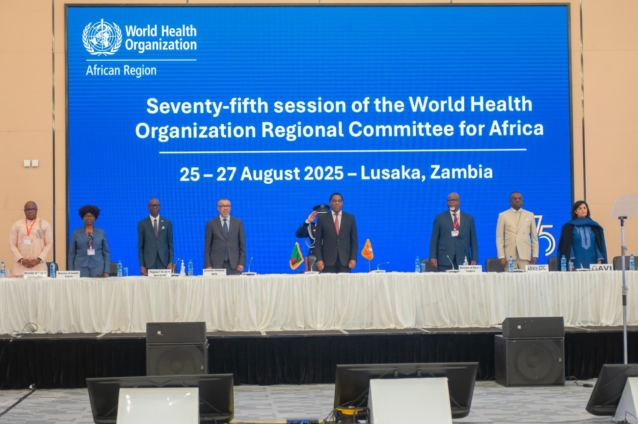
African ministers of health and global partners at the 75th session of the World Health Organization (WHO) Regional Committee for Africa have pledged to speed up local manufacturing of medicines and medical products to make the continent more self-sufficient.
The health leaders said they are committed to increasing domestic investment, expanding clinical trial capacity, and putting into action the Regional Framework for Strengthening Local Production of Medicines, Vaccines, and Other Health Technologies (2025–2035).
“The issue of local manufacturing must be high on Africa’s agenda,” said Hakainde Hichilema, President of the Republic of Zambia.
President Hakainde Hichilema said Zambia will take the lead in manufacturing local medical products to inspire other African countries to follow the same path.
“We hope other countries can join to improve the well-being of people across the region,” he said.
Africa produces less than 1% of the vaccines it uses, leaving the continent exposed to global shortages and supply chain problems.
Although some progress has been made in pandemic preparedness, the region still struggles to secure strong partnerships, sustainable financing, and supportive policies for local medicine production.
Partners such as Unitaid, the International Vaccine Institute (IVI), and Gavi, the Vaccine Alliance, have pledged their support. They joined African leaders at a high-level side event on local manufacturing of medicines, vaccines, and other health technologies during the WHO Africa Regional Committee meeting.
WHO Regional Director for Africa, Dr Mohamed Janabi, said the COVID-19 pandemic exposed Africa’s weaknesses, limited access to vaccines, fragile supply chains, and heavy dependence on imports. But he added that the crisis also sparked a new determination.
He said Africa aims to produce 60% of its vaccines locally by 2040 and with stronger political will and better collaboration, the continent can respond to future pandemics on its own terms.
CEO of Gavi, Dr Sania Nishtar, said global health is at a turning point. She explained that in today’s difficult development environment, there is a need for a new model centered on country ownership and empowerment.
“Through the Gavi Leap transformation plan, Gavi will provide countries the tools, trust and assistance to shape their own futures.”
At the event, partners called for a coordinated ecosystem approach to support end-to-end manufacturing in Africa. Organizations such as WHO, Gavi, IVI, and Unitaid stressed that local production is not just important for health but is also a key driver of economic resilience and innovation.
The discussions also highlighted IVI’s ACHIEVE 2.0 initiative, which seeks to raise funds to support vaccine research, development, production, approval, and use — all carried out within Africa.
“ACHIEVE 2.0 is an African-led initiative accelerating innovations in vaccines and therapeutics through cutting-edge science and a collaborative research ecosystem rooted in the continent,” said Dr Jerome H. Kim, Director General of IVI.
Unitaid also called for inclusive and long-term investment. Deputy Executive Director of Unitaid, Dr. Tenu Avafia, said the organization has committed nearly US$50 million to two key programmes aimed at boosting Africa’s ability to produce medical diagnostics and treatments. He added that this will help reshape markets and allow African institutions to grow stronger.
They pledged to scale up policy support, involve communities, build on Africa’s scientific and regulatory strengths, and jointly develop a framework to strengthen local production across the continent.
Latest Stories
-
Reintroduce scrapped taxes to close revenue gap – Tax expert
40 minutes -
GRA applauds CPS study, urges continuous policy scrutiny
51 minutes -
Wear blue or green hat to survive – IBAG president says insurance industry ‘captured by politics’
1 hour -
AGI commends government’s move to resolve the power crisis in Volta and Oti Regions
1 hour -
Broker sector worse hit by state interference – IBAG president reveals
1 hour -
IBAG president alleges political interference driving kickbacks in insurance sector
2 hours -
Trump agrees to two-week ceasefire, Iran says safe passage through Hormuz possible
2 hours -
Dozens killed as Angola flood death toll rises
2 hours -
Russia confirms deaths of 16 Cameroonians fighting in Ukraine war, Yaounde says
3 hours -
Plan to scrap presidential elections puts Zimbabweans at loggerheads
3 hours -
Guinea-Bissau transporters strike over higher fuel prices
3 hours -
Iran ceasefire deal a partial win for Trump – but at a high cost
3 hours -
Oil slides below $100 after Trump announces two-week ceasefire
3 hours -
Madagascar declares state of emergency over energy situation due to Iran war
3 hours -
Ex-Meta worker investigated for downloading 30,000 private Facebook photos
4 hours