

Audio By Carbonatix
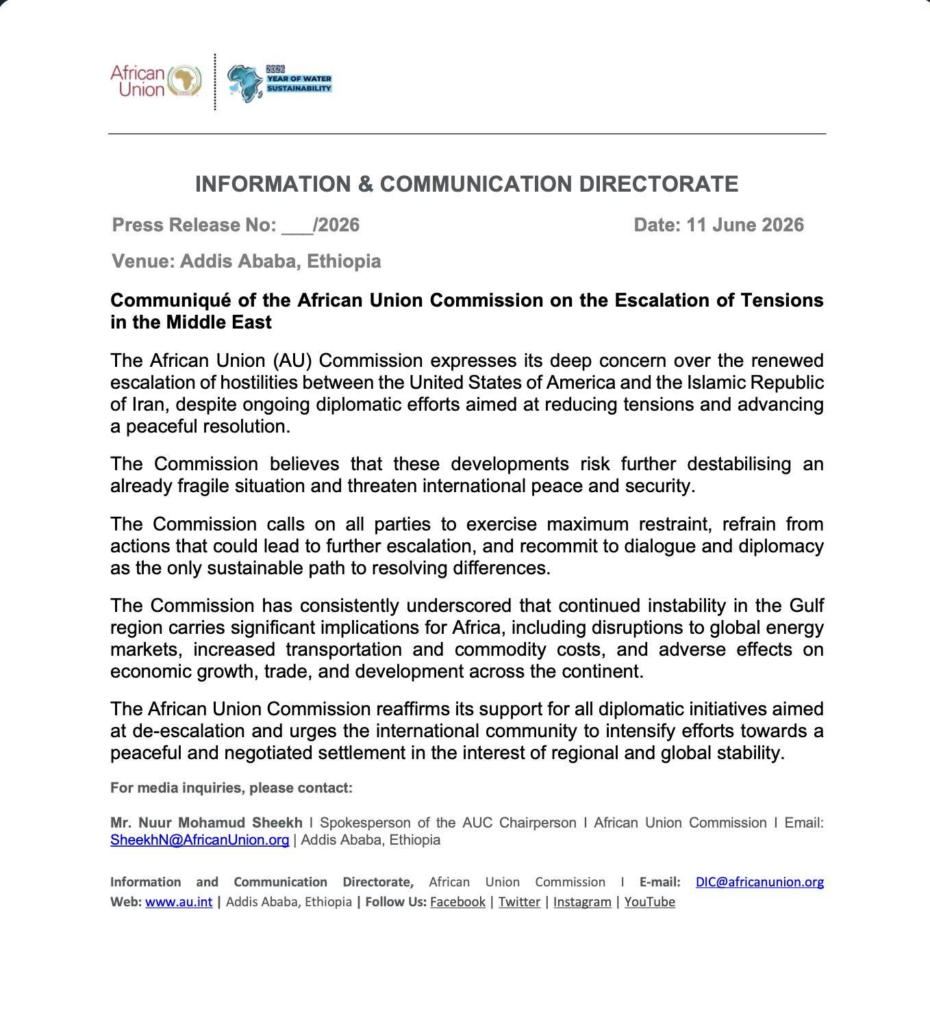
The African Union (AU) Commission has expressed deep concern over the renewed escalation of hostilities between the United States and Iran, warning that continued tensions threaten international peace and security and could have far-reaching consequences for African economies.
In a statement issued on Thursday, June 11, the Commission voiced alarm over the deterioration of relations between the United States of America and the Islamic Republic of Iran despite ongoing diplomatic efforts aimed at easing tensions and achieving a peaceful resolution to longstanding disputes.
The AU Commission cautioned that the latest developments risk further destabilising an already fragile geopolitical environment and could undermine efforts to preserve stability in one of the world's most strategically important regions.
"The Commission believes that these developments risk further destabilising an already fragile situation and threaten international peace and security," the statement noted.
Amid growing concerns over the possibility of a broader regional conflict, the AU Commission called on all parties involved to exercise maximum restraint and avoid actions that could further inflame tensions.
The continental body emphasised that dialogue and diplomacy remain the only viable and sustainable means of resolving disputes, urging both sides to recommit themselves to peaceful engagement rather than military confrontation.
The Commission stressed that a return to diplomatic negotiations is essential to preventing further instability and ensuring that disagreements are addressed through internationally recognised mechanisms.
"The Commission calls on all parties to exercise maximum restraint, refrain from actions that could lead to further escalation, and recommit to dialogue and diplomacy as the only sustainable path to resolving differences," the statement said.
While the conflict is centred outside the African continent, the AU warned that instability in the Gulf region carries significant implications for African nations, many of which remain vulnerable to global economic shocks.
According to the Commission, heightened tensions between Washington and Tehran could disrupt global energy markets, leading to fluctuations in oil and gas prices that would affect African economies already grappling with inflationary pressures and development challenges.
The organisation noted that any disruption to international shipping routes or energy supplies could trigger increased transportation costs and higher commodity prices, placing additional strain on governments, businesses and households across the continent.
For many African countries that rely heavily on imported fuel and global trade networks, prolonged instability in the Gulf could translate into rising operational costs, reduced economic activity and slower progress towards development goals.
The AU Commission reaffirmed its support for ongoing diplomatic initiatives aimed at reducing tensions and preventing further escalation between the two countries.
It also called on the broader international community to intensify efforts towards securing a peaceful and negotiated settlement that would promote stability both within the Gulf region and globally.
Latest Stories
-
King warns malicious online actors are evolving tactics
54 seconds -
Several injured as Saudi capital airport reportedly hit again
4 minutes -
Christa Pike discharged from hospital and returned to prison, her lawyers say
6 minutes -
Ghana’s BRICS move requires clear strategy to manage risks – Godfred Bokpin
2 hours -
Pay teachers realistic income – Duncan Amoah to gov’t
2 hours -
Bechem to become chicken capital of Ghana – Mahama projects
2 hours -
Gov’t targets recruitment of 16,500 health professionals in 2026
2 hours -
Two-week strike will not derail academic calendar – GNAT President
3 hours -
Headmaster detained after BBC investigation into alleged sexual abuse of students
3 hours -
GNAT pushes for clear implementation procedures of teachers’ conditions of service
3 hours -
Recurrent strikes threaten quality of education and academic calendars – Prof Bokpin
3 hours -
‘Cockroach’ group leaders among hundreds detained in Delhi protest
3 hours -
Don’t let speed of information become your judgement – CJ tells new lawyers
4 hours -
World Cup visa scandal: People have leveraged public office to facilitate fraud – Senyo Hosi
4 hours -
Glut! Farmers count losses as prices crash, customers happy
5 hours