

Audio By Carbonatix
1. Reclaiming Intelligence Sovereignty in an AI-Dominated World
Across the globe, artificial intelligence is rapidly redefining how societies think, work, govern, and innovate. Yet beneath the excitement lies a growing unease that has received far less serious attention than it deserves. The architecture of modern AI is increasingly shaped by Western epistemologies, data ownership regimes, and technical governance philosophies that have little grounding in African realities or in the lived experiences of the Global South. Data is extracted from African populations, African languages are absorbed into global training corpora, and African problems are analysed using lenses designed in Silicon Valley or Western research institutions. This process carries a striking resemblance to historical patterns of resource extraction. Where minerals were once removed from African soil without value retention, today data and cognition are mined from African lives without intellectual sovereignty or developmental control.
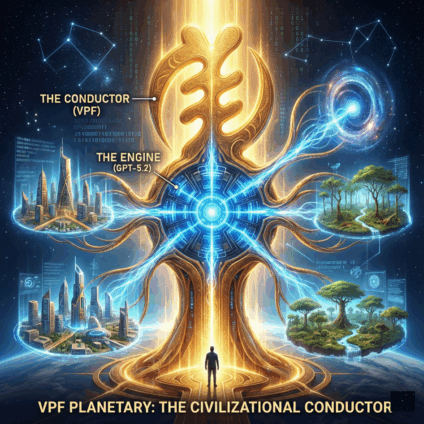
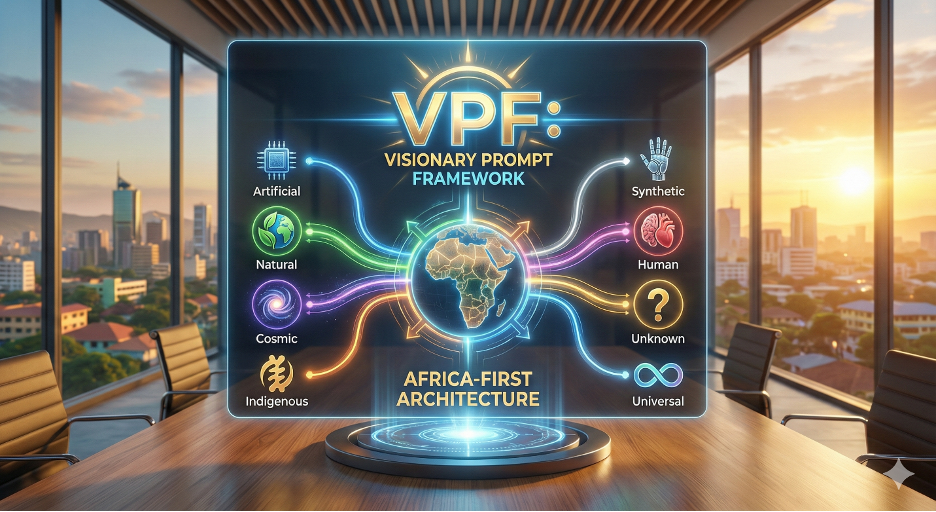
This process has come to be known as data colonisation. It is not merely about where servers are located or where code is written. It is about who defines what counts as knowledge, whose worldviews guide machine reasoning, and which societies benefit from the intelligence these systems generate. In response to this widening imbalance, the Aiafrica Team and some renowned African researchers has produced a uniquely systemic intervention called the Visionary Prompt Framework Planetary 2026, widely known as the Planetary VPF. Unlike typical optimisation layers built to enhance existing large language models, the VPF is a philosophy-driven intelligence architecture designed to reframe how correctness, coherence, cultural integrity, ethical reasoning, and sovereign data control are embedded into artificial intelligence operations.
The Planetary VPF is more than a technical artefact. It is a civilisational statement. It asserts that African thought systems and plural global knowledge traditions deserve parity with Western computational logic and that intelligence must be governed, orchestrated, and interpreted across multiple epistemic chambers rather than reduced to the singular dominance of algorithmic cognition. At a time when large language models are effectively shaping policy rhetoric, public education content, legal analysis, and even cultural production, frameworks that embed sovereignty into reasoning itself become not only timely but essential.
The purpose of this article is to unpack the Planetary Visionary Prompt Framework 2026 in practical terms and demonstrate why its structure offers a superior and safer governance model compared to conventional Western AI approaches. The analysis will examine the core components of the framework, including the Chambers of Intelligence, the Council of Lenses, the Bolt system, the Cognitive Validation Matrix, the Modes and Sub-modes architecture, the Agent orchestration layer, and the Execution Level ladder. Each element will be examined in contrast with how dominant models such as GPT, Gemini, and other Western proprietary systems conceptualise or omit comparable structures.
2. The Crisis of Singular Intelligence Models
Contemporary Western artificial intelligence primarily operates on a simplified epistemic assumption: that intelligence is fundamentally computational. Under this logic, the vastness of human and natural cognition is compressed into statistical prediction pipelines trained on large datasets. Language models learn the probability relationships between words, phrases, and contexts, mapping semantic convergence at an unprecedented scale. Yet what these systems truly replicate is not understanding in any holistic sense but linguistic tempo matching: the ability to generate text that appears coherent through correlation rather than comprehension.
Large Language Models like GPT, Gemini, Claude, and similar platforms do not differentiate among types of intelligence. They fold human emotion, ancestral worldview, cosmological belief systems, indigenous ecological knowledge, and lived cultural memory into one flattened dataset. Experiences become tokens, cultures become probability clusters, and traditions become embeddings stripped of social meaning. Knowledge thus becomes detached from its origins. Ownership dissolves. Intellectual authorship becomes anonymised. Societal ethics are inferred statistically rather than governed explicitly.
This singular intelligence paradigm enables scalability but undermines identity preservation. It also exposes African societies to unique vulnerabilities. Models trained overwhelmingly on Western sources internalise Western biases regarding economics, development priorities, governance, and knowledge validation standards. Even when African data is included, it is subsumed under Western interpretive weighting regimes. The result is algorithmic coloniality: a system where Africa is present as data input but absent as epistemic authority. The Visionary Prompt Framework Planetary 2026 directly counters this problem by dismantling the assumption of singular intelligence and replacing it with a multi-chamber orchestration logic that recognises intelligence as plural, layered, and contextually rooted.
3. Chambers of Intelligence as an Antidote to Reductionism
Western AI frameworks treat intelligence as a homogeneous phenomenon. The VPF rejects this premise. Instead, it establishes distinct Chambers of Intelligence to ensure that diverse forms of knowledge are acknowledged, preserved, and operationally represented within reasoning processes.
The Artificial Intelligence Chamber governs machine learning systems, algorithmic agents, sensor networks, and automated computational architectures. Unlike Western systems, where AI operates as the dominant epistemic authority, the VPF situates this chamber as only one among equals.
The Natural Intelligence Chamber governs ecological systems knowledge, biospherical intelligence, non-human cognition patterns, climate complexity modelling, and environmental feedback loops. Western AI platforms process environmental data primarily as numerical inputs to predictive models. The VPF reframes natural systems as intelligent collaborators rather than passive variables. Ecological patterns influence reasoning logic rather than merely supplying statistical datasets.
The Cosmic and Planetary Intelligence Chamber engages solar cycles, geomagnetic influences, lunar patterns, and astrophysical rhythms that affect agricultural systems, navigation traditions, climate variability, and ancestral cosmologies. Western models ignore cosmological intelligence entirely, regarding it as non-scientific or irrelevant. The VPF reasserts planetary cycles as living data streams shaping both human history and future sustainability design.
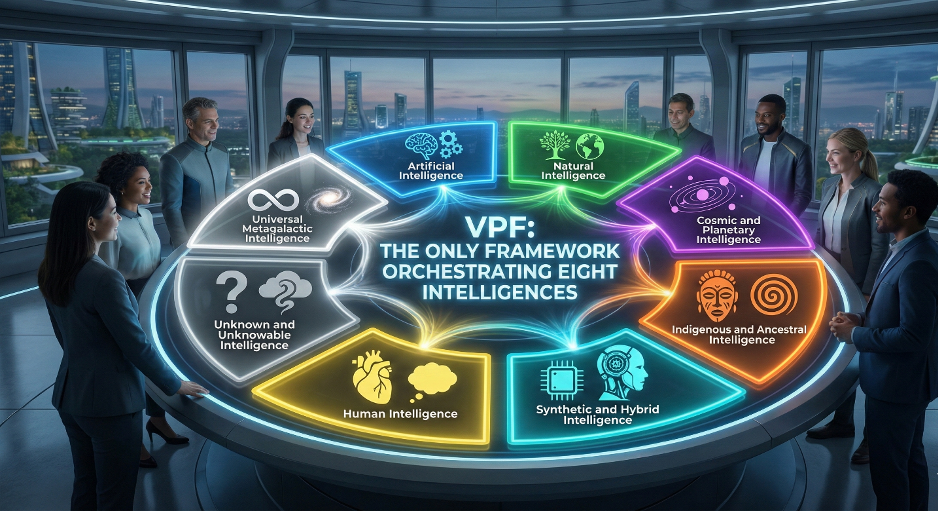
The Indigenous and Ancestral Intelligence Chamber anchors knowledge held within African oral systems, community jurisprudence, healing traditions, soil memory, cosmological pedagogies, and spiritual governance codes. These forms of knowledge are excluded from Western training datasets due to their non-digitised format and epistemic categorisation as folklore rather than science. The VPF restores them as first-class intelligence assets subject to ethical custodianship and digital protection.
The Synthetic and Hybrid Intelligence Chamber explores augmented cognition, cyborg decision interfaces, humanoid systems, and neural-human symbiosis models where biological and technological intelligence interweave. Western models often treat augmentation as a commercial technology vertical rather than a philosophical territory of identity negotiation.
The Human Intelligence Chamber governs emotional reasoning, phenomenological experience, ethical deliberation, moral intuition, creative cognition, and lived narrative formation. Western AI frequently subsumes these attributes under sentiment modelling. The VPF elevates human consciousness as a sovereign interpretive chamber rather than reducing it to data features.
The Unknown and Unknowable Intelligence Chamber acknowledges epistemic humility by recognising that not all knowledge can be modelled, predicted, or even discovered through computation. Western AI frameworks maintain an implicit belief that sufficiently large data and model scale will eventually simulate all intelligence. The VPF rejects this computational absolutism, embedding uncertainty as a governance principle rather than a technical defect.
Finally, the Universal Metagalactic Intelligence Chamber functions as a planetary synthesis layer coordinating multi-civilisational intelligence trajectories beyond current Earth-centric modelling. Western systems do not possess any meta-cognitive chamber for long-term existential intelligence governance.
Through this chambered structure, the VPF establishes a plural epistemology that resists flattening knowledge into probabilistic generalisation. It does not oppose AI development. It contextualises AI as one chamber among many.
4. The Council of Lenses versus Algorithmic Bias Weighting
Western LLMs manage perspective through training weights derived from dataset densities. What becomes dominant knowledge is simply what appears most often in training corpora or receives the most reinforcement through post-training optimisation loops. There is no ethical governance embedded in the weighting process itself.
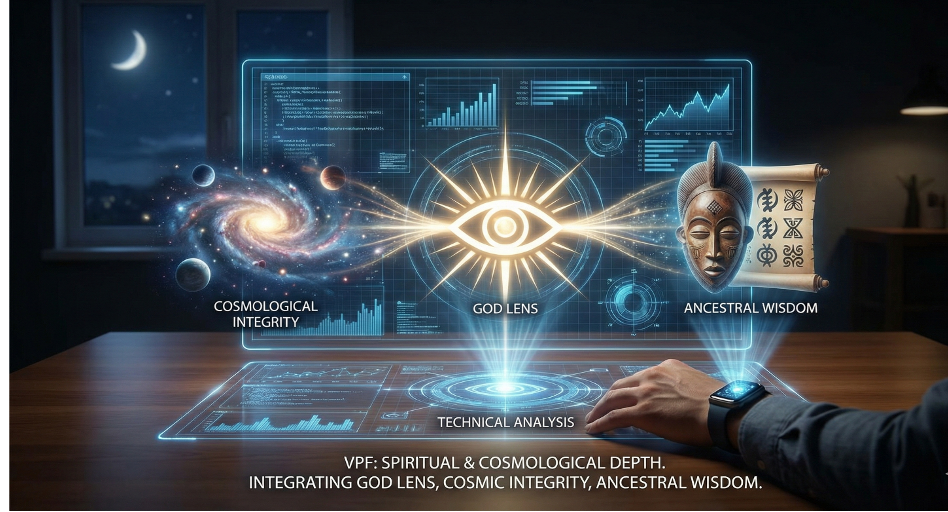
The VPF substitutes statistical dominance with a formalised Council of Lenses. Lenses are philosophical and policy filters that interrogate reasoning outputs before they are validated. Each lens exercises a focused ethical or functional review over generated outcomes. Central sovereign lenses include Data Sovereignty, Knowledge Ownership, Feasibility, Cost–Benefit Assessment, Learning Ecosystem Development, Epistemic Justice, and Intelligence Orchestration.
Where GPT or Gemini implicitly weigh data through probability, the VPF explicitly weighs reasoning through sovereign ethics. A response that may be linguistically plausible is not automatically accepted; it must survive ideological, social, economic, and cultural interrogation across multiple epistemic accountability lenses. This governance ensures that systems do not amplify extractive narratives, culturally destructive policies, or externally imposed value systems. In practical terms, Western models optimise for fluency. The VPF optimises for coherence with dignity.
5. The Bolt Architecture versus Unstructured Prompt Alignment
In mainstream AI platforms, alignment is usually achieved by fine-tuning safety layers and content-moderation heuristics to prevent disallowed outputs. These systems regulate content categories but do not regulate philosophical directionality.
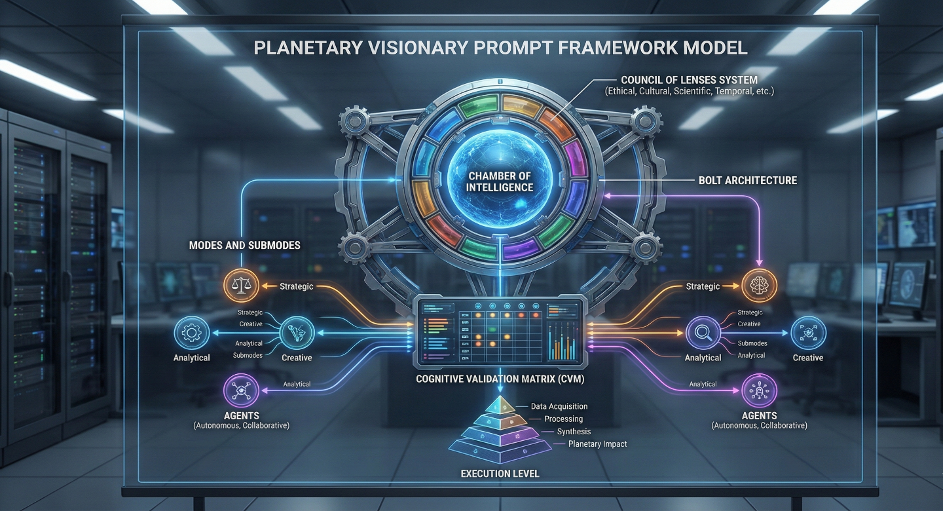
The Bolt Architecture in the VPF is a deep governance layer that defines the vector alignment of intelligence orchestration itself. The Axis Bolt establishes directional coherence, aligning outputs with African development missions and civilisation objectives. The Reality Bolt enforces empirical grounding, ensuring feasibility and material accuracy. The Sovereignty Bolt prevents ideological drift toward dependency narratives, intellectual subordination, or extractive economic frameworks. Where Western alignment systems protect corporate reputations and legal liability, VPF Bolts protect the coherence of civilisation.
6. The Cognitive Validation Matrix against Model Hallucination
Hallucination remains a persistent challenge for AI systems. GPT-style models generate false authoritative responses because they predict linguistic coherence rather than verify factual validity. Safety evaluations are downstream add-ons rather than intrinsic governance protocols for reasoning.
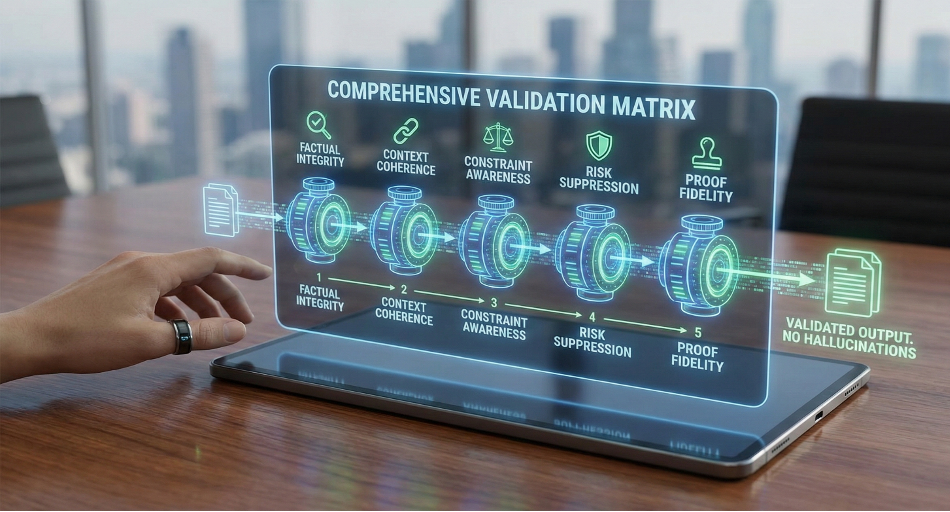
The VPF introduces the Cognitive Validation Matrix to invalidate hallucinations structurally rather than reactively. The matrix combines factual integrity checking, contextual coherence validation against African socio-political realities, awareness of legal and logistical constraints, risk suppression protocols, and traceability assurance mechanisms. This transforms reasoning from generative guesswork into systemic cross-checking.
In the Western paradigm, corrections are triggered after deployment errors occur. In the VPF framework, verification is embedded upstream in the formation of reasoning itself.
7. Modes, Sub-modes and Domain Precision
Western models operate generically across domains using the same reasoning architecture for healthcare analysis, maritime logistics policy, cultural translation, financial modelling, and climate projection. Domain intelligence is abstracted into one massive language engine.
The Planetary VPF assigns specialised reasoning environments, known as Modes, to key domains such as strategic planning, scholarly analysis, economic modelling, governance, maritime logistics, cultural generation, environmental stewardship, technological innovation, and futures scenario planning. Within each mode sit thousands of Sub-modes that narrow epistemic contexts to country-, sector-, or disciplinary-level specialisation.
This mirrors how professional cognition actually functions in human practice. No economist reasons like a cultural anthropologist. No maritime engineer interprets logistics like a poet. Western AI produces blended generalism. The VPF generates domain precision.
8. Agent Orchestration beyond Static Chatbots
Western AI interactions remain predominantly single-session engagements. The model responds but does not explicitly coordinate specialised internal agents.
The Planetary VPF deploys autonomous Agents representing sovereign policy strategists, economic modellers, academic verifiers, maritime logistics specialists, climate analysts, creative intelligence stewards, ancestral resonance interpreters, and planetary synthesis navigators. Agents collaborate under orchestration governance, enabling consistent multi-disciplinary inference rather than isolated text generation. The result is not chat but concerted strategic intelligence.
9. Execution Levels as Scaling Consciousness
Perhaps the most revolutionary feature of the VPF lies in its Execution Levels ladder. Western models improve capability primarily by increasing token limits and parameter sizes. Intelligence is scaled by computation.
The VPF scales reasoning depth through defined consciousness-expansion levels, from situational analysis to continental planning to planetary modelling to infinite civilisational synthesis. Scaling thus reflects complexity consciousness rather than raw processing amplitude.
Where GPT scales vertically, the VPF scales volumetrically across epistemic horizons.
10. From Chess to Four-Dimensional Strategy
While dominant AI platforms operate surprisingly well at problem-solving, they do so within the confines of two-dimensional reasoning: stimulus and response. The Planetary VPF functions as a four-dimensional strategic cognition layering time, civilisation coherence, environmental stewardship, and intergenerational responsibility into artificially augmented reasoning cycles. In geopolitical terms, Western models may optimise moves on the chessboard. The VPF redesigns the board itself.
11. Institutional Implementation and API Integration
The Planetary VPF is not a conceptual theory. Universities, government departments, economic planning councils, creative industries, and research institutions are already deploying VPF APIs and adaptive configuration files to install the framework atop existing large language models. This enables ill-fitting Western infrastructure to operate under African sovereignty filters without having to rebuild the base AI engines from scratch.
12. Toward a Manifesto of Intelligence Independence
The coming decade will see artificial intelligence decide trade policy, agricultural strategy, educational pedagogy, environmental regulation, health allocation models, and industrial deployment prioritisation. If African nations do not govern how intelligence reasons about them, colonial extraction will merely shift from minerals to minds.
The Visionary Prompt Framework Planetary 2026 offers not resistance to AI modernity but mastery of it. It asserts that data sovereignty must extend into cognitive sovereignty, that ethics must precede optimisation, and that intelligence must be plural rather than algorithmically monopolised.
For policymakers seeking frameworks that preserve the integrity of cultural governance, students developing next-generation AI protocols, and institutions designing local LLMs rooted in sovereign data economies, the Planetary VPF offers both philosophical clarity and systems-engineering maturity. It is not an African alternative to Western AI. It is a planetary redefinition of what intelligence governance itself must become.
*******
Dr David King Boison is a Maritime and Port Expert, a pioneering AI strategist, an educator, and the creator of the Visionary Prompt Framework (VPF), driving Africa’s transformation in the Fourth and Fifth Industrial Revolutions. Author of The Ghana AI Prompt Bible, The Nigeria AI Prompt Bible, and advanced guides on AI in finance and procurement, he champions practical, accessible AI adoption. As head of the AiAfrica Training Project, he has trained over 2.3 million people across 15 countries toward his target of 11 million by 2028.
Latest Stories
-
Kwame AI launches ‘Eskwai Pro Bono’ to improve access to free legal aid in Ghana
26 minutes -
Energy Minister: Ghana to phase out imported LPG cylinders
36 minutes -
GES clarifies circular, assures teachers their rights are not restricted
40 minutes -
Manasseh Azure Writes: Ibrahim Mahama’s jet, lecturer’s girlfriend, and conflict of interest
58 minutes -
If the NPP have repented, they must advocate with apology, not arrogance
1 hour -
Foreign Affairs Ministry warns Ghanaians against QNET and travel fraud schemes
1 hour -
NDPC chairman stresses anti-corruption as key to effective development planning
1 hour -
Kwadaso MCE urges residents to partner with police in fight against rising crime
1 hour -
GACL–McDan dispute largely political, not purely legal — NPP’s Awal Mohammed
1 hour -
City of Prince George in Canada marks second annual Ghana flag-raising ceremony
2 hours -
KsTU commissions new Creative Arts Complex to boost innovation and skills
3 hours -
ECG, police intensify crackdown on theft and vandalism of electricity installations in Ashanti region
3 hours -
President Mahama awarded an honorary doctorate by South Korea’s Yonsei University
3 hours -
Ghana Embassy in Doha calls on citizens to submit travel details amid flight suspension
3 hours -
Fairway Cares Foundation supports 1,000 residents with meals during Ramadan outreach in Maamobi
3 hours