

Audio By Carbonatix
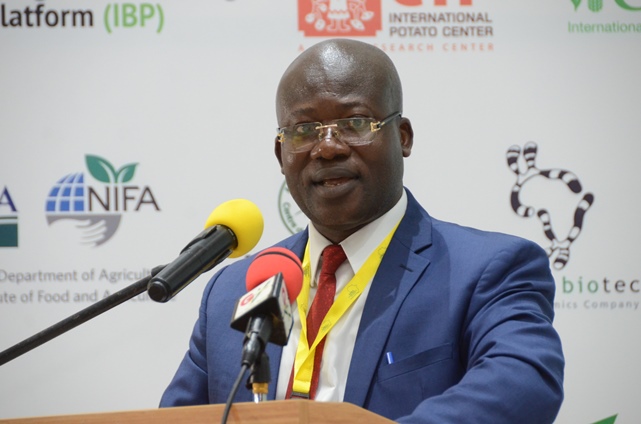
2022 Africa Food Prize winner Prof. Eric Danquah has called on African governments to increase investments in the agricultural sector.
He said there is a frustrating lack of investments by African governments in agricultural science because there is a lot of short-term thinking by visionless leaders.
“Despite typically being farmers themselves, many African politicians mentally uncouple farming and science. They somehow expect smallholders to flourish even if research and development gets no money.
"But to paraphrase a former Tanzanian president, agriculture without investment is like dancing without music,” he said in an interview.
The founding director of the West Africa Centre for Crop Improvement (WACCI) at the University of Ghana said Africa cannot afford to keep on importing so much food.
“Spending foreign exchange on crops we could be growing locally is not only perverse but also unsustainable,” he said.
“When good African science gets into their hands, our farmers can compete, improve their livelihoods, and feed their countries,” he assured.
Prof. Danquah said African crop scientists must ensure that they are using the most efficient methods such as speed-breeding and other advanced technologies to develop better seeds for farmers.
“We have to keep abreast of what is happening elsewhere and be on the lookout for new, sometimes unexpected partnerships. At the same time, we must always align our science with societal needs,” he said.
“That means, for example, breeding varieties that help improve smallholders’ resilience rather than “only” tolerating a particular pest or disease.
"That’s a subtle mindset shift, but a vital one. And it means a greater focus on multi-disciplinary teams that develop, implement and learn together,” he noted.
The University of Ghana professor said the Covid pandemic was a big reminder of the fragility of African food supply chains.
“Here in Accra, as in most of the continent’s cities, informal channels play a crucial role in ensuring access to food and income.
"To tackle major challenges to the supply chain, African countries must meet their own needs locally. We can’t depend on imports,” he said.
He said African farmers could and should be more productive than they are currently.
“They deserve better varieties, developed locally…African crop science still lacks the critical mass required to serve the continent’s agriculture appropriately,” he said.
Prof. Danquah called for more efforts to tackle brain drain on the African continent. “International experience is highly valuable.
"Just look at all the places where our faculty trained! What matters is that Africans who study overseas then come back. And for WACCI, with its international intake, there is also an intra-continental aspect,” he said.
“One of the most rewarding sides to my job is seeing the impact that our alumni make back home. Former WACCI students are now spearheading crop improvement in more than 15 African countries.
"Who would have thought that would be possible 20 years ago? There were many doubters. But my WACCI team believes in young scientists, and they continue to justify that confidence,” he added.
Prof. Danquah observed that battling brain drain also requires high-quality organizations and facilities that encourage Africans to stay and work at home.
“We have to offer people a great place to work, in all respects. That’s why “People” are one of the five priorities in the University of Ghana’s 2024-29 Strategic Plan,” he said.
“In crop science, ambitious academics want top-class labs, greenhouses, and demo plots. And they need good long-term prospects – properly endowed fellowships, for example, not just a series of temporary grants. Nobody can live on a vague “we might extend it” from governments or donors,” he added.
Latest Stories
-
Serial killer pleads guilty to eight murders in case that haunted Long Island, New York
1 minute -
NPP used Bosomtwe road as ‘election machine’ but failed to dedicate funds for its completion – Dr Amoakohene
7 minutes -
CSOs warns of contraceptive crisis as $500k UNFPA supplies stall at port
12 minutes -
Africa’s youth bulge a ‘defining moment’ that requires urgent action – NYA CEO Osman Ayariga
20 minutes -
No looming power crisis; Ghana’s electricity supply remains stable – Energy Ministry PRO insists
36 minutes -
Mahama should reset his stance on LGBTQ -Clinton Baffour
41 minutes -
Rising sachet water costs should spark a bigger conversation on plastic waste
45 minutes -
Two-week ceasefire takes effect as US and Iran prepare for talks in Pakistan
48 minutes -
Dr. Amoakohene debunks claims Sewua and other Agenda 111 hospitals are ready for operationalisation
56 minutes -
AMA rolls out new shift system for street sweepers to improve sanitation
59 minutes -
Focus on capacity, not connections in Damang lease decision – Paa Kwesi Schandorf
1 hour -
Teen defender Eric Mensah undergoes trial at Malaga CF after standout ROC Cup display
1 hour -
Journalism out loud: Why silence is no longer an option
1 hour -
NYA boss identifies unemployability as Africa’s core youth challenge
1 hour -
5,000 miners stranded in Ahafo-Ano North as alleged NAIMOS operatives take over site
1 hour