

Audio By Carbonatix
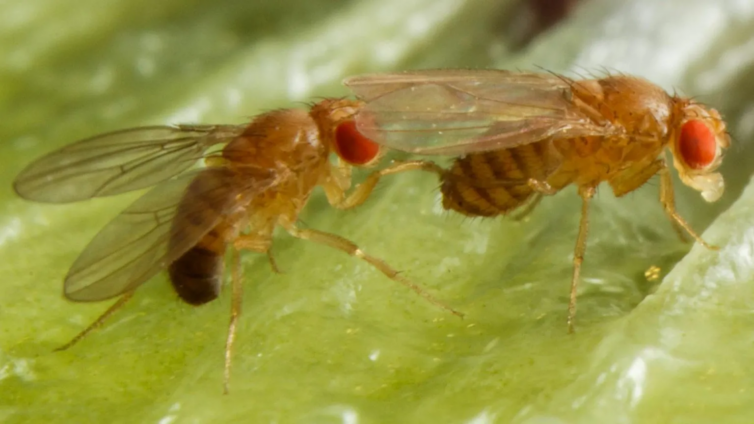
Male fruit flies that drink alcohol become more attractive to females, according to a new study.
Adding alcohol to males' food increases their release of chemicals that attract females and leads to higher mating success.
Fruit flies, or Drosophila melanogaster, are often found around our food waste bins as they feed on rotting fruit which gradually produces alcohol.
Scientists have been trying to study why they are attracted to alcohol and how it affects them.
Previous research has studied different theories about this attraction, such as the flies were seeking a euphoric state or a substitute for the high of mating among males rejected by females.
Study author Bill Hansson, head of the Department of Evolutionary Neuroethology at the Max Planck Institute, said such research has taken an anthropomorphic view of fly behaviour, whereas this latest study suggests drinking alcohol gives the flies a reproductive advantage.
"We don't think flies drink alcohol because they are depressed," he said.
The fly's attraction both to the carbohydrates and yeast in rotting fruit, as well as to the alcohol, cannot be separated, he added.
In the study, alcohol, and particularly methanol, increased the males' production and release of chemical sex signals, called pheromones, which made them more attractive to females.
Pheromones are released into the air from one individual to influence the behaviour of another animal of the same species.
Males were therefore strongly attracted to alcohol, especially those males which had never mated.
The new study also showed that the fly's response to smelling alcohol is controlled by three different neural circuits in its brain.
While two are responsible for attracting male flies to small amounts of alcohol, a third ensures that excessive amounts have a deterrent effect.
Because alcohol is toxic, the fly's brain must carefully weigh the risks and benefits of drinking it, and it does this by balancing signals of attraction with aversion.
"This means that the flies have a control mechanism that allows them to get all the benefits of alcohol consumption without risking alcohol intoxication," lead author Ian Keesey, of the University of Nebraska, said.
For their investigations, the researchers combined physiological studies - such as imaging techniques to visualise processes in the fly brain, chemical analyses of environmental odours, and behavioural studies.
The paper is published in the journal Science Advances.
Latest Stories
-
After more than 14 years at Atletico Madrid, what next for Simeone?
2 hours -
Conquering the World – Building on the foundations laid by Otto Addo
2 hours -
[Watch Live] Obrafour, Kwaw Kese, Tinny, Keche and others thrill fans at Gomoa Easter Carnival
2 hours -
Gomoa Easter Carnival: Experts charge indigenes to own festival to ensure sustainability
3 hours -
Gomoa Easter Carnival: Edem Agbana and Joy Prime fans shower festival with huge endorsements
5 hours -
Gov’t to overhaul free zones into manufacturing hubs for local production – Trade Minister
6 hours -
Ghana losing $2.5bn yearly from raw exports – Trade Minister reveals
6 hours -
Mahama unveils plans for Kwahu Airport, Convention Centre
6 hours -
World’s oldest leader, Paul Biya to get a deputy for first time in 43-year rule
6 hours -
Search for missing US airman continues as Trump threatens ‘hell’ if Iran does not reach deal
6 hours -
US says it has arrested relatives of late Iranian general Qasem Soleimani
6 hours -
La Liga: Real Madrid’s title hopes hang in the balance as Mallorca snatch stoppage-time winner
6 hours -
FA Cup: Haaland hat-trick powers Man City past Liverpool into semi-finals
6 hours -
FA Cup: Chelsea thrash Port Vale to reach Wembley semi-final
6 hours -
Gov’t to boost tourism in coastal communities through infrastructure, sanitation – Vice President
7 hours