

Audio By Carbonatix
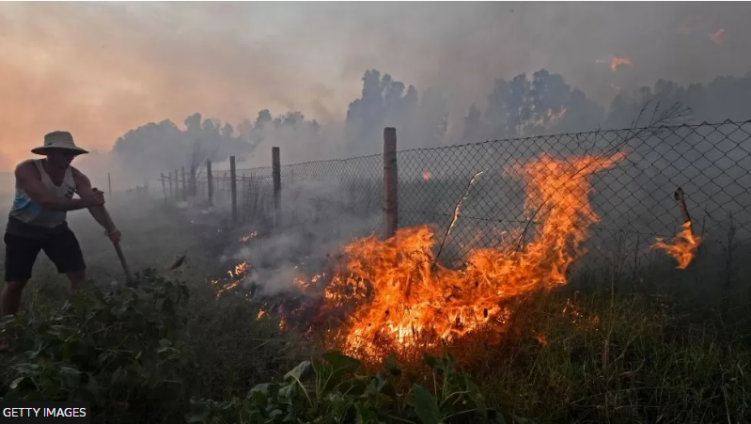
At least 34 people have been killed and thousands evacuated after wildfires broke out across Algeria, the country's interior ministry says.
Outbreaks of 97 wildfires were recorded across 16 provinces affecting forest, crops and farmland on Monday.
About 8,000 firefighters were working to bring the blazes under control, authorities said.
Twenty-six people were also injured and 1,500 evacuated from their homes in Fenaia, Bejaia, Zbarbar and Bouira.
Ten soldiers were killed battling the fires in Bejaia, the Algerian defence ministry said.
The most extensive fires, in the mountainous Kabylie region to the east of Algiers, spread to residential areas in the coastal towns of Bejaia and Jijel, fanned by high winds.
Authorities said they had launched a judicial investigation into the causes of the fires.
Northern Algeria has been experiencing a record heatwave in recent days, with temperatures reaching 48C.
Temperatures in several regions in North Africa are up to 7C higher than normal for the time of year.
Algeria's Meteorological Office has warned that temperatures of more than 48C are likely to continue until the end of the month in the north of the country.
On Monday, Algeria's national electricity and gas company, Sonelgaz, said it had recorded a "historic peak" in electricity consumption.
A leading outlet critical of the government, Tout Sur l'Algerie (TSA), reported earlier this month there had been an unprecedented use of air conditioners, saying current methods of construction were less effective than traditional bricks in keeping homes cool.
Meanwhile, southern Europe has been dealing with a challenging heatwave that has seen Greece ravaged by wildfires.
The UN weather agency, the World Meteorological Organization, has warned that the heatwave in Europe could continue into August and that the extreme temperatures sweeping the globe are the new normal in a world warmed by climate change.
The three hottest days ever recorded were in July, according to the EU climate and weather service, Copernicus.
The average world temperature hit 16.89C on Monday 3 July and topped 17C for the first time on 4 July, with an average global temperature of 17.04C.
Provisional figures suggest that was exceeded on 5 July when temperatures reached 17.05C.
The World Meteorological Organization says extreme weather patterns highlight the need for greater climate action.
Climate change increases the risk of the hot, dry weather that is likely to fuel wildfires. The world has already warmed by about 1.1C since the industrial era began and temperatures will keep rising unless governments around the world make steep cuts to emissions.
Latest Stories
-
Ghana Medical Trust Fund set for launch as Board finalises key systems
8 minutes -
Ghana restores investor confidence through economic reform – Deputy Finance Minister
8 minutes -
We never promised to end sole sourcing, only its abuse – Sammy Gyamfi
10 minutes -
Middle East tensions: Ghana’s current energy resilience thanks to increased domestic gas production – Mahama
12 minutes -
KsTU unveils ‘Nimde3 Hyiren’ Regenerative Electric Vehicle
25 minutes -
(VIDEO) Kumasi Technical University shatters EV barriers with self-charging car
34 minutes -
Mahama praises JoyNews’ ‘Tax for Galamsey’ exposé, orders end to illegal mining levies
39 minutes -
Mahama vows stronger environmental governance, seeks CSO collaboration in fighting galamsey
1 hour -
Anti-LGBTQ bill not Ghana’s most pressing concern, but must be addressed through democratic processes – Mahama
1 hour -
Gender Ministry mourns victims of Accra New Town building collapse
1 hour -
Gov’t will introduce amendment to Procurement Act to limit sole sourcing – Mahama
1 hour -
Victims of Accra New Town building collapse can sue as state pursues criminal case – Lawyer
1 hour -
Supreme Montessori books final spot in Luv FM Primary Schools Quiz
2 hours -
Mahama orders Roads Minister to submit response to Big Push sole-sourcing allegations
2 hours -
We’re examining recommendations of CRC, will soon announce review implementation committee – Mahama
2 hours