

Audio By Carbonatix
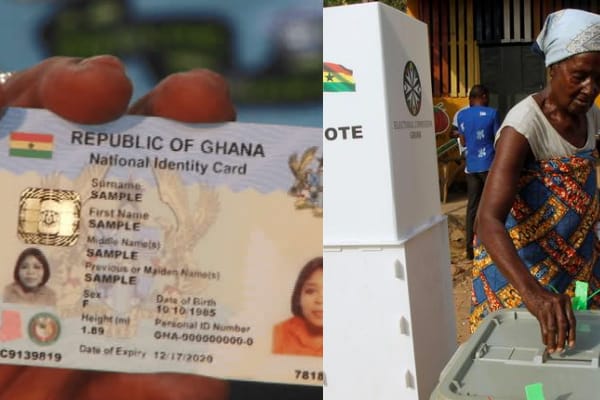
A Deputy Chairman in charge of Corporate Services at Ghana’s Electoral Commission (EC) says his outfit is pushing for the passage of the Constitutional Instrument (CI) that seeks to make the Ghana Card the sole document for voter registration. And the EC’s Chairperson, Jean Mensa, has revealed that the Ghana Card — a verification document issued to Ghanaians and permanently resident foreign nationals — will not be a requirement in the casting of votes in the 2024 General Elections, but will be the sole identity document used in the voters registration process for the acquisition of new Voters’ IDs.
Analysis
Ghana has less than two years before it goes to the polls, and the first flashpoint in the electoral debate has been the effort to pass a new CI seeking to make the Ghana Card the sole legal identification to enrol new voters onto the Electoral Commission’s voter register through the continuous voter registration exercise. The minimum age for acquiring a Ghana Card is 15.
According to the 2021 Population and Housing Census (PHC), there are 19.9 million Ghanaians within this age range. Of those, about 2 million will be 18 by 2024, making them likely eligible to vote. The minority National Democratic Congress caucus has been at the forefront of the debate and has explicitly opposed the new CI, which has been tabled before parliament. Defending the government’s position, key cabinet members and senior election officials insist that they are committed to providing Ghana cards to qualified voters and funding the effort. The minority insist that the current government’s national security and election security commitments are insufficient.
It is worth understanding what the new instrument aims to achieve. The CI seeks to facilitate year-round registration of eligible voters at the EC's district offices. That is a significant change from the current system in which voter registration is only permitted briefly. The new instrument will empower citizens who turn 18 and hold a valid Ghana Card to walk to any EC district office across the country’s 16 regions to register. It is a sensible position on the face of it, but this debate is happening in the penultimate year before parliamentary elections.
The minority caucus fears that the NIA may connive with the government to either slow the Ghana Card registration process or not to distribute in NDC’s strongholds but prioritise NPP districts. The caucus believes it may frustrate voters who could eventually decide not to obtain the card, disenfranchising them. Minority Leader Cassiel Ato Forson has accused the Commission of planning to use the CI to rig the election in favour of the ruling New Patriotic Party (NPP).
The EC argues that the Ghana Card will deter foreigners and children from registering to vote and end the corruption-ridden guarantor system, which often encourages disputes, violence and labouriously expensive follow-up procedures. While the EC makes a sensible point, the question as to why it has chosen to implement this policy so close to the election is not an academic one. The minority caucus may play politics, but its concerns are not unfounded.
The numbers at play here are not insignificant. As of 19 February, the authority had registered 17,375,861 Ghanaians aged 15 years or above on the national identity database and printed 16,737,734 cards. Of those, the number of registered Ghanaians aged 18 and above is 16.9 million, while the number on the EC voters’ register is 17,229,000. In other words, more than 100,000 likely voters are at play. In a tight electoral race, every vote counts.
There is also the financial angle to consider. As the country struggles to service domestic and external loans, the NIA owes its main partners: The Identity Management Limited and CAL Bank. Due to payment challenges, the agency has 3.5 million unclaimed cards. A GH¢100 million facility taken out to ensure the 3.5 million cards are released is only 80% paid. Despite this turbulence, the NIA insists it has the technical and operational competencies to print, issue and distribute cards to citizens.
Ghana typically has free, fair and plaid elections, but this will be one of its most closely fought. The current government has a parliamentary majority of one — an independent MP who closely aligns with the administration. Largely viewed as profligate and wasteful, Nana Akufo-Addo’s government is firmly on the ropes, and the NDC smells blood. All is up for grabs as the slow build-up to West Africa’s second most important democratic exercise heats up.
Ghana Card
The Ghana card is a valid verification document issued by the National Identification Authority (NIA) to Ghanaians and permanently resident foreign nationals living everywhere for the purpose of identification. The card bears personal information about the individuals whose identity can be verified at all times. The card contains basic identification information including a photograph of the cardholder, along with a name, date of birth, height, a personal identification number that has been randomly generated and assigned to the holder and has an expiry date.
Depending on the age of the individual, the card will have either a 2-dimensional barcode or a Machine Readable Zone (MRZ) at the back which holds biometric information: the holder’s fingerprints in digitized templates as well as the holder’s signature. Both citizens and non-citizens have the same ID card. The only distinguishing feature on the cards are the country codes in the Personal Identification Number (PIN) i.e. the PIN for Ghanaians starts with the code “GHA” followed by ten digits “GHA-000000000-0 whilst that for Nigerians for example will read “NRG-000000000-0” per the International Civil Aviation Organization (ICAO) country codes and foreigners card has NON-CITIZEN in bold red on the front of the card.
Latest Stories
-
$600m tomato imports undermining Ghana’s economy — Chamber of Agribusiness
3 minutes -
Rainstorm wreaks havoc: Faulty transformers, feeder failures leave parts of 3 regions without power
11 minutes -
CUTS International calls for urgent competition law amid sachet water price hikes
51 minutes -
‘I never did this advert’, AI clones hijack Ghanaian identities for profit
1 hour -
25-year-old woman battles trauma after surviving deadly Nkwanta attack
1 hour -
Vice President honoured at Tortsogbeza as South Tongu leaders highlight development needs
2 hours -
Kwahu Business Forum 2026: Corporate citizenship, sustaining African businesses take centre stage with KGL as the case study
3 hours -
Trump seeks $152m to reopen notorious Alcatraz prison
5 hours -
Ex-Chelsea player Oscar retires with heart issue
5 hours -
CA Foundation drives constitutional literacy in Kpone Katamanso municipality
5 hours -
GPRTU to hold talks with Transport Ministry over rising fuel costs
5 hours -
CUTS International urges gov’t to halt sachet water price hike pending cost review
5 hours -
Chief Justice: Efficient Judiciary essential to reducing business costs
5 hours -
Bayern grabs 99th-minute winner to cap superb fightback
5 hours -
Ahmed Ibrahim urges Ghanaians to reflect Easter values in nation-building
6 hours