

Audio By Carbonatix
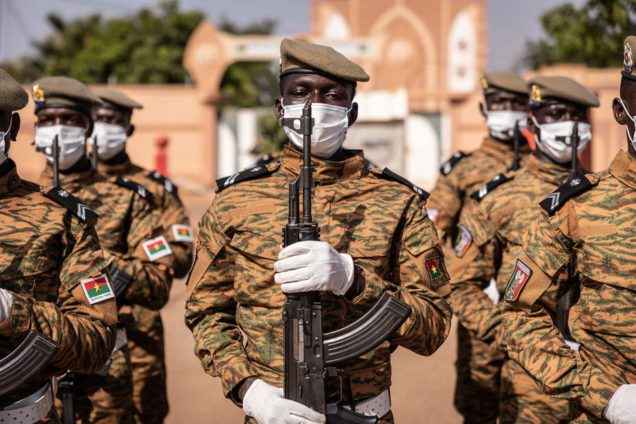
Within a few weeks of the start of a new year and West Africa had its first attempted coup d’état. On January 12 the Burkinabè government announced that it foiled a plot from within the armed forces to destabilise the state.
At a press conference, Minister of Defence, General Aimé Barthélemy Simporé, announced that 10 soldiers and five civilians had been arrested in connection with the plot. They will be tried by military tribunal.
Military governments are already in power in Mali, Guinea, Chad, and Sudan following four coup d’états in the last year.
Speculation and rumour that a coup plot might topple Ouagadougou next has swirled over social media. For now, that crisis has been averted but there are still many reasons to be concerned.
Burkina Faso has a long legacy of military intervention. In the first 27 years of independence, Burkinabè soldiers staged five coups d’état and one autogolpe – a military coup initiated or abetted by a country’s elected leader.
The last coup killed the famed Captain Thomas Sankara. He gave Burkina Faso its name, meaning land of the upright people. The coup saw Sankara’s second-in-command Captain Blaise Compaoré installed as president.
Compaoré put an end to Burkina Faso’s coups. After taking power, he ruthlessly eliminated his rivals. With few to stand in his way, Compaoré succeeded in restructuring the military, creating the Régiment de la sécurité présidentielle, an elite unit that functioned as a sort of special forces and praetorian guard.
The unit answered only to Compaoré operating under a separate hierarchy and exhibited the sine qua non of coup proofing tactics. It insulated him from coup threats, even helping him endure a widespread mutiny in 2011.
But they were unable to protect him from citizens demanding change.
In 2014, millions of protesters filled the streets demanding that Compaoré adhere to, rather than reform, presidential term limits barring him from contesting another election. The insurrection ultimately forced him to resign and flee into exile.
This popular movement then transformed into a political transition to democracy.
The transition was nearly overturned when Compaoré loyalists within the unit staged their own coup d’état in September 2015. But Burkinabè citizens refused to stand by and again took to the streets.
To support them, a detachment of the regular army operating under the orders of civilian transitional authorities, surrounded the putschists and ended the failed coup. The political transition culminated in the country’s freest, fairest, and most competitive elections to date.
What is unclear today, however, is the armed forces’ continued commitment to civilian leadership. The recent coup attempt calls into question the coherence of a republican and professional ethos among Burkinabè military officers.
Deja vu?
Past military interventions into politics have resulted from popular pressures for change. Similar pressure may be building anew, driven by a growing insecurity in the country.
Militant Islamist groups have been gaining ground across the country’s territory. Violence has displaced nearly two out of every 25 citizens from their homes. The insecurity wrought by these groups and other criminal opportunists, has grown exponentially over the last five years.
The number of violent events linked to militant Islamist groups in Burkina Faso more than doubled from nearly 500 in 2020 to more than 1,150 in 2021. This put Burkina Faso well ahead of Mali’s 684 and Niger’s 149 violent events.
The inability to get the security situation under control has soured support for the current administration led by President Roch Kaboré. Now in his second term, Kaboré has seen his unprecedented election in 2015 shift from a beacon of democratisation to a test of the country’s strength.
Violence initiated by militant Islamist groups has torn at Burkina Faso’s well-known social tolerance. It has sparked inter-communal violence and reprisal attacks. It has also brought war economies and child soldiers to the landlocked nation.
In June, civilians working in and around an artisanal gold mine were massacred by teenagers presumably armed and deployed by militant Islamist groups seeking to control the resource. In response to popular outcry over the event, Kaboré sacked his Minister of Defense.
Four months later dozens of gendarmes were killed by militants after having gone weeks without resupply. A letter from the unit explained that they had run out of rations and had been relying on poaching to feed themselves. The event laid bare serious dysfunction within the military’s administration and command.
Given these circumstances, discontent among the rank and file and up the chain of command is understandable. As is the impatience and disillusionment of Burkinabè citizens. The country is in disarray. The government must confront multiple crises that it has failed thus far to even contain.
Ominously, the situation resembles that of Mali prior to the August 2020 coup d’état: an embattled administration scrambling to address a quickly evolving and spreading security crisis in the country’s hinterland, a frustrated military lacking the basics tools to confront the enemy and growing popular dissatisfaction with the perceived shortcomings of their elected officials. In short, a recipe for a coup d’état.
Key difference
But there’s a key difference to the Malian experience. Little more than six years ago and no doubt still present in the minds of many Burkinabè citizens, the military stood up and defended the people and constitution against soldiers seeking power.
Burkina Faso has never been more in need of such a service from the military. Burkinabè soldiers and civilians have an opportunity to further strengthen their democratic institutions by remaining firmly against any extra-constitutional seizure of power.
Those citizens who stood against the Régiment de la sécurité présidentielle putschists in 2015 may need to be called on again to protect Burkina Faso’s democratisation.
Democracy is messy. It facilitates change, but through an imperfect process of self-correction. This requires patience, engagement, and commitment.
Latest Stories
-
Mahama honoured at 2026 World Health Summit in Berlin for global health leadership
3 minutes -
Breast cancer is not a death sentence – Besease Kontire Obaapanin, Magmina Foundation lead awareness campaign
5 minutes -
EcoBank invests in digital education of 4 Garisson School to mark 40 years in Africa
35 minutes -
AGI urges investment in skills and raw materials to strengthen local manufacturing
39 minutes -
GPL 2026/27: ‘We have to rectify our mistakes’ – Boadu reacts to Aduana FC defeat
39 minutes -
No disability access, no building permit – KMA declares
40 minutes -
Asantehene to lead environmental restoration effort at Jimi Land Reclamation Site
43 minutes -
Poor Ghanaians are being jailed because they cannot afford justice – Crime Check Foundation
45 minutes -
No conflict in appointing Emelia Agbenyo as Deputy EC Chair – NDC
45 minutes -
87-year-old man jailed 20 years for defiling 9-year-old girl at Ofankor
48 minutes -
Sankofa Gold targets 70kg output after 9-month shutdown
50 minutes -
Tamale, Bolgatanga had just one Legal Aid lawyer between them – Kwesimintsim MP
57 minutes -
PAC orders eviction of former irrigation company MD from official residence
1 hour -
Legal Aid Commission has offices in only 45 of Ghana’s 261 districts, needs 180 more staff
1 hour -
Challenging Heights welcomes Ghana’s Tier 1 ranking, calls for more anti-trafficking funding
1 hour