

Audio By Carbonatix
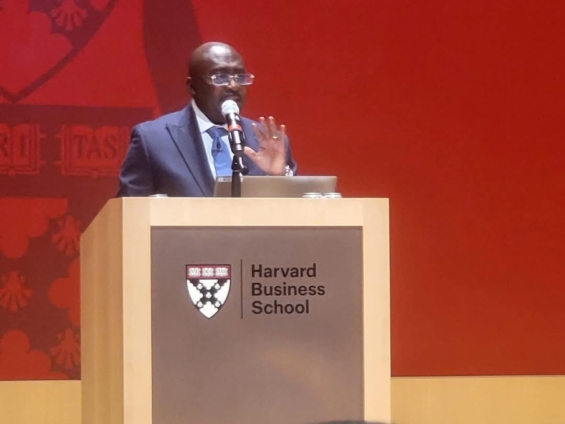
Former Vice President, Dr Mahamudu Bawumia, impressed students at Harvard University in the United States when he delivered a lecture on Ghana's digitalisation journey and its impact on economic transformation.
Speaking at Harvard University on Saturday as the keynote speaker on the theme "Africa Beyond Borders: A Myth or a Mandate for Africa’s Progress," Dr Bawumia outlined Ghana's digitalisation initiatives and their positive contributions to economic growth.
Dr Bawumia first reflected on how Africa had missed out on the first, second, and third industrial revolutions before stressing the necessity of embracing the Fourth Industrial Revolution to drive economic transformation.
"Policymakers in Africa must adopt a mindset of possibilities. We should embrace technology and not be intimidated by it. We must believe that we can leapfrog advanced nations in many areas if we put our minds to it," Dr Bawumia stated. He highlighted how Ghana's digitalisation efforts, in which he played an instrumental role, are addressing long-standing challenges that have hindered modern economic growth.
"For over 60 years after independence, Ghana had a largely informal system without many of the basic elements necessary for a modern economy. Today, we are building a formal, data-driven economy to compete in the Fourth Industrial Revolution," he said.
Ghana's digital success story
Dr Bawumia noted that in the past eight years, Ghana has pursued an "aggressive policy of digitalisation" to "jumpstart the economic transformation of our country."
"Our focus has been on digital technology that addresses real challenges. At this stage of our development, we are not looking at driverless cars or humanoid robots. Instead, we seek technology that solves problems in agriculture, health, education, access to credit, payment system efficiency, public service delivery, and revenue mobilisation," he explained.
Dr Bawumia pointed out that, before this digitalisation drive, the issue was largely seen as peripheral and not central to Ghana’s national development agenda.
"My focus on digitalisation as Vice President was initially ridiculed by political opponents. But I remained committed to my vision of using digitalisation to address everyday challenges faced by Ghanaians while building an engine for economic growth and job creation," he stated.
Expounding on Ghana's digital transformation, Dr Bawumia demonstrated how the country has tackled long-standing challenges through technology.
"One of the biggest challenges was the inability to uniquely identify individuals. It was possible to be born, live an entire life, die, and be buried in Ghana without any official record of your existence. This made it difficult to access public services such as acquiring a driver’s licence, passport, or government permits," he explained.
He also highlighted the absence of a functional national property address system, which he described as a major obstacle to economic modernisation.
To address these issues, Dr Bawumia cited the issuance of Ghana Cards to 85% of the adult population and the implementation of a digital address system as transformative steps.
Other key challenges being addressed through digitalisation include:
- A large informal sector and over-reliance on cash payments, which has been mitigated through mobile money interoperability, making Ghana one of the most financially inclusive countries in the world.
- Fragmented and manual government databases, which have been streamlined through the digitisation of services such as passport applications, driver’s licences, and business registrations.
- Inefficient manual records in healthcare facilities, which have been replaced with digital health records in government hospitals.
- Poor healthcare access in remote areas, now addressed by Ghana's world-renowned medical drone delivery service.
A major pathway for job creation
Beyond modernising the economy, Dr Bawumia emphasised that Ghana’s digital transformation has created job opportunities and strengthened businesses, particularly through digital payment systems.
"The digital payments infrastructure, along with the digital property address system, is boosting e-commerce in Ghana and creating jobs," he said.
"E-commerce is thriving in Ghana. Many sales now take place via Instagram, Facebook, and websites. Individuals who cannot afford to rent or build physical shops can now conduct business online at little cost, with deliveries facilitated by digital addresses and payments enabled through mobile money interoperability."
A call to African Leaders
Concluding his address, Dr Bawumia urged African leaders to embrace digital technology to unlock the continent's vast potential.
"The digital economy holds the key to unlocking Africa's potential and creating jobs for our youth. By working together—governments, businesses, educators, and innovators—we can build a future where every African has the opportunity to thrive and contribute to a brighter tomorrow."
Latest Stories
-
Edmond Boateng takes up secretary role at Honorary Consular Corps of Ghana
3 hours -
Gambia appoints British barrister to prosecute gruesome Jammeh-era crimes
3 hours -
Girl group Flo on entering into their ‘bombastic, confident, strong’ era
3 hours -
Germany suspends military approval for long stays abroad for men under 45
3 hours -
Liverpool face uphill Champions League task after PSG thrashing in Paris
3 hours -
‘Ketamine Queen’ sentenced to 15 years in Matthew Perry overdose death
4 hours -
Nigeria begins mass trial of 500 terrorism suspects
4 hours -
Atletico Madrid stun 10-man Barcelona to seize Champions League semi-final advantage
4 hours -
Black Stars coach to be announced by next week – Sports Minister
4 hours -
Chiefs, queen mothers and principal elders of Odau group denounce ‘rebellious Etweresohene’, pledges allegiance to Okyenhene
5 hours -
KNUST library dress code sparks online backlash over strict rules
5 hours -
Cultural Diplomacy in Action: Ghanaian youth leaders present symbolic smock to U.S. Chargé d’Affaires
5 hours -
Ghana Card payment activation under review – NIA breaks silence on financial integration
5 hours -
Ofori-Atta’s ICE release on bail positive; he poses no risk – Amanda Clinton
5 hours -
Ken Ofori-Atta’s passport seized after bail, set to reappear in US Court on April 27
5 hours