

Audio By Carbonatix
Following the killing of George Floyd, Bundesliga players have spoken out against racism.
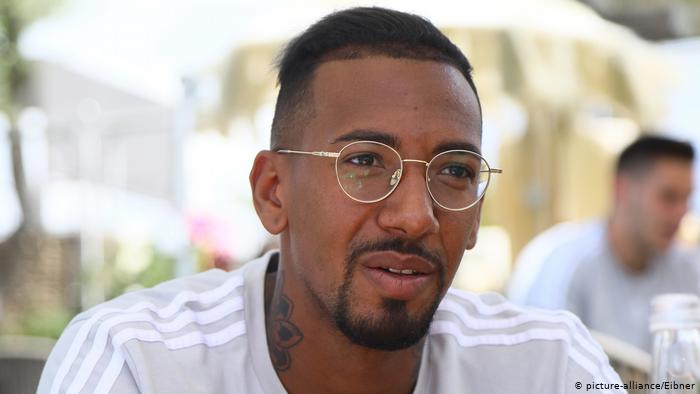
German footballer, Jerome Boateng talked to DW about the importance of education and the room for more support.
"The images shock me. Some of the things on social media at the moment are brutal. And unfortunately, the protests are also taking on a difficult form. Nevertheless, the case of George Floyd shows us just how widespread racism against black people is in America, and the role racial profiling plays. I find it extremely upsetting because I’m often in America myself and I like the country and the culture a lot. But it’s nothing new; it’s something which is omnipresent. Racism is found everywhere, but it is extreme in the USA.
I read a good quote recently: It’s as if racism is a dark room and, every now and then, someone turns the light on and everything is revealed.
When you think about how much African-Americans have done for the image and culture of the United States, I find it inexplicable. And I’m only thinking of sport, fashion and music. Barack Obama as President was also a defining figure.
Do you see any parallels with Germany?
Of course racism is a topic here as well, it’s very present. In recent years, we’ve seen attacks on foreigners and different religious groups in Germany. All in all, things are traveling in a certain direction where I think: we were once further along.
During my childhood in Berlin, I also had experiences with racism, of course. But I also remember my time on the football pitch, where it didn’t matter where you came from or what religion you were. We were Iranians, Africans, Turks, Germans. We didn’t really think or talk about it. It was all about being together.
Do you think that Afro-Germans are acknowledged and visible enough in Germany?
Generally speaking, people of African heritage are underrepresented in certain areas. Although, I often get the impression that sportspeople are the ones who do get the recognition.
But I don’t want to malign everything: fundamentally, I think Germany is an open country. Personally, I’ve had a lot of good experiences, too. There are countries in Europe where it’s a lot worse.
In today's world, do you think that athletes and sportspeople should be activists, too?
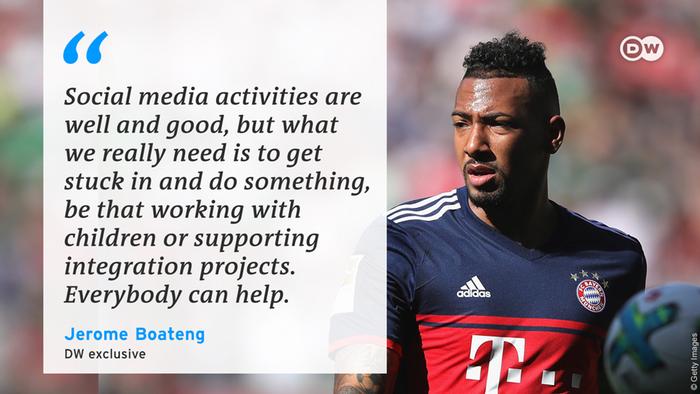
Our voices are heard, we have a platform and we have reach. But I think it’s important that it’s not just limited to social media. Initiatives like Black Out Tuesday are all well and good but what we really need is to really get stuck in and do something, be that working with children or supporting other integration projects. Everybody can help.
I personally would definitely like to do something in this area in the near future. There are already various suggestions and ideas.
His name was George Floyd. Say his name. Pray for his family. 👊🏽 I Can‘t believe it happened again, even in broad daylight and while being recorded. #BlackLivesMatter #JusticeForGeorgeFloyd pic.twitter.com/fDcsO3Cifx
— Jerome Boateng (@JB17Official) May 27, 2020
Many black footballers have spoken out about recent events. But what could your white colleagues do to support them?
Not every white athlete who doesn’t speak out right now is a racist. Of course not. When I watch videos of demonstrations, I see people of all skin colors. But of course it would be desirable if they used their fame to support this cause. Many do, but I think there’s still a lot of room for improvement.
Is there anything that I have not asked, but which is important to you and which you would like to say?
Everything begins with the education of children. That’s the most important thing. No child in this world is born a racist. It's up to the parents and what they tell their children.
The worst thing that could happen would be for my children to experience such things. It’s vital that we teach them that racism isn’t acceptable and that, should they see someone being abused, they should defend them and speak up. That has to start in school. It has to be an integral part of the curriculum. Only in that way can we make progress.
Born in Berlin in 1988, the son of a German mother and Ghanaian father, Jerome Boateng honed his skills on the city's streets before coming through the ranks at Hertha Berlin, making his first professional appearance for the club in 2007. Following spells at Hamburg and Manchester City, the central defender joined Bayern Munich in 2011, for whom he has since made 313 appearances and won seven Bundesliga titles, four German Cups and the 2013 Champions League. Boateng was a mainstay in the German national team between 2009 and 2019, making 76 senior appearances and starring in the side which won the World Cup in Brazil in 2014. He was named German Footballer of the Year in 2016.
The interview was conducted by DW's Jonathan Harding.
Latest Stories
-
Netherlands Fire Chief in Ghana to support fire safety reforms and market fire prevention efforts
2 hours -
Mason goes on remand for stealing
2 hours -
Gov’t cuts fuel taxes, deploys buses to curb impact of rising fuel prices
3 hours -
Interior Minister calls for intelligence-driven strategy as Ghana strengthens counter-terrorism efforts
3 hours -
Adenta Circuit Court remands Pastor William Gyimah over viral threats against Vice President
4 hours -
“We’ve implemented changes to prevent a repeat of the AFCON final” – CAF President Motsepe
4 hours -
Gov’t orders deployment of Metro Mass buses to cushion commuters amid fuel price hike
5 hours -
Key Indian state polls begin in test for Modi’s party
5 hours -
Playback: Gomoa Easter Carnival in photos
5 hours -
Gov’t orders removal of fuel taxes to ease pump price hikes
5 hours -
“Whatever the decision of CAS, we will respect it” – CAF President Motsepe after AFCON final meetings in Morocco
5 hours -
Emma Ankrah: When waiting becomes part of treatment – Reflections on hospital care
5 hours -
Ghana urges travellers to prepare for new EU border system roll-out
5 hours -
Mahama enforces fuel coupon ban for ministers as cabinet moves to slash fuel taxes
6 hours -
Task force probes strange fish deaths in Tema
6 hours