

Audio By Carbonatix
BBC News and three leading news agencies have expressed desperate concern for journalists in Gaza, who they say are increasingly unable to feed themselves and their families.
Those reporting the conflict from Gaza now face starvation and "the same dire circumstances as those they are covering," a joint statement from BBC News, Agence France-Presse (AFP), Associated Press (AP) and Reuters said.
"For many months, these independent journalists have been the world's eyes and ears on the ground in Gaza", it reads.
International news outlets rely on local reporters within Gaza, as Israel does not allow foreign media, including BBC News, to send journalists into the territory.
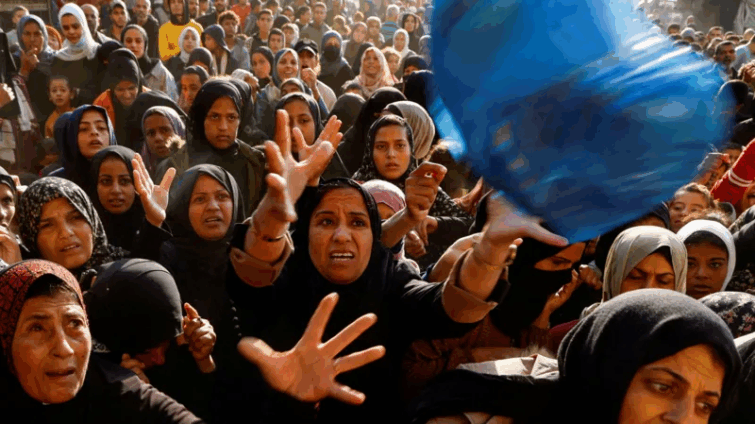
It comes as more than 100 international aid organisations and human rights groups have warned of mass starvation in Gaza.
The full statement reads: "We are desperately concerned for our journalists in Gaza, who are increasingly unable to feed themselves and their families.
"For many months, these independent journalists have been the world's eyes and ears on the ground in Gaza. They are now facing the same dire circumstances as those they are covering.
"Journalists endure many deprivations and hardships in warzones. We are deeply alarmed that the threat of starvation is now one of them.
"We once again urge the Israeli authorities to allow journalists in and out of Gaza. It is essential that adequate food supplies reach the people there."
In a separate joint statement, Médecins Sans Frontières (MSF), Save the Children and Oxfam, said their colleagues and the people they serve were "wasting away".
But Israel, which controls the entry of supplies into Gaza, has accused the charities of "serving the propaganda of Hamas".
Since Sunday, 45 Palestinians have died as a result of malnutrition, according to Gaza's Hamas-run health ministry.
Israel prevented aid deliveries to Gaza in early March following a two-month ceasefire.
The blockade was partially lifted after nearly two months, but food and medicine shortages have worsened.
Israel, along with the US, helped to establish a controversial new aid system run by the Gaza Humanitarian Foundation (GHF).
Hundreds of killings have been recorded in the vicinity of GHF's aid sites since they began operating eight weeks ago.
The World Health Organization has said that a quarter of Gaza's population is facing famine-like conditions, according to its assessments.
On Wednesday, its director Tedros Adhanom Ghebreyesus said: "I don't know what you would call it other than mass starvation, and it's man-made.
"And that's very clear, this is because of the blockade."
Latest Stories
-
Stroke survivors demand inclusive healthcare, urgent policy interventions nationwide
13 minutes -
China reaffirms unwavering ties with Ghana as Ambassador presents credentials
20 minutes -
Wrongful teacher postings undermine early childhood education in Upper East
25 minutes -
Five new envoys present Letters of Credence to Mahama
30 minutes -
BoG Governor says building buffers and lowering credit costs go together
36 minutes -
Fuel shock looms as petrol nears GH¢15.19, diesel GH¢17.85 from April 1
43 minutes -
From May to December, nothing works – Tomato traders reveal harsh reality for farmers
56 minutes -
Ghanaian farmer can’t grow tomatoes because of lack of irrigation – Tomato Importers Association president
1 hour -
Social media firms must better enforce Australia under-16 ban, watchdog says
2 hours -
King Charles should meet Epstein victims, US lawmaker says
2 hours -
Belgian ex-diplomat appeals order to stand trial in Congo’s Lumumba murder
2 hours -
Cholera aid for African countries stalled by Iran conflict
2 hours -
The Oscars are leaving Hollywood
2 hours -
Too watery, too risky – Why Ghanaian traders prefer Burkina tomatoes
3 hours -
We buy from Burkina because ours rot fast – Tomato traders defend import dependence
3 hours