

Audio By Carbonatix
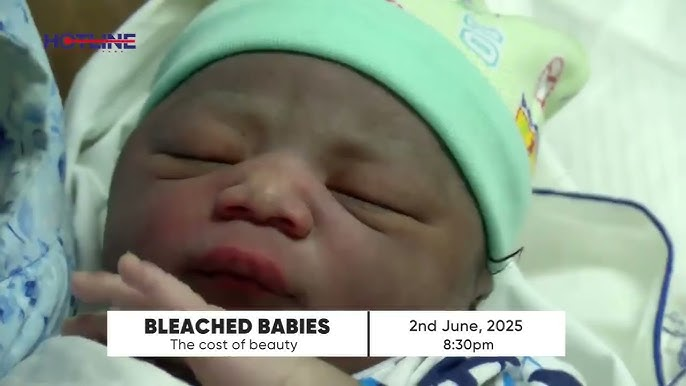
A joint investigation by JoyNews and Nigeria Health Watch has uncovered a disturbing public health crisis: parents in Ghana are bleaching the skin of their babies and children as young as three using toxic, banned substances.
In communities like Chorkor, a densely populated fishing enclave in Accra, skin tone is becoming a status symbol, and children are the latest victims. Mothers are applying creams containing dangerous ingredients like hydroquinone, mometasone, and tretinoin, all banned by Ghana’s Food and Drugs Authority (FDA). Some even resort to household bleach—hypochlorite—commonly sold as Parazone.
Caro, a fishmonger and mother of two, says beauty in her community begins with lighter skin. She started bleaching her children when they were just three. “They were born dark. I didn’t like that,” she said. “Now their skin is lighter. That’s beauty.”
Caro uses a cream called Skin Light, one of the most popular on the market despite its banned ingredients. She knows it’s harmful. “Yes, it can cause kidney failure or skin cancer. But I’ve found my way around it,” she claims. The financial cost is high, but the social pressure is higher.
She is not alone.
Naa Ashorkor, another mother in Chorkor, says keeping children’s skin fair is a major priority for many parents. “Some use bleach found in detergents,” she confessed. “It’s what makes them look acceptable.” To them, light skin means beauty, class, and opportunity.
FDA’s Head of Cosmetics, Emmanuel Nkrumah, says the use of hypochlorite on human skin, especially children, is extremely dangerous. “It’s not designed for the skin. It’s toxic,” he warned.
The skin-lightening craze is not limited to topical creams. Some women are using intravenous methods—injecting bleaching agents directly into their bloodstream. These risky procedures are offered in unregulated beauty clinics across urban neighbourhoods, charging as much as GH¢1,500 per session.
Dr. Titus Beyuo, a gynaecologist and former Deputy General Secretary of the Ghana Medical Association, confirms a rise in mothers bleaching newborns. He says some do it to dispel suspicion about the baby’s paternity. “It’s happening more than we think,” he said.
In 2018, the FDA issued a public alert over the use of cosmetic pills by pregnant women aiming to lighten their unborn babies’ skin. Now, intravenous bleaching poses an even greater risk. “It affects every part of the body,” Dr. Beyuo warned.
Former Director-General of the Ghana Health Service and current Presidential Advisor on Health, Dr. Nsiah Asare, says this must stop. “Parents do not have the right to bleach their children. There are laws to protect children from harmful practices.”
Despite limited studies on child skin bleaching in Ghana, the World Health Organisation reports that over a third of Ghanaians tone their skin. The figures are even higher in other African countries: 77% in Nigeria, 25% in Mali.
In Chorkor, the trend is deeply entrenched. Even residents like Quaynor Allotey, whose sisters bleach their children, express alarm. Yet the practice continues, driven by societal ideals that associate fair skin with worth.
Behind every bottle of bleaching cream, every bar of whitening soap, lies a painful truth: children are being taught that their natural skin is not enough. The damage is not only physical—it’s psychological, generational, and cultural.
But this cycle can be broken.
The true beauty of Ghana lies not in the shade of one’s skin but in the resilience of its people and the richness of its heritage. We must say enough. We must protect our children.
Let this documentary be more than a report. Let it be a call to action—for education, for regulation, and a cultural awakening.
No child should ever feel they must change their skin to be loved, respected, or accepted. Let self-worth shine brighter than any cream ever could.
This investigation was supported by Nigeria Health Watch.
Latest Stories
-
Penplusbytes’ statement on police action against deepfake and misinformation activities in Ghana
15 minutes -
QNET, EOCO partnership showcased at UN global fraud summit as model for fighting organised crime
16 minutes -
Mussa Dankwah is like a ‘lotto doctor’ – Miracles Aboagye
21 minutes -
Investors target Ho Airport for training and maintenance hub — GACL Chair
26 minutes -
NDC’s ‘grand deception’ on anti-LGBTQ+ bill exposed – Ntim Fordjour
27 minutes -
Speak out against Mahama government’s LGBTQI+ u-turn – Ntim Fordjour to clergy
31 minutes -
Ghanaians worse off despite improved macroeconomic indicators — Miracles Aboagye
34 minutes -
Police intercept narcotics, arrests five suspects in Upper West
40 minutes -
Government to establish Kumasi Machinery Innovation Park under 24-Hour Economy programme
43 minutes -
When Hormuz Fails: The day a waterway stops the world
44 minutes -
Ghanaian students in UK to protest over unpaid fees, stipends
44 minutes -
Inflation to go up marginally in April 2026 – Report
46 minutes -
Newborn baby found abandoned at Kronkromase cemetery, residents in shock
46 minutes -
VIP Jeoun Transport increases fares effective April 8
49 minutes -
Minority warns against alleged LGBTQ provisions in constitutional review
54 minutes