

Audio By Carbonatix
The Bank of Ghana (BoG) has identified mounting pressure on the country’s external position as one of the key risks confronting the Monetary Policy Committee (MPC) as it considers its latest policy stance.
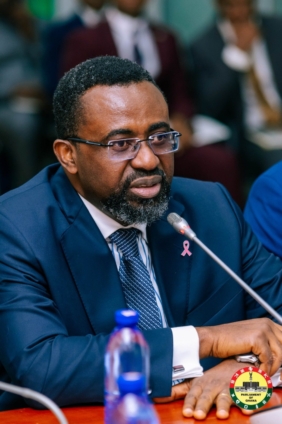
Governor Dr Johnson Asiama says the decline in international reserves, a weaker current account and a slowdown in gold shipments require careful assessment, particularly ahead of the expected increase in foreign exchange demand in the fourth quarter.
Speaking at the opening of the 132nd Monetary Policy Committee meeting, Dr Asiama said gross international reserves currently provide about 4.2 months of import cover, while the current account is projected to record a deficit in the third quarter.
He also noted that gold shipments have slowed, with GoldBod pausing exports since mid-August.
"Rebuilding reserves will be a key priority for the bank in the coming months indeed,” he said.
According to the Governor, the external position will determine how much policy space the Bank of Ghana can safely use, despite relatively stable domestic macroeconomic conditions.
“The domestic position affords policy space indeed. The external position determines how much of it can safely be used,” he said.
Dr Asiama also pointed to rising global risks, with the Middle East conflict pushing up energy prices and creating tighter global financial conditions.
Brent crude, he said, had risen from above $85 per barrel at the previous MPC meeting to about $107 per barrel as of last week.
He said the stronger US dollar and tighter global financial conditions had also weighed on emerging-market currencies, including the cedi.
Domestically, the Governor said headline inflation stood at 5% in August, although this remains below the Bank’s target band of 8% ±2%.
However, inflation has increased from a low of 3.2% in March to 5% in August, prompting the committee to assess whether the rise represents a temporary adjustment or could develop into more persistent inflationary pressure.
The MPC is also expected to consider developments in private-sector credit, fiscal policy and the implications of higher domestic borrowing for liquidity and the exchange rate.
At its previous meeting in July, the committee unanimously maintained the policy rate at 14%.
Dr Asiama said the key question before the 132nd MPC is whether the current policy rate remains an appropriate anchor for inflation expectations given the changing balance of risks.
The meeting is the first MPC session under Ghana’s new 36-month Policy Coordination Instrument with the International Monetary Fund, approved by the IMF Executive Board in July 2026.
Latest Stories
-
Digital transformation without an ownership culture can digitise poor service
3 minutes -
Fishing communities demand revocation of offshore gold exploration licences over livelihood concerns
6 minutes -
How Ghanaian tycoon Manoj Lakhiani built a water and plastics empire from a $25,000 loan
7 minutes -
GoldBod recovers GH¢38.7m of GH¢55.8m outstanding receivables; remainder subject to legal action – Sammy Gyamfi
14 minutes -
GEXIM Bank donates GH¢200,000 worth of medical equipment to Korle-Bu Child Health Department
17 minutes -
Majority rejects Minority’s claims over GH¢49.7m South Africa evacuation
19 minutes -
GEXIM urges banks to support refurbishment of Korle-Bu Teaching Hospital’s Child Health Department
22 minutes -
Don’t appoint your cheerleader as referee
26 minutes -
Ghana needs stronger international cooperation to fight cybercrime – CSA
29 minutes -
CSA warns of growing cyber threats as Ghana’s digital dependence increases
35 minutes -
USTED dean warns GAUA strike could disrupt Ghana’s restored academic calendar
48 minutes -
Bechem meat processing factory 50% complete, set for March 2027 completion – Kwakye Ofosu
1 hour -
NDC can appoint whoever they want to EC, but Ghanaians will make a decision in 2028 – Titus Glover
1 hour -
GoldBod initiative has created over 1,300 public and private sector jobs – Sammy Gyamfi
1 hour -
Financial wellness key to retaining Ghana’s skilled workforce – Merban Capital CEO, Benjamin Ackah-Nyamike
1 hour