

Audio By Carbonatix
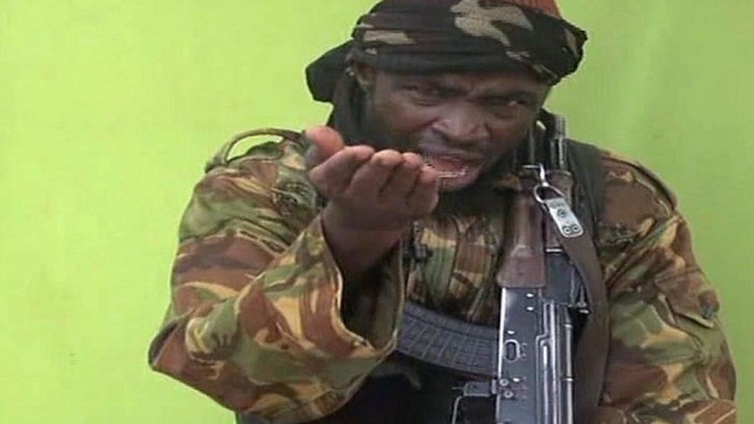
The leader of the Nigerian militant group Boko Haram, Abubakar Shekau, has killed himself, rival Islamist militants said in an audio recording.
In audio obtained by news agencies, the Islamic State West Africa Province (Iswap) said Shekau died detonating explosives on himself after a battle between the two groups.
Shekau was reported dead last month and has been reported killed before.
Neither Boko Haram nor the Nigerian government have confirmed his death.
What did the recording say?
In the undated audio recording, a voice thought to be that of Iswap leader Abu Musab al-Barnawi said Shekau "killed himself instantly by detonating an explosive".
Iswap fighters hunted down the warlord and offered him the chance to repent and join them, al-Barnawi said.
"Shekau preferred to be humiliated in the afterlife than getting humiliated on earth," he said.
When reports of Shekau's death in a clash circulated last month, the Nigerian army said it would investigate.
Army spokesman Brig Gen Mohammed Yerima told the BBC at the time the army was looking into what happened, but that it would not issue a statement until it got definitive proof.
One journalist with close links to security agencies said that Shekau died when Iswap attacked Boko Haram positions in the Sambisa forest, north-east Nigeria.
He has been reported dead numerous times before, only to resurface.
Who is Abubakar Shekau?
After taking the reins of Boko Haram after its founder died in police custody in 2009, Shekau led its transformation from an underground sect to a deadly insurgency that has swept north-east Nigeria.

Under Shekau, Boko Haram staged bombings, kidnappings and prison breaks across the region. And from 2014, it began overrunning towns in a bid to create an Islamic State under Sharia law.
Believed to be in his early- to mid-40s, Shekau backed a bloody jihadist campaign in propaganda videos that drew comparisons to Osama Bin Laden.
"I enjoy killing... the way I enjoy slaughtering chickens and rams," he said in one 2012 video.
Since he took charge, more than 30,000 people have been killed and over two million displaced from their homes.
The group gained global attention after its 2014 kidnapping of hundreds of girls from a school in Chibok, in Borno state, sparking the #BringBackOurGirls movement. Many of them are still missing.
Soon after, the US declared Shekau a "global terrorist" and placed a $7 million (£4.9m) bounty on his head.
Shekau's agenda was so radical that he was rejected by Islamic State, which split from Boko Haram to form Iswap in 2016.
What next for Boko Haram?
Should Shekau's death be confirmed, it is uncertain it would spell the end for Boko Haram, analysts say.
Since breaking away, Iswap has displaced Boko Haram as the dominant insurgency in the region.
Some predict Shekau's death could lead to the end of the violent rivalry between the two groups, enabling Iswap to absorb Boko Haram fighters, but others say they will remain loyal to his ideas.
"There's division among Shekau's followers about whether to join Iswap now or fight Iswap," Jacob Zenn, editor of the Jamestown Foundation Terrorism Monitor, told the BBC
"There was never a plan for the dictator of the group meeting his demise. It appears there will now be a chaotic period."
Latest Stories
-
Armed men reportedly storm Adjen Kotoku Onion Market amid tensions
12 minutes -
Tecco Mensah writes: Why football fans must look beyond statistics
54 minutes -
Police recover stolen Honda CR-V in Kumasi within 48 hours
1 hour -
Apetorku Gbodzi 2026 Festival opens in Dagbamete with development focus
2 hours -
President Mahama arrives in Lyon to co-chair One Health Summit
2 hours -
Beverly View Plus Hotel draws crowds amid coastal Easter rush in Volta
2 hours -
Maiden Zongo Festival held in Wa amid calls to tackle drug abuse among the youth
2 hours -
FDA warns of fake HIV test kits on Ghanaian market
3 hours -
Africa urged to build resilient health systems as donor support tightens
3 hours -
Easter gesture: Ablakwa settles medical bills for 85 North Tongu constituents
5 hours -
Africa must harness its population strength—Titus-Glover
5 hours -
Visa-free access doesn’t mean unlimited stay – Lom Ahlijah
5 hours -
From Golgotha to Kwahu: The Easter Migration of the Faithful and the Faithless
6 hours -
How the Ghanaian onion traders’ standoff with Nigeria unfolded and threatened local supply
6 hours -
No compensation for demolished structures on 24-Hour Economy market lands — Gov’t to structure owners
6 hours