

Audio By Carbonatix
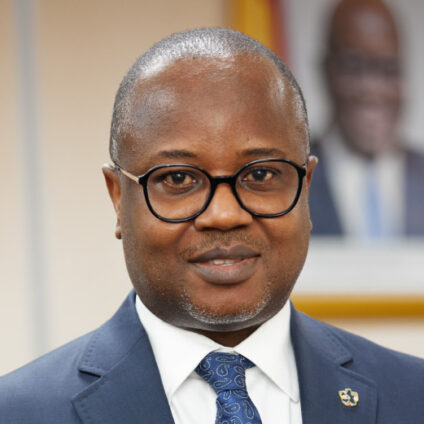
The first Deputy Governor of the Bank of Ghana (BoG), Dr Maxwell Opoku-Afari, has called for policies to stimulate savings and investment in the economy, describing borrowing as an “unsustainable” way of development.
“Most of the lower-middle income countries, and in particular, our savings rate is nowhere compared with other middle-income countries. We’re under 10 per cent, but the investment requirement is huge,” he said.
He said this during a panel discussion on the back of the launch of the 2024 World Development Report, “The middle-income trap,” by the World Bank in Accra.
Dr Opoku-Afari noted that considering the country’s development needs, it was important to close the critical savings and investment gap, which often made the government resort to borrowing.
“… But borrowing is not the most sustainable way of development. You have to focus on domestic revenue mobilisation, and to achieve that, you have to grow the savings rate,” he said.
The Deputy Central Bank Governor noted that for the country to witness the structural economic transformation that would be more impactful, it was important to be intentional about driving sustainable investment.
“This should focus on getting a savings rate that can lead to a higher revenue mobilisation domestically to support instead of borrowing at a very expensive market rate, especially when that investment does not go into projects that can pay for itself,” he stated.
Dr Opoku-Afari called for a national dialogue that would focus on identifying and addressing the root causes of the country’s long-standing stagnant savings, saying, “Without a higher level of savings, we cannot mobilise revenue domestically.”
He also called for policies and programmes that would train the growing youthful population to acquire the needed skills to fit into the global labour market as part of efforts for structural transformation and economic development.
President and Chief Executive Officer (CEO) of the Centre for Economic Transformation (ACET), Ms Mavis Owusu-Gyamfi, called for intentional policies to transform the economy.
She stated that ACET, through its Africa Transformation Index, has observed that since Ghana became a lower-middle income country, there had been retrogression on all the five pillars for structural transformation.
The structural transformation pillars are economic diversification, export competitiveness, productivity, the use of technology, and human well-being.
“Ghana has regressed in four of those pillars, with the progress made only on human wellbeing, and even with human wellbeing, what we’ve seen is that people’s income on the average has gone up, but inequality has also increased,” she said.
“With this trajectory, Ghana is now in the bottom third of Africa [out of 30 countries, which represents 86 per cent of the continent’s Gross Domestic Product (GDP), when it comes to transformation,” she stated.
She recommended that successive governments should select specific high-growth and diversification sectors of the economy, including agriculture, and tourism, and channel the needed support to drive change.
“To do that you have to work across the sub-region. We need to be able for example, to import cotton from our neighbouring countries, and add value to it. We must stop throwing away second-hand clothing, extract thread from it and merge it with virgin cotton, and build the cotton value chain and export,” she said.
The World Bank middle-income trap report found that while 108 countries were classified as middle-income, only 34 had reached a higher-income status with the ambition of many to attain the same, being gloomy in the last two decades.
The report noted that for those countries to escape the trap, they ought to undergo two transitions; move from accelerating investment to infusion, then to a mix of innovation, investment and infusion.
Latest Stories
-
Health Ministry engages Ga Mantse ahead of Free Primary Healthcare launch
13 minutes -
We can tackle multiple priorities – Sam George defends Anti-LGBTQ Bill push
48 minutes -
Statement: Ghana Chamber of Mines’ Response to Claims in Joe Jackson’s “Ananse Stories about the Economy of Ghana”
50 minutes -
GES opens 2026 teacher recruitment for licensed B.Ed graduates
52 minutes -
Ghana must value skilled trades, build resilient learners — Ibn Chambas
60 minutes -
Ghana must rethink education around relevance, resilience and responsibility — Ibn Chambas
1 hour -
Prince Harry faces defamation lawsuit from charity he co-founded
1 hour -
South Korea deploys thermal cameras to track escaped zoo wolf
1 hour -
Calls for royal meeting with Epstein survivors grow ahead of US visit
1 hour -
Ibn Chambas advocates blend of technology and human values in education
1 hour -
UMA improves healthcare access in Asutifi North with GH₵700k ‘Kim Taylor Legacy’ Walkway
1 hour -
Scholarships Authority and Fanaka University offer sponsorship for procurement and supply chain studies
1 hour -
Bisa Kdei drops new single ‘Go N Look’ featuring Medikal
1 hour -
Benin facing rising terrorism in north as French military presence faces growing criticism
1 hour -
UEW Public Lecture Series 2026: Education debate ‘about the soul of Ghana’s future’ — Dr Ibn Chambas
1 hour