


Audio By Carbonatix
"It's really expensive. When all this started, I had to sell everything I owned," says cancer patient Awa Florence.
"I don't have anything left. I'm a widow and I don't have the means to pay for further tests."
The civil servant from Senegal's capital city, Dakar, was diagnosed with cervical cancer last year.
Cancer is a growing problem in Africa and Senegal is the latest country to try to improve patient care by subsiding chemotherapy in all public hospitals.
The government says the drugs will be free for women suffering from breast or cervical cancer and up to 60% cheaper for other types of cancers.
Some of the essential drugs needed to treat the side effects of chemotherapy will also be covered, Khady Mbaye Sylla, director of public hospitals, tells the BBC.
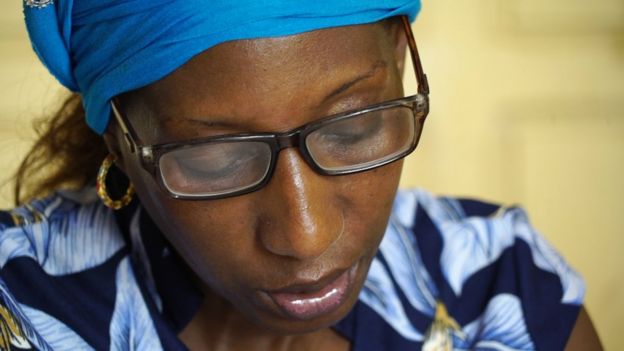 "When I first saw the invoice I started to cry," Ms Florence says
Cervical cancer and breast cancer are the biggest causes of cancer deaths among women in sub-Saharan Africa, according to the World Health Organization (WHO).
Yet it is only in recent years that prevention and control of these diseases have become a matter of public health.
In 2011, the WHO said that non-communicable diseases were "an impending disaster" for some countries, pushing millions of people into poverty.
So, Senegal's efforts should be lauded as "an excellent step", says Dr Anderson.
"When I first saw the invoice I started to cry," Ms Florence says
Cervical cancer and breast cancer are the biggest causes of cancer deaths among women in sub-Saharan Africa, according to the World Health Organization (WHO).
Yet it is only in recent years that prevention and control of these diseases have become a matter of public health.
In 2011, the WHO said that non-communicable diseases were "an impending disaster" for some countries, pushing millions of people into poverty.
So, Senegal's efforts should be lauded as "an excellent step", says Dr Anderson.
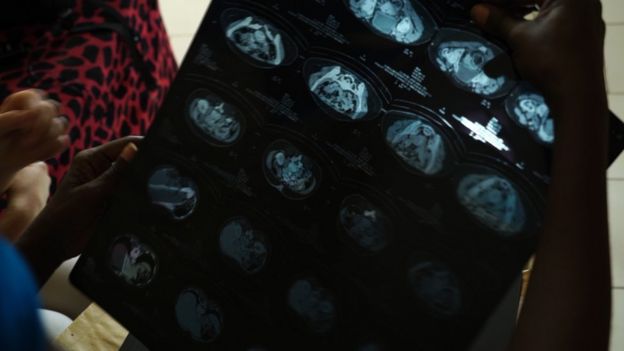 These are the scans which showed that Ms Florence has cancer
In Senegal, a course of radiotherapy can cost about $250 (£195) and surgery $330. That is after the patient has undergone required tests and examinations that can cost up to $1,600.
For women like Ms Florence, who earns about $80 a month, it is just too expensive.
Ms Florence is hopeful the new measure could help women like her, but also has some reservations.
"They say it's for free, but we don't know if we will need to fill out paperwork here and there, and if we need to buy drugs urgently…," she says, her voice trailing off.
"Will the government pay for radiotherapy that costs $250 or scans that cost $130? If the government pays all that, then yes - it's a good thing."
These are the scans which showed that Ms Florence has cancer
In Senegal, a course of radiotherapy can cost about $250 (£195) and surgery $330. That is after the patient has undergone required tests and examinations that can cost up to $1,600.
For women like Ms Florence, who earns about $80 a month, it is just too expensive.
Ms Florence is hopeful the new measure could help women like her, but also has some reservations.
"They say it's for free, but we don't know if we will need to fill out paperwork here and there, and if we need to buy drugs urgently…," she says, her voice trailing off.
"Will the government pay for radiotherapy that costs $250 or scans that cost $130? If the government pays all that, then yes - it's a good thing."
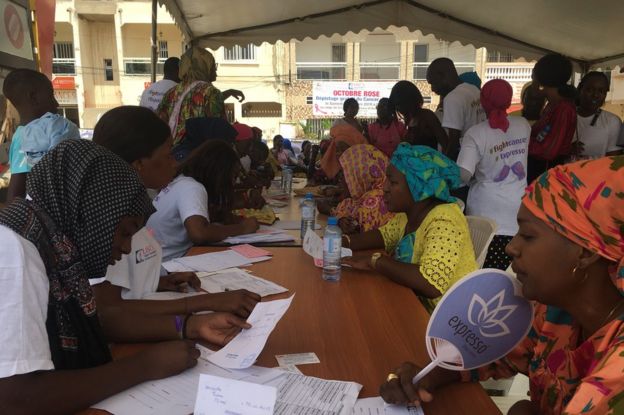 Senegal's Anti-Cancer League organises free cancer screening days
Despite the announcement from Senegal's government, Dr Diop believes there are still many cancer sufferers across the country who aren't receiving any treatment at all, with many people not knowing they have it.
Overall the five-year survival rate across different cancers is as low as 10 to 20% in low-income countries, while in richer countries it averages between 80 and 90%, says Dr Prebo Barango of the WHO.
Factors include:
Senegal's Anti-Cancer League organises free cancer screening days
Despite the announcement from Senegal's government, Dr Diop believes there are still many cancer sufferers across the country who aren't receiving any treatment at all, with many people not knowing they have it.
Overall the five-year survival rate across different cancers is as low as 10 to 20% in low-income countries, while in richer countries it averages between 80 and 90%, says Dr Prebo Barango of the WHO.
Factors include:
'Like new tyres'
But cancer often requires more complex treatment than just chemotherapy alone, and that costs more money, which patients have to pay for. "It's a bit like getting new tyres. For your car to work, you still need to buy gas, to have roads, a driving licence," says Dr Ben Anderson, director of the Breast Health Global Initiative.
"When I first saw the invoice I started to cry," Ms Florence says
Cervical cancer and breast cancer are the biggest causes of cancer deaths among women in sub-Saharan Africa, according to the World Health Organization (WHO).
Yet it is only in recent years that prevention and control of these diseases have become a matter of public health.
In 2011, the WHO said that non-communicable diseases were "an impending disaster" for some countries, pushing millions of people into poverty.
So, Senegal's efforts should be lauded as "an excellent step", says Dr Anderson.
Cancer in Senegal:
- Most common cancers: cervix (17.8); breast (16.7%); liver (10.2%); prostate (9.1%); stomach (5.2%)
- Number of new registered cancer cases (2018): 10,549 - from a population of 16 million
- Number of registered cancer deaths (2018): 7,571
These are the scans which showed that Ms Florence has cancer
In Senegal, a course of radiotherapy can cost about $250 (£195) and surgery $330. That is after the patient has undergone required tests and examinations that can cost up to $1,600.
For women like Ms Florence, who earns about $80 a month, it is just too expensive.
Ms Florence is hopeful the new measure could help women like her, but also has some reservations.
"They say it's for free, but we don't know if we will need to fill out paperwork here and there, and if we need to buy drugs urgently…," she says, her voice trailing off.
"Will the government pay for radiotherapy that costs $250 or scans that cost $130? If the government pays all that, then yes - it's a good thing."
Lack of data
In the meantime, she has sought help for her medical bills elsewhere. "When I first saw the invoice I started to cry. I told my doctor I couldn't pay it and he put me in touch with the Anti-Cancer League who were able to help me." "I have an appointment soon for radiotherapy and I'll bring the results to the doctor who will tell me what to do next," Ms Florence says. "Chemotherapy is really hard. I would prefer him to tell me I don't need to do it again… The side effects are painful and you're supposed to eat healthy food, fruits, but it's hard when you don't have the means."
Senegal's Anti-Cancer League organises free cancer screening days
Despite the announcement from Senegal's government, Dr Diop believes there are still many cancer sufferers across the country who aren't receiving any treatment at all, with many people not knowing they have it.
Overall the five-year survival rate across different cancers is as low as 10 to 20% in low-income countries, while in richer countries it averages between 80 and 90%, says Dr Prebo Barango of the WHO.
Factors include:
- lack of information about early signs and symptoms of cancer
- late diagnosis or misdiagnosis
- weak or non-existent referral systems
- geographical distance from care and treatment
- catastrophic costs of treatment and medicines
- weak healthcare systems and instances of abandoned treatment.
DISCLAIMER: The Views, Comments, Opinions, Contributions and Statements made by Readers and Contributors on this platform do not necessarily represent the views or policy of Multimedia Group Limited.
DISCLAIMER: The Views, Comments, Opinions, Contributions and Statements made by Readers and Contributors on this platform do not necessarily represent the views or policy of Multimedia Group Limited.
Latest Stories
-
Ghana Faces Sierra Leone Moment as Prosecutorial Powers come under strain
8 minutes -
Don’t consume fish or seafood from Tema Shipyard until further notice – FDA warns
13 minutes -
Why volunteering might be Africa’s most underrated career accelerator
19 minutes -
ActionAid Ghana raises concern over gender gaps in Feed Ghana Programme
21 minutes -
Windstorm wreaks havoc in Gushegu, displacing nearly 2,000 residents and damaging schools
24 minutes -
Friends of Bridget Bonnie Marks her 35th birthday with donation to Kasseh Model Health Centre
1 hour -
From Ekumfi Kokodo to the Pulpit Stage: Essi Donkor’s gospel journey takes shape
1 hour -
Landfilling waste management creates no value, it’s an economic waste
2 hours -
Photos: Speaker Bagbin Commissions MPs constituency office under parliamentary decentralisation programme
2 hours -
Black Stars technical advisor Winfried Schäfer sacked as GFA shakes up backroom staff
2 hours -
Wenchi water project almost complete, critical to gov’t agenda – GWL MD
2 hours -
Anti-LGBTQ+ bill not part of government’s legislative agenda – Inusah Fuseini
2 hours -
Anti-LGBTQ Bill: Forget the rumour mongers, I’m a man of action, and will pass the bill – Speaker
3 hours -
Women and children among those killed in Sudanese army shelling of wedding celebration
3 hours -
President Mahama is not sincere with Ghanaians on LGBTQ bill matter – Hassan Tampuli
3 hours