

Audio By Carbonatix
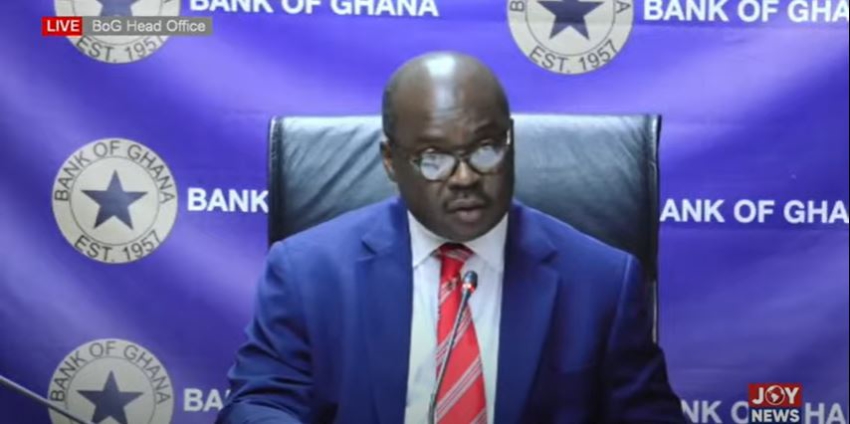
Following widespread criticisms over the GHȼ60 billion loss recorded by the Central Bank in 2022, the Governor of the bank, Dr Ernest Addison has explained that central banks ordinarily do not exist for profits but for national welfare.
Speaking at a news conference on Monday, August 21, to address a number of issues that have emerged since the bank released its annual report and financial statement for 2022, Dr Addison said, “We must recognise the special character of Central Banks and the role they play in an economy. Central Banks are institutions of public policy and do not exist for profit but for national welfare and as such could have a negative equity position and continue to be policy effective.
“Very clear policies have been put in place to return to positive equity in the medium term. And as we do this, we will continue to rebuild our policy buffers to continue to provide the necessary assurance of policy support as we rebuild a stronger and more resilient and inclusive economic post-pandemic"he noted.
He added that the bank remains strong, and that its operations will not be affected by the losses.
“Let me end by reassuring the public on the policy solvency of the Bank of Ghana to achieve its statutory mandate going forward. Every central bank’s credibility depends on its ability to achieve its mandate. These technical losses do not jeopardize that ability and are sometimes the price to pay for achieving those aims. It is important that we place the central bank’s policy mandate ahead of profits."
Dr Addison said his assertion that the loss will not affect the bank’s operation was validated by the International Monetary Fund’s (IMF) Technical Assistance mission before granting Ghana a bailout.
“It is worth noting that Central Banks are not commercial banks. Bank of Ghana’s current financial condition will not impact negatively on the operations of the Bank,” he stated.
According to him, the IMF declared the bank “was policy solvent and would remain so, as it had enough income to cover monetary policy operational costs.”
He said BoG will also manage to reduce its operational costs during this period – 2023.
He further explained that the loss the bank recorded last year were technical losses arising from the “haircut and the application of accounting standard (in particular IFRS 9) to estimate credit losses over the tenure of the government dealt by Bank of Ghana.”
He noted that the financial loss was not money lost by the bank through its operations in 2022.
“Rather, one should look at this as the reflection of the total cost of the economic and social crises that the country has faced over the years and an attempt to resolve a major structural problem of the Ghanaian economy,” he added.
He said loss recorded by the bank is not the first time since the bank has gone into negative equity before, according to historical financial statements.
According to him, in the period of 2017, and 2018, BoG incurred similar negative equity from the impairment of legacy liquidity support loans granted in 2015 and 2016 to insolvent banks.
He stated that the external auditors were impaired due to the uncertain prospects of recovering from those insolvent banks. However, the bank recovered and generated profits from 2019 to 2021.
“During the early years of structural adjustment, very large exchange rate depreciations led to revaluation losses that drove the Bank into negative Equity. Indeed, anytime the economy faces major challenges, the Bank of Ghana's balance sheet suffers, and the equity position moves into negative territories,” he said.
The BoG Governor noted that in all its dealings, the Bank acted within the applicable laws, adding that it is not true that the Bank of Ghana has been providing financing for the government every year.
“There has been zero financing in 2017, 2018, 2019 and 2021. The Bank of Ghana has only had to support in the pandemic year of 2020 and the crisis year of 2022."
The Minority in Parliament at a press conference on Tuesday, August 8, disclosed the cost of the central bank’s new head office under construction. Its Leader, Dr Cassiel Ato Forson said the bank spending a whopping $250 million to build a head office in the current economic crisis was untenable.
It has thus demanded the resignation of the BoG Governor and his two deputies for the GHȼ60 billion loss the bank incurred in 2022.
But the Governor has explained that the losses were not occasioned by mismanagement but largely by the government through its initiatives like the Domestic Debt Exchange Programme and other factors.
Latest Stories
-
Prudential Life settles GH¢100,000 medical bills under its PRUCares Valentine Experience Initiative
4 hours -
Wa West Picnic: Peter Lanchene Toobu champions peace, health and unity in landmark celebration
4 hours -
Dr Mensah Market flooded after downpour in Kumasi
4 hours -
Armed men reportedly storm Adjen Kotoku Onion Market amid tensions
5 hours -
Tecco Mensah writes: Why football fans must look beyond statistics
6 hours -
Police recover stolen Honda CR-V in Kumasi within 48 hours
6 hours -
Apetorku Gbodzi 2026 Festival opens in Dagbamete with development focus
7 hours -
President Mahama arrives in Lyon to co-chair One Health Summit
7 hours -
Beverly View Plus Hotel draws crowds amid coastal Easter rush in Volta
7 hours -
Maiden Zongo Festival held in Wa amid calls to tackle drug abuse among the youth
7 hours -
FDA warns of fake HIV test kits on Ghanaian market
8 hours -
Africa urged to build resilient health systems as donor support tightens
8 hours -
Easter gesture: Ablakwa settles medical bills for 85 North Tongu constituents
9 hours -
Africa must harness its population strength—Titus-Glover
9 hours -
Visa-free access doesn’t mean unlimited stay – Lom Ahlijah
9 hours