

Audio By Carbonatix
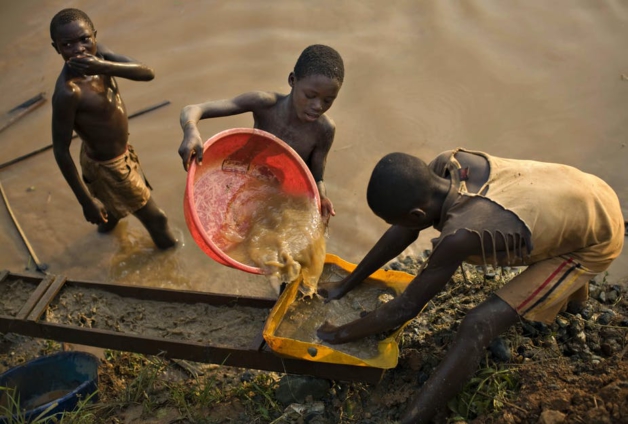
The 2021 Population and Housing Census (PHC) report reveals that 419,254 children aged 5 to 17 are engaged in economic activity in the country.
Out of the figure, 76,439 are aged 5 to nine, 153,189 aged 10 to 14, and 189,626 aged 15 to 17.
This is in a statement by the Ghana Statistical Service (GSS) on economic activities of children to mark World Day Against Child Labour.
The statement said children aged 5 to 17 worked on average 29.2 hours in the seven days preceding Census Night.
"Children 15 to 17 years worked an average of 35.2 hours, children 10 to 14 years worked an average of 26.5 hours (about 5 hours per weekday), and children 5 to 9 years worked an average of 19.8 hours (about 4 hours per weekday), " it said.
The statement said children engaged as paid apprentices worked the highest number of hours on average (48.4), almost twice that of those engaged as contributing family workers who worked the lowest hours on average (25.0).
It said children in the service sector worked 36.8 hours on average, while those in the agricultural sector worked an average of 25.6 hours.
"Nationally, 153,773 children aged 5 to 17 engaged in economic activity had never attended school.
"Out of this number, 37,963 children were 5 to 9 years. In all, 94,748 children aged 5 to 17 years engaged in economic activity were also attending school during the census," it said.
"Eight in every ten (81.3 per cent) children aged 5 to 9 who were engaged in economic activity lived in six regions – Northern (19,727), Oti (14,875), North East (8,073), Upper West (7,071), Savannah (6,525), and Upper East (5,851)," it said.
The statement said Nkwanta North (9,707), Krachi Nchumuru (7,598) and Nanumba North Municipal (7,598) had the highest number of children 5 to 14 years engaged in economic activities.
The three districts, the statement said had 21,726 children representing 10.8 per cent of all children 5 to 14 years engaged in economic activities.
It said the population of children engaged in economic activities in the Nkwanta North, Krachi Nchumuru and Nanumba North Municipal districts exceeded that of the Bono (3,635), Ahafo (3,261), Western North (2,088), Western (4,179) and Central (4,834) regions combined.
In all, 30 out of the 261 districts had more than 10 per cent of children 5 to 14 years
engaged in economic activity, the statement said.
It said the district with the highest percentage was Krachi Nchumuru, where one in every three children (34.8 per cent) was engaged in economic activity.
The percentage in the district was about 10 times the national average of 3.2 per cent. Nkwanta North with 27.8 per cent and Yunyoo Nasuan, 25.3 per cent, were the two other districts where over a quarter of children were engaged in economic activity, the statement added.
Latest Stories
-
Mr President, Ghana was mentioned at the UN; why aren’t we talking about it?
3 hours -
Accra to convene Africa’s regulators and markets on tokenisation at AVAS 2026
3 hours -
The Paradox of Plenty — When every smartphone becomes a newsroom
4 hours -
GTA sensitises taxi drivers in ‘Know Ghana’ tourism campaign
5 hours -
Archbishop Agyinasare calls for responsible speech amid growing social media abuse
5 hours -
‘It will be inexcusable for gov’t not to honour payment of teachers’ arrears by 30th October’ – Haruna Iddrisu
5 hours -
Forbes’ World’s Best Employers 2026: No Ghanaian firm ranked among 900 companies
6 hours -
Electronic processing of teachers’ data: ‘The decision is the Controller’s’ – GES boss
6 hours -
Teachers’ Strike: Haruna Iddrisu questions paper-based processing of promoted teachers’ data
6 hours -
Savannah Region: Kunfusi bridge collapses again, leaving nearly 4,000 residents cut off
6 hours -
Teachers’ strike: GES targets Monday deadline to submit promotion data to Controller
6 hours -
Inflation to average 11.3% in 2027 – Fitch Solutions
6 hours -
‘I didn’t campaign for NDC to come and do this nonsense’ – Kpebu on EOCO’s conduct
6 hours -
Fitch Solutions maintains policy rate forecast of 14% by December 2026
7 hours -
Diaspora Nasara Caucus congratulates Mohammed Ali Suraj, new NPP executives
8 hours