

Audio By Carbonatix
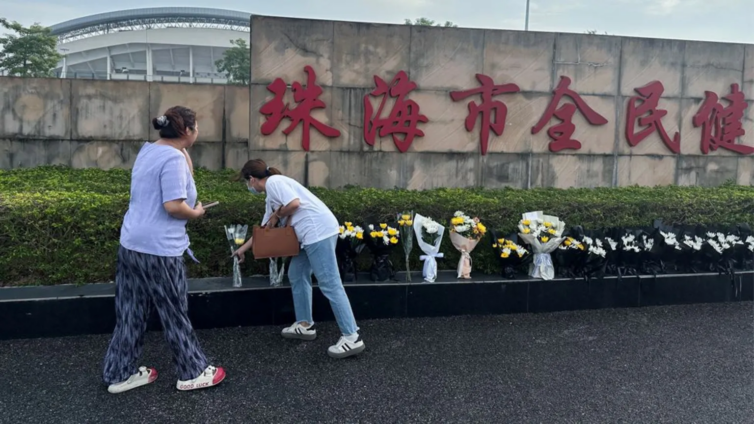
China has executed a man found guilty of killing at least 35 people in a car attack in November, in what is thought to be the deadliest attack in the country for a decade.
Fan Weiqiu, 62, injured dozens more when he drove his car into people exercising outside a stadium in the southern city of Zhuhai.
State media said a second man was executed for a separate attack that came days later. Xu Jiajin, 21, killed eight people in a stabbing spree at his university in the eastern city of Wuxi.
Authorities said Fan was driven by "dissatisfaction" over how his property had been divided following his divorce, while Xu carried out his attack after "failing to obtain his diploma due to poor exam results".
Fan was detained at the scene on 11 November, where police said he was found with self-inflicted wounds.
In December, he was found guilty of "endangering public safety", with the Zhuhai Intermediate People's Court describing his motive as "extremely vile" and the methods used "particularly cruel".
His execution on Monday comes less than a month after the court sentenced him to death.
In the case of Xu, police said he confessed to his crime "without hesitation" on 16 November. He was sentenced to death on 17 December, with the court hearing that the circumstances of his crime were "particularly bad" and "extremely serious".
Human rights groups believe China is the world's leading executioner, killing thousands of people every year. The country does not release details about its use of the death penalty, so reliable numbers are unavailable.
China has been grappling with a spate of public violence, with many attackers believed to have been spurred by a desire to "take revenge on society" - where perpetrators target strangers over their personal grievances.
The number of such attacks across China reached 19 in 2024.
Within days of the Zhuhai and Wuxi attacks, a man drove into a crowd of children and parents outside a primary school in Changde city, injuring 30.
Authorities said the man, Huang Wen, wanted to vent his anger after dealing with investment losses and family conflict.
Huang was handed a suspended death sentence last month, which could be commuted to life imprisonment if he does not commit another crime in the next two years.
Analysts earlier told the BBC that the string of mass killings raised questions about how people in China have been dealing with various sources of stress, such as the country's sluggish economy.
"The tensions do seem to be building, and it doesn't look like there is any way it is going to ease up in the near future," says George Magnus, an economist at Oxford University's China Centre.
Latest Stories
-
Residents hand over two suspects for attempted arson in Savannah Region
7 minutes -
GCTU dragged to court over VC’s alleged unlawful dismissal
8 minutes -
Deputy Health Minister commissions first-ever Surgical Eye Centre in Central region
11 minutes -
Inflation drop good news, but sustainability is key – Dr Stephen Amoah
15 minutes -
Mrs Cecilia Asamoah (Adwoa Konadu)
16 minutes -
Finance expert warns Ghana could face deflation amid rapid inflation drop
18 minutes -
GCTU governing council ends tenure of VC Prof. Afoakwa, appoints acting replacement
19 minutes -
One Volta Group proposes integrated transshipment deep seaport at Keta
22 minutes -
Dr Stephen Amoah outlines strategies to sustain Ghana’s single-digit inflation
25 minutes -
UBA Ghana wins 2 prestigious awards at Global Business and Finance Magazine Awards
26 minutes -
Globen School marks 30th anniversary with outreach to Good Samaritan Home in Adidome
30 minutes -
Maguire given reduced 15-month suspended sentence
38 minutes -
Liverpool top-five failure ‘could cost £120m’
50 minutes -
Interior Ministry announces release of aptitude test results for 2025/26 security recruitment
52 minutes -
Secondary bond market expected to sustain recovery trajectory in 2026 – Databank Research
54 minutes