

Audio By Carbonatix
China has reaffirmed its commitment to working with Ghana to advance sustainable and responsible mining as part of ongoing cooperation in the minerals sector.
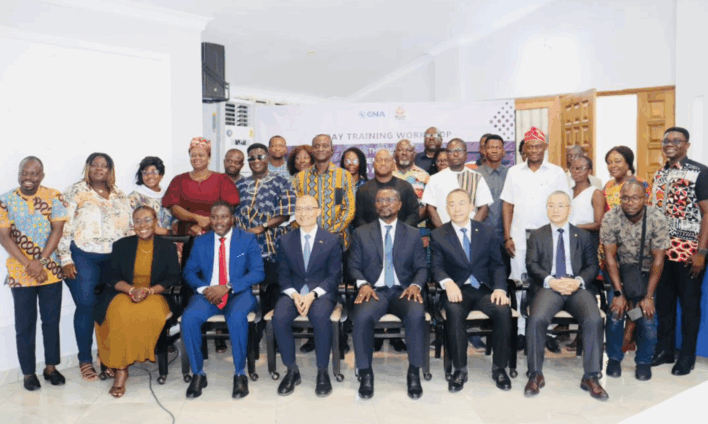
Mr. Tong Defa, the Chinese Ambassador to Ghana, who made the commitment at the opening of a three-day workshop for editors and reporters in Peduase, said China was ready to deepen collaboration to promote green mining practices.
“We are ready to work with Ghana to promote green and sustainable development in the mining industry,” he said.Ambassador Tong said China consistently urged its companies to comply with Ghana’s laws and regulations.
China would also support Ghana through knowledge-sharing and technology transfer to help Ghana improve its technology, upgrade its mining equipment, control costs, increase revenue, and enhance the added value of minerals.
Mr Tong noted that the Chinese Embassy recently hosted a China-Ghana Mining Cooperation Roundtable on Sustainable Mining, with some key stakeholders, coming from China, to deepen engagement,” he said.
Ambassador Tong highlighted the role of Chinese mining companies in job creation, community development and environmental responsibility.
He cited the operations of the Cardinal Namdini Gold Mine of Shandong Gold in the Upper East Region and the Wassa Gold Mine of the Chifeng Gold, in the Western region, as among the Chinese mining firms driving sustainable mining in Ghana.
He said Shandong Gold, for instance, had prioritised local employment, noting that “94 per cent of its approximately 1,600 contract employees were local Ghanaians”, while also strengthening ties with host communities.
The Chinese Ambassador said the company had invested about two million US dollars in health, education, environmental sanitation, and community infrastructure construction,” and had built “a 25-kilometre road open to the public, connecting more than 10 communities.”
Ambassador Tong said Chifeng Gold had also made significant investments through the Golden Star Community Development Fund.
“Chifeng Gold has established the Golden Star Community Development Fund, investing approximately 4.5 million US dollars to construct community centres, schools, clinics, drinking water projects, roads, and other infrastructure for the local communities,” he said.
He added that the company had partnered local farmers to reclaim mined lands for agriculture, saying it had worked with smallholder farmers to establish the Golden Star Oil Palm Plantations Limited on former mining land.
“Currently, the company plans to build a medium-sized oil palm processing plant in the area, capable of processing 10 tonnes of fresh fruit bunches per hour, to increase the industry’s added value.
“This would further increase farmers’ income, and provide more employment opportunities for local residents,” he said.
Ambassador Tong said China was committed to expanding cooperation with Ghana across several sectors, including mining, energy, infrastructure, agriculture and fisheries, to support national development.
“China is eager to expand collaboration in mining, energy, infrastructure construction, agriculture, and fisheries with Ghana, to transform Ghana’s natural resource advantages into drivers of development,” he said.
He said the approach would ensure “effective synergy between resource exploitation and environmental protection,” while fostering high-quality cooperation between the two countries.
Ambassador Tong noted that President John Dramani Mahama had expressed appreciation to China for its support through the Forum on China–Africa Cooperation (FOCAC) and the Belt and Road Initiative.
On China’s development strategy, the Chinese Ambassador said cooperation with Ghana would be further strengthened under China’s long-term planning framework.
“Opening up and cooperation for mutual benefit are integral to Chinese modernization,” he said, adding that the Fourth Plenary Session of the 20th Communist Party of China Central Committee had underscored the need to strengthen alignment with Belt and Road partner countries,” he stated.
“This will present greater opportunities for China-Ghana mining cooperation.” Ambassador Tong urged journalists to adopt a fair and comprehensive approach in reporting on mining involving Chinese nationals.
While noting that a “tiny” population of Chinese were involved in illegal mining, he said the actions of a few should not overshadow the contributions of law-abiding companies.
The training, organised by the Ghana News Agency (GNA) in partnership with the Association of China-Ghana Mining, brought together editors and reporters from Accra, Western and Upper East regions.
It strengthened journalists’ capacity to report on mining issues with balance and depth, amid Ghana’s ongoing efforts to address the environmental and socio-economic effects of illegal mining and promote best practices.
Latest Stories
-
Tecco Mensah writes: Why football fans must look beyond statistics
21 minutes -
Police recover stolen Honda CR-V in Kumasi within 48 hours
56 minutes -
Apetorku Gbodzi 2026 Festival opens in Dagbamete with development focus
1 hour -
President Mahama arrives in Lyon to co-chair One Health Summit
1 hour -
Beverly View Plus Hotel draws crowds amid coastal Easter rush in Volta
1 hour -
Maiden Zongo Festival held in Wa amid calls to tackle drug abuse among the youth
2 hours -
FDA warns of fake HIV test kits on Ghanaian market
2 hours -
Africa urged to build resilient health systems as donor support tightens
2 hours -
Easter gesture: Ablakwa settles medical bills for 85 North Tongu constituents
4 hours -
Africa must harness its population strength—Titus-Glover
4 hours -
Visa-free access doesn’t mean unlimited stay – Lom Ahlijah
4 hours -
From Golgotha to Kwahu: The Easter Migration of the Faithful and the Faithless
5 hours -
How the Ghanaian onion traders’ standoff with Nigeria unfolded and threatened local supply
6 hours -
No compensation for demolished structures on 24-Hour Economy market lands — Gov’t to structure owners
6 hours -
Financial Institutions must back local enterprises to spur growth – Deputy Minority Whip
6 hours