

Audio By Carbonatix
More than 7,000 cases of a mosquito-borne virus have been reported across China's Guangdong province since July, prompting measures similar to those taken during the COVID-19 pandemic.
In Foshan city, which has been hit the hardest, chikungunya patients must stay in the hospital, where their beds will be protected with mosquito nets.
They can only be discharged after they test negative or at the end of a week-long stay.
Spread through the bite of an infected mosquito, the virus causes fever and severe joint pain, which sometimes can last for years.
Although rare in China, chikungunya outbreaks are common in South and Southeast Asia and parts of Africa.
How widespread are the infections in China?
Aside from Foshan, at least 12 other cities in the southern Guangdong province have reported infections. Nearly 3,000 cases were reported in the last week alone.
On Monday, Hong Kong reported its first case - a 12-year-old boy who developed fever, rash and joint pain after travelling to Foshan in July.
The virus is not contagious and only spreads when an infected person is bitten by a mosquito that then goes on to bite others.
Officials say all the reported cases have been mild so far, with 95% of the patients discharged within seven days.
Still, the cases have led to some panic, given the virus is not widely known in the country.
"This is scary. The prolonged consequences sound very painful," one user wrote on Chinese social media platform Weibo.
The US has urged travellers to China to exercise "increased caution" following the outbreak.
What else is China doing to curb infections?
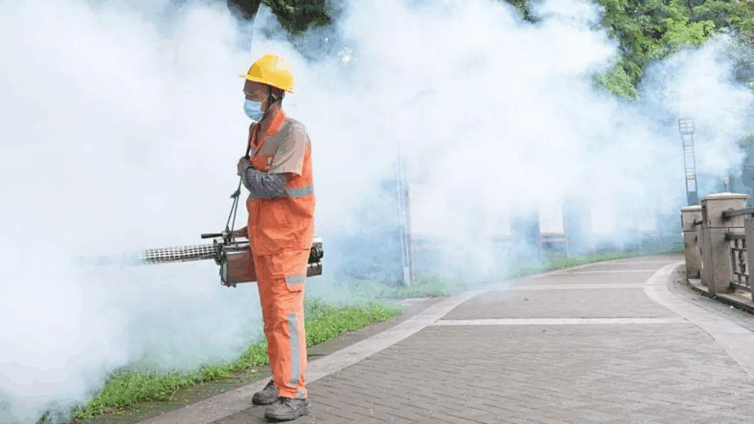
Authorities across Guangdong province have vowed to take "decisive and forceful measures" to stop the spread of the disease.
Those with symptoms, such as fever, joint pain or rashes, are being urged to visit the nearest hospital so they can be tested for the virus.
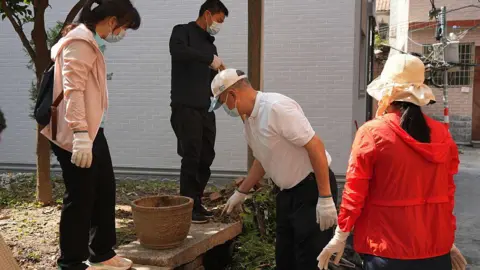
Authorities have instructed residents to remove stagnant water in their homes, such as in flowerpots, coffee machines or spare bottles - and warned of fines up to 10,000 yuan ($1,400) if they don't do this.
They are also releasing giant "elephant mosquitoes" that can devour smaller, chikungunya-spreading bugs; and an army of mosquito-eating fish.
Last week, officials in Foshan released 5,000 of these larvae-eating fish into the city's lakes. In parts of the city, they are even flying drones to detect sources of stagnant water.
Some neighbouring cities had ordered travellers from Foshan to undergo a 14-day home quarantine, but that has since been withdrawn.
Some people have compared these measures to those imposed during the pandemic, and questioned their necessity.
A user on Weibo wrote, "These feel so familiar... But are they really necessary?"
Another wrote: "What's the point of the quarantine? It's not as though an infected patient will then go around biting other people?"
China implemented severe restrictions during the pandemic, including forcing people into quarantine camps and sealing residential buildings and whole neighbourhoods on short notice for days or even weeks.
What is chikungunya?
Most people bitten by an infected mosquito will develop symptoms of chikungunya within three to seven days.
Apart from fever and joint pain, other symptoms include rash, headache, muscle pain and swollen joints.
In most cases, patients will feel better within a week. In severe cases however, the joint pain can last for months or even years.
Those at risk for more severe disease include newborns, the elderly, and people with underlying medical conditions, such as heart disease or diabetes.
There is no cure, but deaths from chikungunya are rare.
The virus was first identified in Tanzania in 1952. It then spread to other countries in sub-Saharan Africa and South East Asia.
To date, it has been reported in more than 110 countries.
The best way to prevent the virus from spreading is to reduce pools of stagnant water that allow the mosquitoes to breed, according to the World Health Organization.
Latest Stories
-
IGP’s Special Operations Team gets new leadership
1 minute -
FoSCeL to hold National World Sickle Cell Awareness Day 2026 event at KNUST
2 minutes -
Ghana earns nearly $12bn from petroleum sector since 2011
6 minutes -
Classic ‘I Told You So’ to be remade in 2027 for Ghana at 70
8 minutes -
533 admitted to Ghana Armed Forces College of Nursing and Midwifery
13 minutes -
Manhyia North MP, Akwasi Konadu questions speed of Damang mine tender process
16 minutes -
Accra hosts 24th EBID AGM as Finance Minister calls for bold action
19 minutes -
The Insurance Paradox: Of state capture, greedy monopolies, and the SIC reset
21 minutes -
AU welcomes US-Iran ceasefire, urges sustained dialogue for lasting peace
22 minutes -
Ato Forson praises EBID’s resilience and strategic impact at 24th AGM in Accra
23 minutes -
Ghana welcomes ECOWAS leaders to Accra for EBID high-level meeting
26 minutes -
Ato Forson urges ECOWAS states to honour EBID capital commitments
28 minutes -
Why Ghana’s Mobile Money security is a house of cards
31 minutes -
EBID records strong financial growth amid global economic uncertainty – Ato Forson
32 minutes -
PSG vs Liverpool: Date, time and everything you need to know about the Champions League quarterfinal
49 minutes