

Audio By Carbonatix
China has cut its annual economic growth target to 4.5%-5%, the lowest expansion goal since 1991, as it grapples with challenges both at home and abroad.
It is the first time the target has been lowered since it was cut to "around 5%" in 2023. A target was not set in 2020 due to pandemic-related uncertainties.
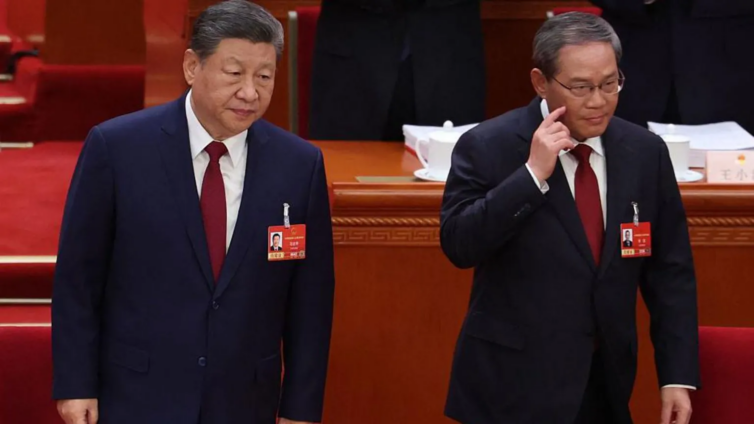
The details were released during China's biggest political gathering, known as the "two sessions", alongside some details of the 15th Five-Year Plan for the world's second-largest economy.
Beijing aims to reshape its economy as it faces issues such as weak consumption, an ongoing property crisis, global trade tensions, and an energy crunch due to the Iran war.
The event, which began on Wednesday and usually runs for at least a week, brings the country's leaders together for back-to-back meetings.
Premier Li Qiang told delegates that the Five-Year Plan will include investments in innovation, high-tech industries, scientific research and more efforts to boost household consumption.
His comments underline Beijing's concerns that weak domestic consumption makes the country too reliant on exports for growth, as well as highlighting its ambitions to upgrade the country's manufacturing industries.
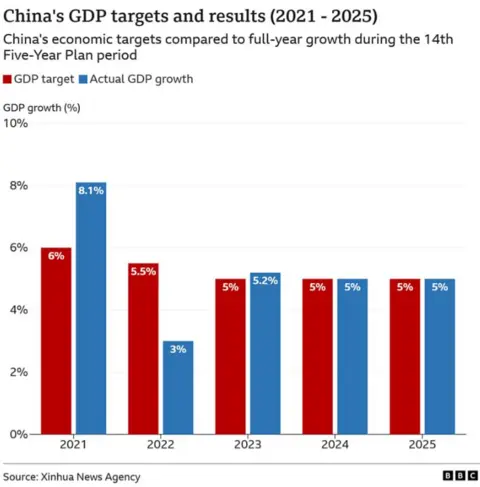
In January, official figures showed that China hit its 5% economic growth target for 2025 as a whole. But Beijing also said economic expansion had slowed to 4.5% in the last three months of the year, weighed down by weak domestic spending and a long-running property crisis.
More than two-thirds of China's provinces have scaled back their growth ambitions, either lowering the target figure or shifting language from aiming higher than a certain rate to targeting "around" that level.
While China hit its growth target last year, it should be taken with "a grain of salt", as other data suggests a weaker economic picture, said Georgetown University policy researcher Ning Leng.
Its people have been cautious about spending, while China's persistent real estate crisis have continued to weigh on its growth.
Manufacturing and exports have helped support China's economy, recording the world's biggest-ever trade surplus last year - the value of goods and services sold abroad compared to its imports - of $1.19tn (£890bn).
But China has become especially reliant on selling overseas to plug the gaps, which is a weakness the US can sense, Ning said.
US President Donald Trump's tariffs have put further pressure on China's export-reliant economy.
China has responded by pouring huge resources to redirect trade with other countries to ensure its products can be sold, sustaining its manufacturing sector, said Ning.
The US-Israel war with Iran means Beijing has now lost two key sources of cheap oil this year.
It also can no longer access Venezuelan oil after the US seized President Nicolás Maduro in January.
But Beijing has highlighted that it is far less dependent on fossil fuels as it has been transitioning to renewable energy for several years.
Latest Stories
-
Prudential Life settles GH¢100,000 medical bills under its PRUCares Valentine Experience Initiative
13 minutes -
Wa West Picnic: Peter Lanchene Toobu champions peace, health and unity in landmark celebration
24 minutes -
Dr Mensah Market flooded after downpour in Kumasi
32 minutes -
Armed men reportedly storm Adjen Kotoku Onion Market amid tensions
1 hour -
Tecco Mensah writes: Why football fans must look beyond statistics
2 hours -
Police recover stolen Honda CR-V in Kumasi within 48 hours
3 hours -
Apetorku Gbodzi 2026 Festival opens in Dagbamete with development focus
3 hours -
President Mahama arrives in Lyon to co-chair One Health Summit
3 hours -
Beverly View Plus Hotel draws crowds amid coastal Easter rush in Volta
3 hours -
Maiden Zongo Festival held in Wa amid calls to tackle drug abuse among the youth
4 hours -
FDA warns of fake HIV test kits on Ghanaian market
4 hours -
Africa urged to build resilient health systems as donor support tightens
4 hours -
Easter gesture: Ablakwa settles medical bills for 85 North Tongu constituents
6 hours -
Africa must harness its population strength—Titus-Glover
6 hours -
Visa-free access doesn’t mean unlimited stay – Lom Ahlijah
6 hours