

Audio By Carbonatix
China has approved the construction of what will be the world's largest hydropower dam, stoking concerns about the displacement of communities in Tibet and environmental impacts downstream in India and Bangladesh.
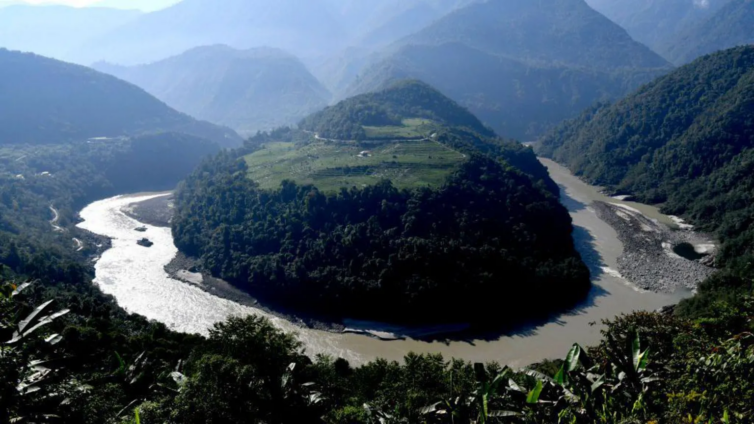
The dam, which will be located in the lower reaches of the Yarlung Tsangpo River, could generate three times more energy than the Three Gorges Dam, currently the world's largest hydropower plant.
Chinese state media has described the development as "a safe project that prioritises ecological protection", saying it will boost local prosperity and contribute to Beijing's climate neutrality goals.
Human rights groups and experts, however, have raised concerns about the development's knock-on effects.
Among them are fears that the construction of the dam - first announced in late 2020 - could displace local communities, as well as significantly alter the natural landscape and damage local ecosystems, which are among the richest and most diverse on the Tibetan Plateau.
China has built several dams in Tibetan areas - a contentious subject in a region tightly controlled by Beijing ever since it was annexed in the 1950s.
Activists have previously told the BBC that the dams are the latest example of Beijing's exploitation of Tibetans and their land. Mainly Buddhist Tibet has seen waves of crackdowns over the years, in which thousands are believed to have been killed.
Earlier this year, the Chinese government rounded up hundreds of Tibetans who had been protesting against another hydropower dam. It ended in arrests and beatings, with some people seriously injured, the BBC learned through sources and verified footage.
They had been opposing plans to build the Gangtuo dam and hydropower plant, which would displace several villages and submerge ancient monasteries with sacred relics. Bejing, however, said it had relocated and compensated locals, and moved the ancient murals to safety.
In the case of the Yarlung Tsangpo dam, Chinese authorities have stressed that the project would not have a major environmental impact - but they have not indicated how many people it would displace. The Three Gorges hydropower dam required the resettlement of 1.4 million people.
Reports indicate that the colossal development would require at least four 20 km-long tunnels to be drilled through the Namcha Barwa mountain, diverting the flow of the Yarlung Tsangpo, Tibet's longest river.
Experts and officials have also flagged concerns that the dam would empower China to control or divert the flow of the trans-border river, which flows south into India's Arunachal Pradesh and Assam states and onwards into Bangladesh.
A 2020 report published by the Lowy Institute, an Australian-based think tank, noted that "control over these rivers [in the Tibetan Plateau] effectively gives China a chokehold on India's economy".
Shortly after China announced its plans for the Yarlung Tsangpo dam project in 2020, a senior Indian government official told Reuters that India's government was exploring the development of a large hydropower dam and reservoir "to mitigate the adverse impact of the Chinese dam projects".
China's foreign ministry has previously responded to India's concerns around the proposed dam, saying in 2020 that China has a "legitimate right" to dam the river and has considered downstream impacts.
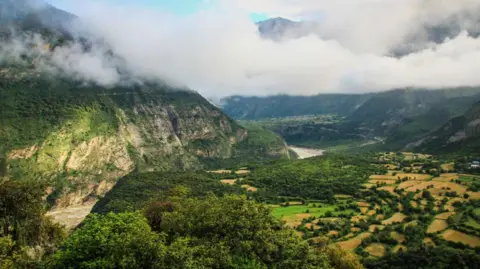
China has constructed multiple hydropower stations along the course of the Yarlung Tsangpo over the past decade in a bid to harness the river's power as a source of renewable energy. Flowing through the deepest canyon on Earth, one section of the river falls 2,000 metres within a short span of just 50 km, offering huge potential for generating hydropower.
The river's dramatic topography, however, also poses major engineering challenges - and this latest dam is by far China's largest and most ambitious to date.
The site of the development is located along an earthquake-prone tectonic plate boundary. Chinese researchers have also previously flagged concerns that such extensive excavation and construction in the steep and narrow gorge would increase the frequency of landslides.
"Earthquake-induced landslides and mud-rock flows are often uncontrollable and will also pose a huge threat to the project," a senior engineer from Sichuan provincial geological bureau said in 2022.
The project could cost as much as a trillion yuan ($127bn; £109.3bn) according to estimates by the Chongyi Water Resources bureau.
Latest Stories
-
Easter gesture: Ablakwa settles medical bills for 85 North Tongu constituents
1 hour -
Africa must harness its population strength—Titus-Glover
1 hour -
Visa-free access doesn’t mean unlimited stay – Lom Ahlijah
1 hour -
From Golgotha to Kwahu: The Easter Migration of the Faithful and the Faithless
3 hours -
How the Ghanaian onion traders’ standoff with Nigeria unfolded and threatened local supply
3 hours -
No compensation for demolished structures on 24-Hour Economy market lands — Gov’t to structure owners
3 hours -
Financial Institutions must back local enterprises to spur growth – Deputy Minority Whip
3 hours -
Photos: Gomoa Easter Carnival 2026 ends in a burst of colour and celebration
3 hours -
Gomoa Easter carnival ends in colour as fashion, music and celebrity appearances light up final night
3 hours -
Families pick Luv Fm Family Party to celebrate Easter Monday with music and more
4 hours -
IMANI flags procurement issues in Ghana Gas insurance switch
4 hours -
Kaneshie footbridge rehabilitation to take up to 9 months — AMA
4 hours -
AMA confirms trading will be banned on Kaneshie footbridge after rehabilitation
4 hours -
IMANI flags procurement concerns in state insurance placements
4 hours -
Mahama’s push for visa-free Africa reflects Nkrumah’s Pan-African vision – Rashid Tanko-Computer
5 hours