

Audio By Carbonatix
A draft law banning speech and dressing "detrimental to the spirit of Chinese people" has sparked debate in China.
If the law comes into force, people found guilty could be fined or jailed but the proposal does not yet spell out what constitutes a violation.
Social media users and legal experts have called for more clarity to avoid excessive enforcement.
China recently released a swathe of proposed changes to its public security laws - the first reforms in decades.
The clothing law has drawn immediate reaction from the public - with many online criticising it as excessive and absurd.
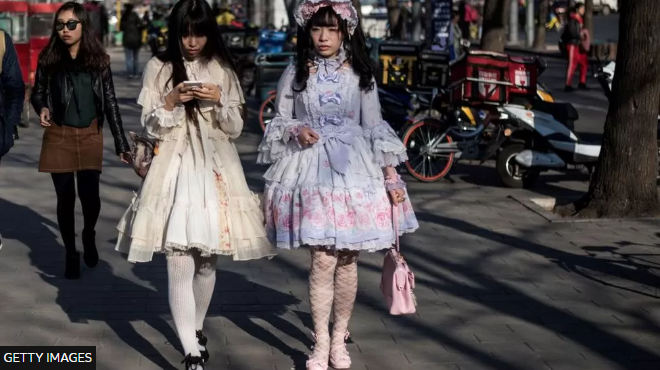
The contentious clauses suggest that people who wear or force others to wear clothing and symbols that "undermine the spirit or hurt the feelings of the Chinese nation" could be detained for up to 15 days and fined up to 5,000 yuan ($680; £550).
Those who create or disseminate articles or speech that do so could also face the same punishment.
The proposed legal changes also forbid "insulting, slandering or otherwise infringing upon the names of local heroes and martyrs" as well as vandalism of their memorial statues.
Online, people questioned how law enforcers could unilaterally determine when the nation's "feelings" are "hurt".
"Will wearing a suit and tie count? Marxism originated in the West. Would its presence in China also count as hurting national feelings," one user posted on Chinese Twitter-like platform Weibo.
Legal experts in the country have also criticised the law's vague phrasing, saying it could be open to abuse.
Zhao Hong, a law professor at the Chinese University of Political Science and Law said the lack of clarity could lead to an infringement of personal rights.
"What if the law enforcer, usually a police officer, has a personal interpretation of the hurt and initiates moral judgment of others beyond the scope of law," she wrote in an article published on Wednesday.
She cited one case that drew headlines in China last year where a kimono-clad woman was detained in the city of Suzhou and accused of "picking quarrels and provoking trouble" because she had worn the Japanese garment. The incident sparked outrage across Chinese social media.
There have been other examples of a crackdown.
In March this year, police detained a woman donning a replica of a Japanese military uniform at a night market.
And earlier last month, people who wore rainbow print clothing were denied entry to a concert by Taiwanese singer Chang Hui-mei in Beijing.
"To wear a kimono is to hurt the feelings of the Chinese nation, to eat Japanese food is to jeopardise its spirit? When did the feelings and spirit of the time-tested Chinese nation become so fragile?" wrote one popular social commentator online, who writes under the pen name Wang Wusi.
The draft law is but one example of how Chinese President Xi Jinping has sought to redefine what makes a model Chinese citizen since he rose to leadership in 2012.
In 2019, his Chinese Communist Party issued "morality guidelines" which include directives like being polite, traveling with a lower carbon footprint, and having "faith" in Mr Xi and the party.
Latest Stories
-
Trump seeks $152m to reopen notorious Alcatraz prison
2 hours -
Ex-Chelsea player Oscar retires with heart issue
2 hours -
CA Foundation drives constitutional literacy in Kpone Katamanso municipality
2 hours -
GPRTU to hold talks with Transport Ministry over rising fuel costs
2 hours -
CUTS International urges gov’t to halt sachet water price hike pending cost review
2 hours -
Chief Justice: Efficient Judiciary essential to reducing business costs
2 hours -
Bayern grabs 99th-minute winner to cap superb fightback
2 hours -
Ahmed Ibrahim urges Ghanaians to reflect Easter values in nation-building
2 hours -
ECG inefficiencies undermining power supply -Mahama outlines reforms
2 hours -
Lewandowski scores as Barca fight back to defeat Atletico
2 hours -
Lack of private sector consultation undermining economic growth – Jerry Ahmed Shaib
2 hours -
Real Madrid seven points adrift after Muriqi’s late Mallorca winner
2 hours -
Ghana must lead AfCFTA implementation by example – Trade Minister Ofosu-Adjare
2 hours -
Strong Judiciary key to business confidence – Chief Justice Baffoe-Bonnie
2 hours -
Mahama announces 60-Hectare irrigation project to boost tomato production
3 hours