

Audio By Carbonatix
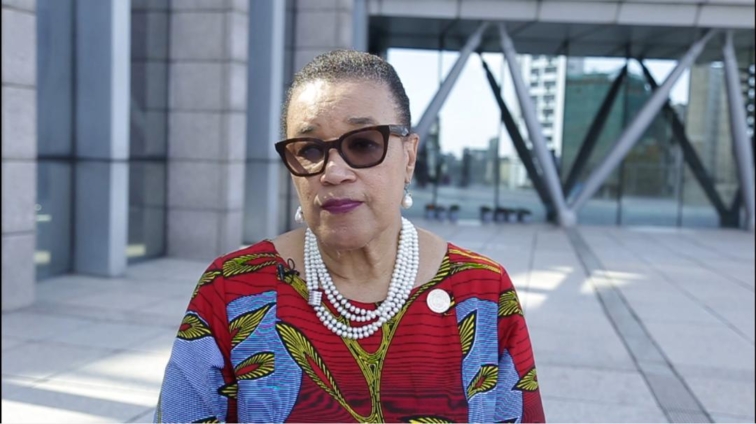
Commonwealth Secretary-General, Patricia Scotland stated that the global financial architecture lacks balance and fails to consider the vulnerability of many African economies in climate adaptation.
This remark was made on the sidelines of the 37th Ordinary Session of the African Union Summit, during a Presidential Dialogue on African Union Financial Institutions.
At the dialogue, attended by many African leaders, calls were made for reforms in the global financial architecture.
President Akufo-Addo, who currently serves as Champion of the African Union Financial Institutions, emphasized the need for a dramatic change in Africa’s development financing.
“We're all in agreement that the way the Global Financial architecture works at the moment it doesn't work in our favor and that there is a need to make some fundamental systemic reforms but making the reforms also requires that we also take some steps that will assist us to have a greater impact in the way in which our economies are financed,” he said while rallying the support of other African leaders and the international community to effect the changes required to achieve this objectives.
Commenting on the push for reforms in the financial architecture, Commonwealth Secretary-General, Patricia Scotland told JoyNews’ Blessed Sogah at the African Union Headquarters in Addis Ababa Ethiopia that similar to President Akufo-Addo’s sentiments the present setup of the global financial architecture “cannot be fair” adding that the commonwealth has been driving this for a long time.
"If you look back to 2018, the Commonwealth was saying that the financial architecture was simply not fit for purpose. If you look at what is happening in so many of our countries when it comes to climate change, and so the structure, the financial structure, which does not take into account that vulnerability, simply doesn't work. And as the president was saying this morning, it cannot be fair".
The Secretary-General stressed that the “Imbalance, unfairness has to be addressed." As part of their remedial proposal she said the Commonwealth came up with the universal vulnerability index adding that the days when people could say, we are all individually responsible for our fiscal health have gone.
“Covid didn't ask any of us before it struck our income. Climate change didn't ask any of us. None of us were the arbiters or the creators of the conflict in Ukraine and Russia, but we were affected in terms of our food security.
"So these exogenous shocks, which are beyond our control, have to be taken into account. So I agreed with absolutely everything that was said. It is absolutely in alignment with what we are doing on the vulnerability index and it's something that we will continue”.
Latest Stories
-
Mahama honoured at 2026 World Health Summit in Berlin for global health leadership
4 minutes -
Breast cancer is not a death sentence – Besease Kontire Obaapanin, Magmina Foundation lead awareness campaign
6 minutes -
EcoBank invests in digital education of 4 Garisson School to mark 40 years in Africa
37 minutes -
AGI urges investment in skills and raw materials to strengthen local manufacturing
40 minutes -
GPL 2026/27: ‘We have to rectify our mistakes’ – Boadu reacts to Aduana FC defeat
41 minutes -
No disability access, no building permit – KMA declares
41 minutes -
Asantehene to lead environmental restoration effort at Jimi Land Reclamation Site
45 minutes -
Poor Ghanaians are being jailed because they cannot afford justice – Crime Check Foundation
46 minutes -
No conflict in appointing Emelia Agbenyo as Deputy EC Chair – NDC
47 minutes -
87-year-old man jailed 20 years for defiling 9-year-old girl at Ofankor
50 minutes -
Sankofa Gold targets 70kg output after 9-month shutdown
52 minutes -
Tamale, Bolgatanga had just one Legal Aid lawyer between them – Kwesimintsim MP
59 minutes -
PAC orders eviction of former irrigation company MD from official residence
1 hour -
Legal Aid Commission has offices in only 45 of Ghana’s 261 districts, needs 180 more staff
1 hour -
Challenging Heights welcomes Ghana’s Tier 1 ranking, calls for more anti-trafficking funding
1 hour