

Audio By Carbonatix
Ghana is considered an area of concern for food insecurity for the first time since the inception of the Global Report on Food Crisis in 2016. According to the report, this is as a result of conflicts in neighbouring countries in the central Sahel district.
“New areas of concern due to conflicts in neighbouring countries were the northern borders of coastal countries, notably Ghana, Côte d’Ivoire, Benin and Togo, and the eastern border of Chad” the report emphasised.
These conflicts have led to the displacement of people across the region. The situation of displaced populations in West Africa and the Sahel has been increasingly challenging due to escalating conflict, deteriorating security and environmental factors, including climate change. The region faced a growing internal displacement crisis with 7.5 million Internally Displaced Persons in seven countries by mid-2023, about half a million more than by the end of 2022, mostly due to conflict and insecurity in the Central Sahel and the Lake Chad Basin according to the United Nations High Commissioner for Refugees.
Ghana alone had around 7,000 refugees and nearly 16,000 asylum-seekers in by the end of 2023. The development led the West African nation to seek emergency external aid to assist them in providing for these refugees.
“Refugees in Ghana were selected for inclusion in the GRFC 2024 for the first time, as the country requested external aid to assist these populations in 2023,” the report stated.
These displaced persons are primarily from Côte d’Ivoire and Togo, which are increasingly affected by the Central Sahel crisis, these refugees have experienced severe livelihood losses, which have limited their access to income and intensified food access constraints.
Their situation was exacerbated by high food inflation in Ghana which, despite declining from 61 percent in January 2023, remained at 28.7 percent by December 2023.
The report indicated however that, there is a notable absence of acute food insecurity data on these displaced populations.
Focus West Africa and the Sahel
44 .3 million people or 11% of the analyzed population in West Africa and the Sahel faced high levels of acute food insecurity in 2023 in 14 countries including Sierra Leone, Benin, Côte Ivoire, Mali, Guinea, Senegal, Togo, Cameroon, Liberia, Chad, Niger, Nigeria, Mauritania, and Burkina Faso.
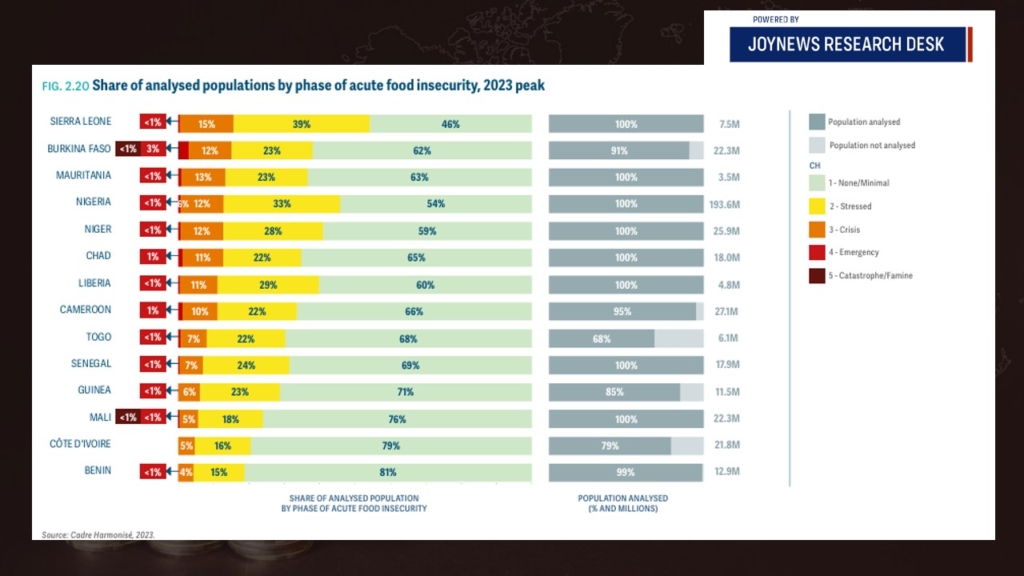
There are 9 .7 million forcibly displaced people in 13 food-crisis countries in 2023 – consisting of 7 .5 million Internally Displaced Persons and 2 .2 million refugees and asylum-seekers.
Latest Stories
-
Ato Forson praises EBID’s resilience and strategic impact at 24th AGM in Accra
39 seconds -
Ghana welcomes ECOWAS leaders to Accra for EBID high-level meeting
3 minutes -
Ato Forson urges ECOWAS states to honour EBID capital commitments
6 minutes -
Why Ghana’s Mobile Money security is a house of cards
9 minutes -
EBID records strong financial growth amid global economic uncertainty – Ato Forson
10 minutes -
PSG vs Liverpool: Date, time and everything you need to know about the Champions League quarterfinal
26 minutes -
Education Minister orders probe into illegal SHS online class fees
28 minutes -
Barcelona vs Atlético Madrid: Date, time and everything you need to know about the Champions League quarterfinal
32 minutes -
Monthly Indicator of Economic Growth slows to 7.5% in January 2026
34 minutes -
The Reputation Bomb: Why fraud in the digital age destroys more than freedom
35 minutes -
Mahama nominates 5 to Ghana’s Fiscal Council to strengthen economic oversight
50 minutes -
Enterprise Insurance crowns first “Insure Na Chilli” winner: Jonathan Syme set for ultimate football experience
52 minutes -
Bear with us over temporary outages as ECG begins transformer upgrade programme – Energy Ministry
1 hour -
President Mahama has not broken promise on anti-LGBTQ bill — Akwatia MP
2 hours -
Education Minister promises swift fix to Aburi Girls’ SHS water crisis
2 hours