


Audio By Carbonatix
The Environmental Protection Authority (EPA) and the Ghana Meteorological Agency (GMeT) are calling for a major expansion of weather monitoring stations across the country to strengthen Ghana’s early warning and climate prediction systems.
Both institutions say the lack of adequate infrastructure and limited access to localized climate data continue to undermine accurate forecasting and national preparedness in a fast-changing climate.
The call was made during the first meeting of the Intergovernmental Panel on Climate Change (IPCC) Working Group, held on the sidelines of the COP30 summit in Belém, Brazil.
EPA Chief Executive and Vice-Chair of IPCC Working Group I, Prof. Nana Ama Browne Klutse, expressed concern over the “serious inadequacy” of local climate monitoring stations.
She acknowledged that while the IPCC’s Interactive Atlas has significantly improved access to global climate data, the absence of localized measurements remains a major challenge for Ghana.
Created in 1988 by the World Meteorological Organization (WMO) and the United Nations Environment Programme (UNEP), the IPCC provides scientific evidence to guide global climate policy. To enhance access to climate information, the Panel developed the Interactive Atlas, a digital tool that visualizes trends, projections, and climate impacts across regions.
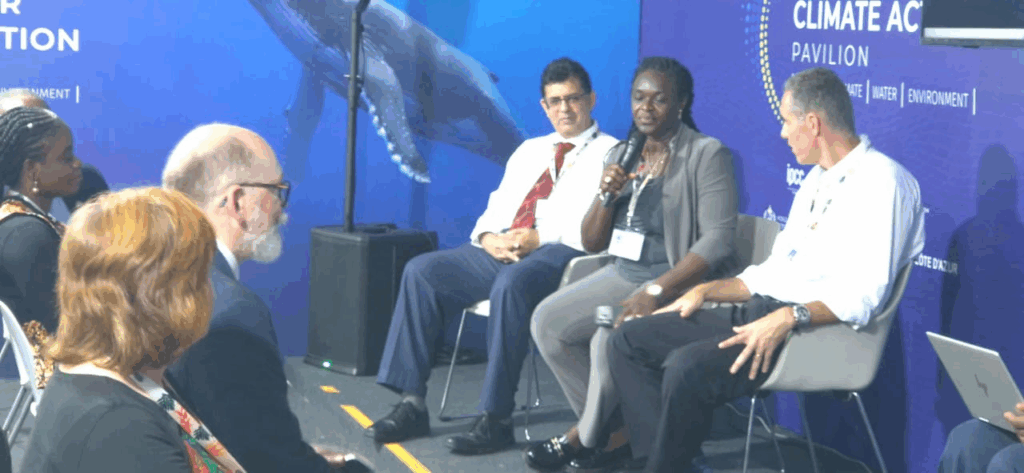
According to Prof. Klutse, “The Interactive Atlas has provided motivation for the Ghana Meteorological Agency to develop a Climate Atlas for Ghana. Beyond that, every Ghanaian can access data from the global atlas for scientific reports and publications.”
She added that the atlas, developed as part of the IPCC’s Sixth Assessment Report, provides valuable datasets that can be downscaled to the African, West African, and even Ghanaian levels.
“One can extract data on rainfall, temperature, humidity both observed and projected, which are crucial for planning and decision-making,” she explained.
Despite these advances, Prof. Klutse stressed that the absence of local data networks continues to limit forecasting accuracy.
“Ideally, we should have meteorological stations recording weather observations at intervals of about two kilometers. In Ghana, these are spaced much farther apart, creating data gaps that affect weather reporting and climate projections,” she said.

The Director-General of the Ghana Meteorological Agency, Dr. Eric Asumah, echoed the concern, emphasizing the need for more ground-level observation stations.
“It’s good to use global and satellite data, but we also need ground truth, real local data to validate what satellites show,” he said.
Dr. Asumah added that limited ground data makes localized forecasting difficult. “People in Ghana want location-specific forecasts. They want to know if it will rain in Osu, Adenta, or Madina not just ‘Accra and its environs.’ To do that, we need more automatic weather stations and equipment, ideally at five-kilometer intervals across the country,” he said.
At COP30, the IPCC is emphasizing a global shift from knowledge to action, urging governments to move beyond awareness toward concrete implementation of climate adaptation, finance, and resilience strategies.

For the first time, the IPCC’s upcoming Seventh Assessment Report will include dedicated chapters on adaptation finance and responses to loss and damage a move that underscores the growing urgency to support vulnerable countries.
The Panel maintains that keeping global warming within 1.5 °C is still technically possible, but only with “immediate, deep, and sustained reductions in CO₂ emissions,” alongside large-scale carbon removal.
By placing greater emphasis on adaptation, equity, and sustainable development goals (SDGs), the IPCC is aligning science with policy and implementation a direction that resonates strongly with Ghana’s call for improved early warning systems and data-driven climate resilience.
Latest Stories
-
IMANI demands review of SIGA directive steering SOEs toward SIC placements
1 minute -
Climate change and pollution threaten livelihoods of White Volta fishermen
9 minutes -
First Atlantic Bank targets regional growth and digital expansion in 2026 outlook
12 minutes -
Bond market: Turnover surges 559.42% to GH¢2.49bn
16 minutes -
Dagomba line residents begin rebuilding after Easter Monday inferno
16 minutes -
ECG substation upgrade exercise: parts of Accra to experience power outages
20 minutes -
IMANI petitions Mahama over alleged procurement breaches in state insurance placements
25 minutes -
First Atlantic Bank posts strong 2025 results as profit surges 30.5%
28 minutes -
Maguire signs contract extension with Man United
30 minutes -
The WTO is debating trade: The world runs on investment
57 minutes -
Minority questions gov’t purchase of fuel-powered buses, pushes for electric alternative
59 minutes -
GFA Executive Council to decide on new Black Stars coach ahead of 2026 World Cup
60 minutes -
One injured as fire destroys 14-bedroom house at Kwame Danso
1 hour -
GACL struggling despite recording profit, levy needed for expansion – Agalga
1 hour -
Kwahu Business Forum: Ghana Sports Fund calls for stronger corporate backing for sports dev’t
1 hour