

Audio By Carbonatix
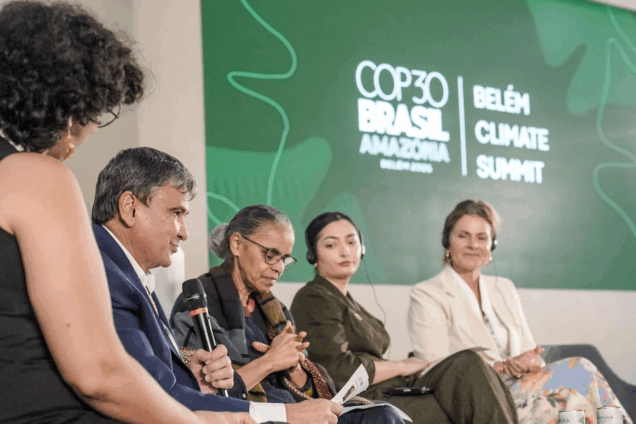
The opening day of COP30 began with a message of solidarity for the world’s most vulnerable communities as global leaders gathered for the High-Level Ministerial Event “Combating Hunger and Poverty for Climate Justice.”
The event focused on the Belém Declaration on Hunger, Poverty, and People-Centred Climate Action, first launched during the Belém Climate Summit on November 7.
The declaration, now endorsed by 44 countries, stresses that the impacts of climate change are already hitting the poorest populations the hardest.
It urges countries to keep investing in emission reduction (mitigation) while giving stronger attention to adaptation—especially programs that protect people directly, such as social safety nets, crop insurance, and livelihood support.
The declaration also highlights the need for climate finance to target projects that create jobs and sustainable opportunities for family farmers, traditional communities, and forest peoples.
During the COP30 opening ceremony, Brazil’s President Luiz Inácio Lula da Silva warned that global warming could reverse decades of development progress by driving millions into hunger and poverty.
He reaffirmed Brazil’s commitment to link climate action with policies that reduce inequality and improve people’s lives.
The event was organised by Brazil’s Ministry of Social Development and Assistance, Family and Hunger Eradication, in partnership with the Global Alliance against Hunger and Poverty.
Brazil’s Minister of Social Development, Wellington Dias, said the climate crisis is not only about the environment, but also about humanity and fairness.
“Today, hunger and poverty are markers of climate injustice, and this Declaration represents a historic step forward,” he said.
“There can be no food security or climate resilience without those who care for the land, the water, the seeds, and production. Family farming supplies most of our food and accounts for a significant share of global agricultural diversity and value.”
Brazil’s Minister of the Environment and Climate Change, Marina Silva, emphasised the need to protect small farmers and vulnerable communities.
“Creating a new cycle of prosperity means not leaving anyone behind,” she said. “It requires a willingness to open new markets and to redirect financial flows toward developing countries.”
Key Goals of the Declaration
The Belém Declaration outlines three main commitments: strengthening social protection as the foundation for resilience, supporting small-scale food producers and family farmers and promoting a just transition for people living in forests and fragile ecosystems.
It also calls for closer international cooperation and better climate finance coordination, with a progress review planned for 2030.
According to Wellington, the Declaration sends a strong signal to the world’s financial systems.
“Climate financing needs to reach people, territories, family agriculture, and the economy of sociobiodiversity,” he said.
“The Declaration calls on its signatory countries to take action — and on international actors, including United Nations agencies, climate funds, and multilateral banks, to support implementation and monitor progress and results.”
Germany’s Minister for Economic Cooperation and Development, Reem Alabali-Radovan, reminded delegates that while climate change affects everyone, the poorest suffer the most.
“The most severe consequences fall upon those who have contributed the least to the problem, yet still strive to live free from hunger and poverty,” she said.
“This stark imbalance reveals a fundamental truth: international climate protection is not only about safeguarding the environment, but also about justice, equality, and human dignity.”
Latest Stories
-
Trump ‘does not care’ if Iran play at World Cup
38 minutes -
Burna Boy’s associate, Rahman Jago confirms singer converted to Islam
43 minutes -
Amazon says drones damaged three facilities in UAE and Bahrain
54 minutes -
NDC’s Baba Jamal wins Ayawaso East by-election
1 hour -
Integrity over individuals: Economic Fighters League maintains vote-buying stance in Ayawaso East
1 hour -
How to follow European football
2 hours -
A new dawn: Formula One charges into an unpredictable 2026
2 hours -
Trump threatens to halt trade with Spain over military base access
2 hours -
Trump says US Navy will protect ships in Middle East ‘if necessary’
2 hours -
Ghana shines in GSMA DNSI and DPRI 2025 report due to E-Levy repeal and tech neutrality
3 hours -
NJA College of Education inducts 379 students amidst infrastructure gains and calls for professional discipline
3 hours -
GJA President, executives join Sammy Gyamfi to observe One-Week memorial of father-in-law
3 hours -
FDA bans mixed alcoholic energy drinks: VAST-Ghana demands ‘Name and Shame’ list for public safety
3 hours -
Police probe deaths of teacher and farmer in Assin Fosu
4 hours -
Gov’t reaffirms commitment to safeguard Ghana’s energy supply amid Middle East crisis
4 hours