


Audio By Carbonatix
Households in Birmingham have been banned from mixing in new lockdown measures announced following a spike in coronavirus cases.
The city now has the second highest rate of Covid-19 infection in England, behind Bolton.The measures also cover neighbouring Sandwell and Solihull, affecting more than 1.6 million people in total.
The restrictions will begin on Tuesday, it was announced at a regional meeting of council leaders.
West Midlands mayor Andy Street said: "The areas will now be escalated to an area of national intervention, with a ban on people socialising with people outside their own household.
"The restrictions were not about "prevention of schools, workplaces, transport" but about mixing of households, he said.
The rate of coronavirus infection in Birmingham on 7 September was 85.4 per 100,000 people, up from 32 in the previous week.Mr Street said residents were being advised to avoid household mixing before Tuesday's rules come into effect as it had been identified "as one of the drivers of transmission".
"This decision has been made in collaboration with local leaders who are considering additional local measures to tackle the increase in the number of cases," Mr Street said.A government announcement on further measures, potentially affecting other areas of the country, would be made later, he added.
The government's latest R number is between 1 and 1.2 which means the epidemic is growing again.
A study of thousands of people in England found cases doubling every seven to eight days, with a marked rise in the north and among young people.Merseyside has been added to Public Health England's list as an "area of concern" after a rise in coronavirus cases, regional mayor Steve Rotheram has said.
Analysis by Rob England, BBC England data unit
Birmingham has the second highest coronavirus infection rate in England, standing at 85.4 cases per 100,000 people as of the week to 7 September.
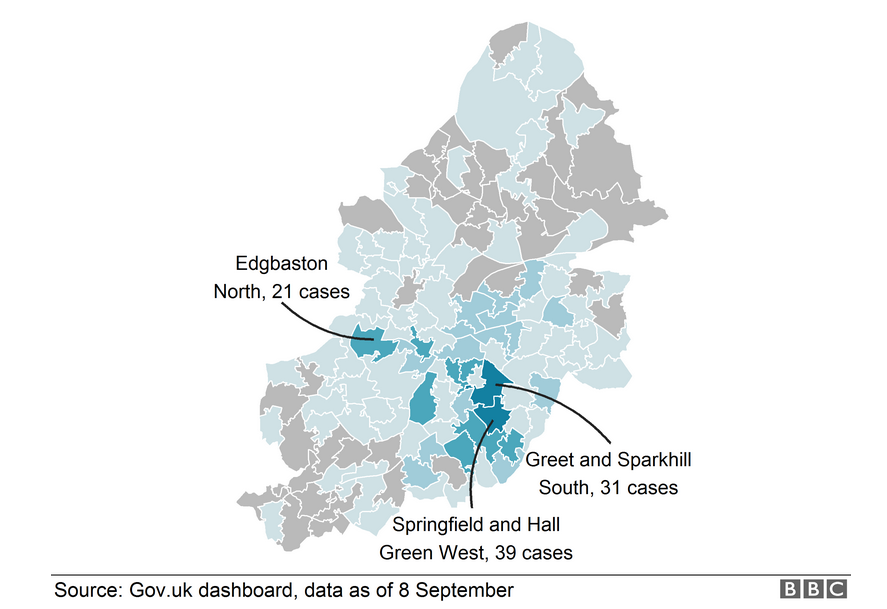
The week before, it recorded a rate of 32 per 100,000.According to the government's more local data, Birmingham is home to six of the top 10 neighbourhoods with the highest number of positive cases in England.
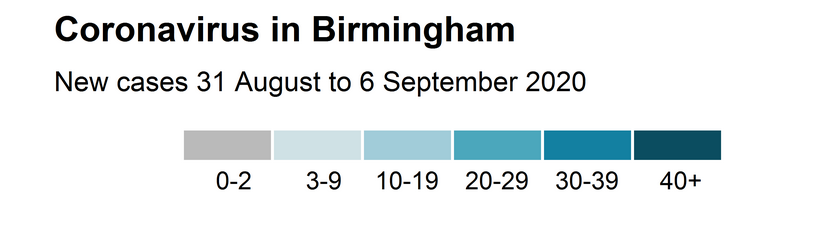
Many of these areas saw spikes in the latest week of available data, compared to the week previously - reflecting the overall trend for the city.Springfield and Hall Green West, in the south east of the city, had the most cases with 39, a sharp rise on the previous week, when only 11 were recorded.
Wake Green East and Moseley Bog, just south of Springfield, went from recording between 0-2 cases for the past four weeks, to 29 most recently.
Leader of Birmingham City Council Ian Ward said the virus has not "weakened", calling it "relentless".
With 892 cases in the latest seven-day period, he said there had been "an increase of hospital admissions with Covid-19 and an increase in cases in care homes".
"I understand that it may be frustrating that you can go down the pub but not see your family, but the data we have shows the infection rate has risen mainly due to social interactions, particularly in private household gatherings," Mr Ward added.Mr Ward said people can still go out to shops and restaurants but not with other households.
He added: "If a venue doesn't look safe and you're not asked for your contact details, take your business elsewhere."
'A critical moment' by Rob Mayor, BBC WM political reporter
The new restrictions are designed to stop the transmission of the virus in people's homes which is thought to be behind the increase in cases across the West Midlands conurbation.
We'll know if it's working if the infection rate starts to drop over the next few weeks.
Health officials have described this as a critical moment in the battle against the virus and hospitals are again starting to see small numbers of seriously ill Covid-19 patients.
Police will move from an approach of engagement to enforcement of the rules, but with more than 1.6 million people now covered by these restrictions, there will have to be an element of trust that they can be followed.
Chief Constable of West Midlands Police Dave Thompson said he understood it had been a "tough time", but urged people to act responsibly.
Student Abby Stapleton, 19 and from Coventry, is due to move into halls of residence at Birmingham City University at the weekend and said the rise in cases had made her nervous.
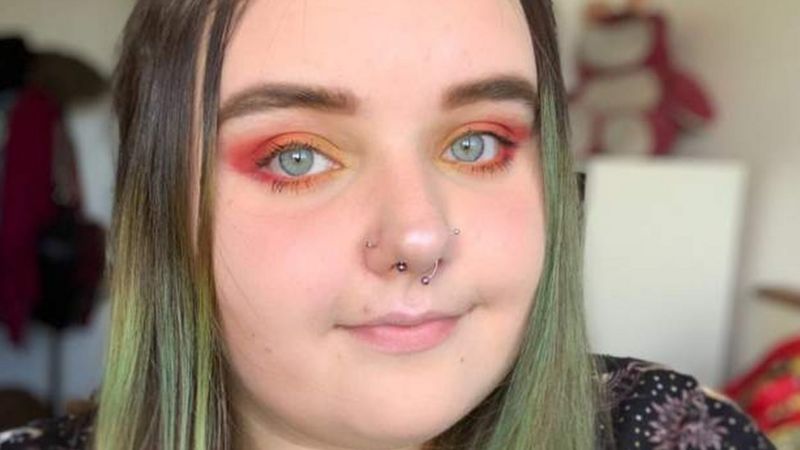
"For the minute it is not too strict, I'm still able to move around for things that are necessities, but I'm nervous over catching it, it is a lot higher than Coventry," she said.
Latest Stories
-
After more than 14 years at Atletico Madrid, what next for Simeone?
2 hours -
Conquering the World – Building on the foundations laid by Otto Addo
2 hours -
[Watch Live] Kwaw Kese, Kwami Eugene, Tinny, Keche and others thrill fans at Gomoa Easter Carnival
2 hours -
Gomoa Easter Carnival: Experts charge indigenes to own festival to ensure sustainability
3 hours -
Gomoa Easter Carnival: Edem Agbana and Joy Prime fans shower festival with huge endorsements
5 hours -
Gov’t to overhaul free zones into manufacturing hubs for local production – Trade Minister
6 hours -
Ghana losing $2.5bn yearly from raw exports – Trade Minister reveals
6 hours -
Mahama unveils plans for Kwahu Airport, Convention Centre
6 hours -
World’s oldest leader, Paul Biya to get a deputy for first time in 43-year rule
6 hours -
Search for missing US airman continues as Trump threatens ‘hell’ if Iran does not reach deal
6 hours -
US says it has arrested relatives of late Iranian general Qasem Soleimani
6 hours -
La Liga: Real Madrid’s title hopes hang in the balance as Mallorca snatch stoppage-time winner
6 hours -
FA Cup: Haaland hat-trick powers Man City past Liverpool into semi-finals
7 hours -
FA Cup: Chelsea thrash Port Vale to reach Wembley semi-final
7 hours -
Gov’t to boost tourism in coastal communities through infrastructure, sanitation – Vice President
7 hours