


Audio By Carbonatix
The number of coronavirus cases in Italy has surged to 400, as other countries battle to try to contain the spread of the outbreak.The rise in Italy, the main focus of infection in Europe, represents a 25% surge in 24 hours.Several European countries announced new cases traced to Italy.Also on Wednesday, the World Health Organization said that for the first time coronavirus was spreading faster outside China, where it originated.Globally, more than 80,000 people in 34 countries have been infected with the new coronavirus, which emerged in December. The vast majority remain in China.Covid-19, the respiratory disease caused by the virus, has killed more than 2,700 people so far.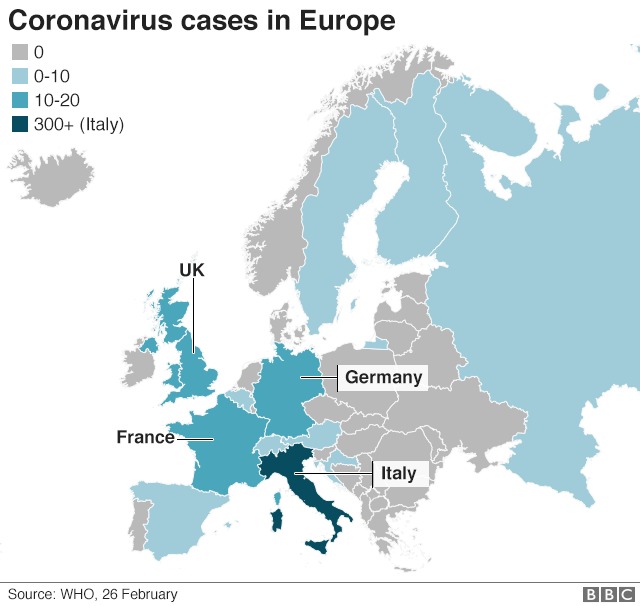 What is the latest in Italy?Late on Wednesday, authorities reported a total of 400 cases - a rise of 80 from Tuesday night.The worst-affected areas are in the industrial north of the country - Lombardy, the region around Milan, and Veneto near Venice. The outbreak has killed 12 people in the country so far.Government officials have sought to reassure the public, and insisted steps were being taken to prevent the spread of the disease. Schools, universities and cinemas have been closed and several public events banned.There are fears that the outbreak may tip the country into recession. The BBC's Mark Lowen in Milan says fear is the reason for the city's empty cafes and many hotel cancellations.Events in other countries have been cancelled as a result of the outbreak.Ireland postponed Six Nations rugby matches with Italy in Dublin that were to be held on 7 and 8 March.In the French city of Nice, near the Italian border, a festival parade and fireworks display due at the weekend was cancelled.EU Health Commissioner Stella Kyriakides told reporters after meeting the Italian health minister in Rome: "This is a situation of concern, but we must not give in to panic."There are still many unknowns about this virus and in particular its origin and how it spreads."
What is the latest in Italy?Late on Wednesday, authorities reported a total of 400 cases - a rise of 80 from Tuesday night.The worst-affected areas are in the industrial north of the country - Lombardy, the region around Milan, and Veneto near Venice. The outbreak has killed 12 people in the country so far.Government officials have sought to reassure the public, and insisted steps were being taken to prevent the spread of the disease. Schools, universities and cinemas have been closed and several public events banned.There are fears that the outbreak may tip the country into recession. The BBC's Mark Lowen in Milan says fear is the reason for the city's empty cafes and many hotel cancellations.Events in other countries have been cancelled as a result of the outbreak.Ireland postponed Six Nations rugby matches with Italy in Dublin that were to be held on 7 and 8 March.In the French city of Nice, near the Italian border, a festival parade and fireworks display due at the weekend was cancelled.EU Health Commissioner Stella Kyriakides told reporters after meeting the Italian health minister in Rome: "This is a situation of concern, but we must not give in to panic."There are still many unknowns about this virus and in particular its origin and how it spreads."What about the rest of Europe and beyond?
On Wednesday, Austria, Croatia, Greece, Norway and Switzerland reported their first coronavirus cases. They involved people who had been to Italy.More cases were also announced in Spain, France and Germany.Algeria and Brazil also reported their first cases. In both, those infected had travelled to Italy.DISCLAIMER: The Views, Comments, Opinions, Contributions and Statements made by Readers and Contributors on this platform do not necessarily represent the views or policy of Multimedia Group Limited.
DISCLAIMER: The Views, Comments, Opinions, Contributions and Statements made by Readers and Contributors on this platform do not necessarily represent the views or policy of Multimedia Group Limited.
Latest Stories
-
Prudential Life settles GH¢100,000 medical bills under its PRUCares Valentine Experience Initiative
5 hours -
Wa West Picnic: Peter Lanchene Toobu champions peace, health and unity in landmark celebration
5 hours -
Dr Mensah Market flooded after downpour in Kumasi
5 hours -
Armed men reportedly storm Adjen Kotoku Onion Market amid tensions
6 hours -
Tecco Mensah writes: Why football fans must look beyond statistics
7 hours -
Police recover stolen Honda CR-V in Kumasi within 48 hours
7 hours -
Apetorku Gbodzi 2026 Festival opens in Dagbamete with development focus
8 hours -
President Mahama arrives in Lyon to co-chair One Health Summit
8 hours -
Beverly View Plus Hotel draws crowds amid coastal Easter rush in Volta
8 hours -
Maiden Zongo Festival held in Wa amid calls to tackle drug abuse among the youth
8 hours -
FDA warns of fake HIV test kits on Ghanaian market
9 hours -
Africa urged to build resilient health systems as donor support tightens
9 hours -
Easter gesture: Ablakwa settles medical bills for 85 North Tongu constituents
11 hours -
Africa must harness its population strength—Titus-Glover
11 hours -
Visa-free access doesn’t mean unlimited stay – Lom Ahlijah
11 hours