

Audio By Carbonatix
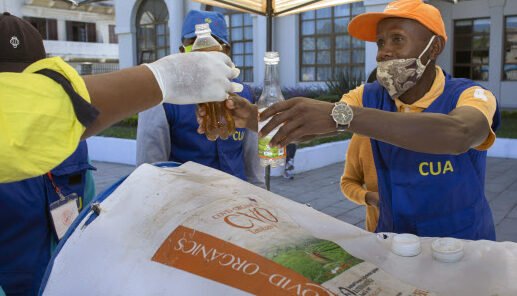
A few days after its official launch, President Andry Rajoelina’s Covid-Organics (CVO) remedy is being handed out free of charge in the country’s streets and schools despite questions surrounding the “miracle remedy”.
At noon on 24 April, a pick-up truck being used as part of Madagascar’s coronavirus response enters the courtyard of Jean Joseph Rabearivelo secondary school, located in the heart of Antananarivo. At the back of the vehicle, two soldiers brandishing assault rifles guard the precious cargo: a white barrel containing 250 litres of the COVID-19 “remedy”.
Men in combat fatigues pour the liquid into buckets. The students, dressed in blue shirts, are already lined up in several rows: one by one, they fill up their empty bottle, imitating the procedure the headmaster showed them earlier.
On 20 April, President Andry Rajoelina himself launched Covid-Organics (CVO), an “improved traditional remedy with curative and preventive properties” against the coronavirus, as he described it.
Officially developed by the Malagasy Institute of Applied Research (IMRA), the remedy is an infusion derived from artemisia and other plants which remain secret. It comes in the form of a liquid or infusion, with a defined dosage.
Distributed for free
After just about a week, CVO is already having a visible social impact.
Authorities are giving it out in schools ever since their staggered reopening began on 22 April as well as in the streets of Antananarivo, Fianarantsoa and Toamasina, the cities hardest hit by the pandemic.
Throughout the capital, the liquid flows freely and at no cost. Malagasy citizens wait in line to serve themselves directly from containers set up by authorities, leading to scenes that remind some, with humour, of the druid Panoramix, a character from the Asterix comics, handing out his magic potion.
According to Sahondra, a street vendor, “this remedy is very effective,” while another seller said that “we’re proud to be Malagasy and to have developed CVO.” Supermarkets stocking the famous liquid have no problem selling the product to more affluent customers.
The remedy’s discovery has also pushed authorities to ease lockdown restrictions.
In theory, people are free to leave their homes until 1 p.m. only. However, in reality, life in Antananarivo has practically gone back to normal, especially in working-class neighbourhoods. Countless sellers often wait until the police drive them out before packing up and leaving. Customers squeeze into small cafés until night-time and it’s not hard to find a way into illegal bars.
Partial lockdown
The easing of lockdown restrictions has helped revive a significant portion of the economy.
Nevertheless, from a health perspective, some are concerned that restrictions are being loosened too early. “We acted quickly enough to get cases imported from foreign countries under control before the borders closed. We also performed very extensive testing”, said Lova Ranoromaro, the president’s chief of staff.
She added that the partial lockdown is being implemented in tandem with mandatory health measures such as wearing a mask, respecting social distancing rules and distributing CVO to protect the population. Since 27 April, law enforcement officials can punish individuals who go out without a mask with 15 minutes of community service.
However, Rajoelina’s “remedy” is being met with scepticism by some, while others just don’t buy it at all. “We are obviously in favour of African medicine effective against the coronavirus, but there’s no evidence that the research conducted on CVO was exhaustive”, said Faraniaina Ramarosaona, coordinator of Rohy, a civil society movement.
It’s true that the IMRA did not publish any information describing the protocols. What’s more, the curative efficacy of CVO seems to have been observed in just two people before it was announced as a remedy, according to President Rajoelina’s statements.
“We offered it to more than 20 patients and, since the launch, others have asked for it”, added Ranoromaro today, assuring that “their health condition is improving”. As of 26 April, the country had 53 active cases, no deaths and 71 recovered patients. It remains to be seen if the effectiveness of this “remedy” will be confirmed in the coming weeks.
Latest Stories
-
Keep the money in Ghana – Gov’t enforces local cargo insurance
41 minutes -
US Army veteran charged with leaking classified information to journalist
59 minutes -
Dr. Dre joins Forbes billionaires list as second-richest hip-hop artist with $1 billion fortune
1 hour -
Trump administration cannot nix legal status of 5,000 Ethiopians, US judge rules
1 hour -
Libya announces new oil and gas discoveries with three major energy companies
1 hour -
Oil rises as investors remain wary US-Iran ceasefire will open supply flow
1 hour -
Police arrest suspect over church threat video
3 hours -
Eight appear in court as police intensify crackdown on illicit drugs in Tamale
4 hours -
Motorist remanded in custody for hitting four-year-old girl
4 hours -
Mobile money vendor robbed at Ziope
4 hours -
Benin’s Finance Minister Wadagni seeks his own mandate in election
4 hours -
GNFS retrieves body of unidentified man from Asylum Down drain
4 hours -
CAF’s Motsepe to visit both Senegal and Morocco amid AFCON fallout
5 hours -
Edmond Boateng takes up secretary role at Honorary Consular Corps of Ghana
5 hours -
Armed men kill 20 and abduct others in northwestern Nigeria villages
5 hours