

Audio By Carbonatix
Thousands of flights have been cancelled worldwide as airlines struggle to cope with a slump in demand caused by the coronavirus outbreak.
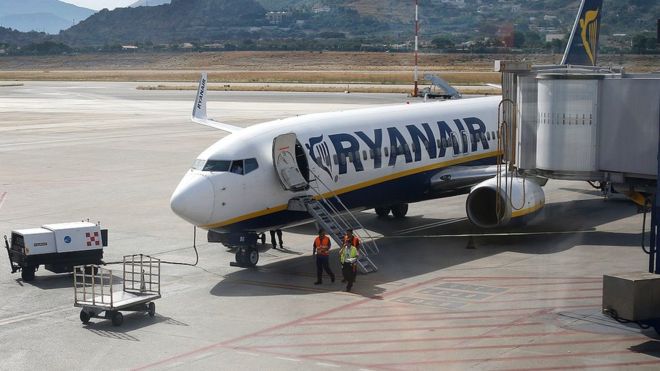
Ryanair will stop services to and from Italy from Friday until 8 April, with BA scrapping its routes until 4 April as the country goes into lockdown.
EasyJet has cancelled all of its flights to and from Italy between 10 March and 3 April.
It has said it will operate "rescue flights" in the coming days.
Norwegian Air has also said it will cut about 3,000 flights in the next three months, about 15% of its capacity.
It also plans to temporarily lay off "a significant share" of its workforce.
"We have initiated formal consultations with our unions regarding temporary layoffs for flying crew members as well as employees on the ground and in the offices," said chief executive Jacob Schram.
While the restrictions on travel to Italy and China have meant some services have stopped completely, there has also been a general fall in demand as holiday-makers put their plans on hold and firms instruct staff to limit travel.

Which airlines have cancelled flights?
- British Airways: All of its Italy routes are cancelled until 4 April
- EasyJet: In the process of cancelling all of its Italy flights between 10 March and 3 April
- Ryanair: Scrapped all Italy flights from this Friday until 8 April
- Norwegian Air: Will cut 15% of its global schedule for a month
- American Airlines: Cutting 7.5% of its domestic flights in April
How do I get home?

Behind the scenes, the government is talking to airlines to make sure that there are enough routes operating from Italy so that British nationals who need to get home can do so.
So Ryanair is not suspending all of its Italy flights until this Friday. Anyone with a flight after then can rebook to an earlier flight this week.
A handful of EasyJet "rescue flights" in the coming days will also be designed to get people back to Britain, and to allow essential travel to Italy.
So far there is no talk of an official repatriation programme, but a co-ordinated response is under way to try and ensure that no-one is left stranded.
If you're concerned about your flight, the usual advice applies: check with your airline.
Ghost flights
Some airlines had continued to operate near-empty flights in order to protect their rights to take-off and landing slots. Under EU "use it or lose it" rules they were required to run services on busy routes or forfeit them to other operators.
However, European Commission President Ursula Von der Leyen has announced that airlines will be allowed to keep their slots even if they are not flying routes.
"This is a temporary measure, and this temporary measure helps both our industry, but it also helps our environment," she said.
"It will relieve the pressure on the aviation industry and in particular, on smaller airline companies. But it will also decrease emissions by avoiding so-called ghost flights."
Survival threat
Earlier on Tuesday, Korean Air warned the coronavirus outbreak could threaten its survival.
In a memo sent to employees, Korean Air's president Woo Kee-hong said the airline could not predict how long the crisis would last.
"But if the situation continues for a longer period, we may reach the threshold where we cannot guarantee the company's survival," he said in the memo, which was seen by Reuters news agency.
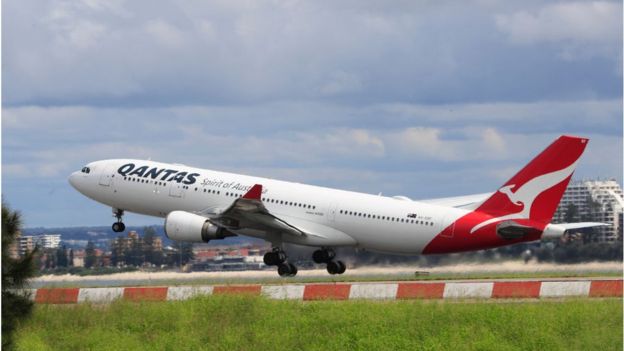
Australia's Qantas airline has said it will reduce international flights by nearly 25% as it sees demand fall from passengers worried about coronavirus.
Qantas and its budget airline Jetstar will reduce operations for the next six months.
ACI Europe, which represents European airports, said its "initial assessment" was that passenger numbers between January and March would drop 14% due to the coronavirus.
"The Covid-19 epidemic is turning into a shock of unprecedented proportions for our industry," said director general Olivier Jankovec.
Aviation consultant John Strickland said how hard an airline will be hit depends on two things: "Firstly, its exposure to affected markets such as China or Italy."
"Secondly, as we saw with Flybe, some airlines, particularly smaller ones, can bleed through money quite quickly. Although they've cancelled flights, they aren't making up those revenues because of falling customer demand."
Mr Strickland added that governments "often give warm words" about the aviation industry, but said "now is the time to act".
Latest Stories
-
AGI commends government’s move to resolve the power crisis in Volta and Oti Regions
32 minutes -
IBAG president alleges political interference driving kickbacks in insurance sector
1 hour -
Trump agrees to two-week ceasefire, Iran says safe passage through Hormuz possible
1 hour -
Dozens killed as Angola flood death toll rises
2 hours -
Russia confirms deaths of 16 Cameroonians fighting in Ukraine war, Yaounde says
2 hours -
Plan to scrap presidential elections puts Zimbabweans at loggerheads
2 hours -
Guinea-Bissau transporters strike over higher fuel prices
2 hours -
Iran ceasefire deal a partial win for Trump – but at a high cost
2 hours -
Oil slides below $100 after Trump announces two-week ceasefire
2 hours -
Madagascar declares state of emergency over energy situation due to Iran war
3 hours -
Ex-Meta worker investigated for downloading 30,000 private Facebook photos
3 hours -
World Bank says Nigerian economy to grow in 2026 but Iran war lifts inflation
3 hours -
Ringleader of suspected human trafficking network arrested in Ethiopia
3 hours -
Alexander-Arnold fails to ease Tuchel concerns as Kane stars
3 hours -
Amad backs Carrick for Manchester United job
4 hours