

Audio By Carbonatix
Grim milestone reached as countries battle rising infections despite gradual roll-out of vaccination campaigns.
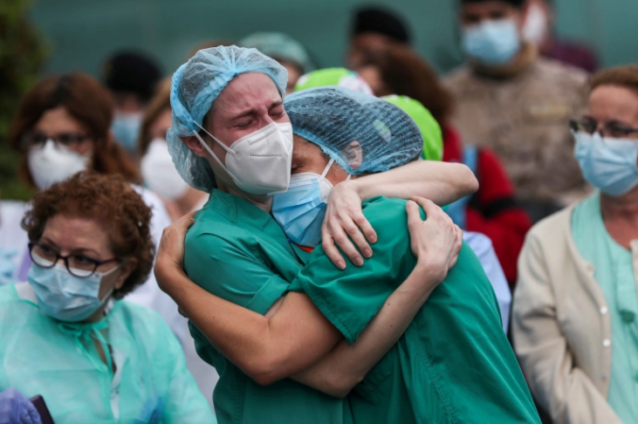
The global death toll from COVID-19 has now crossed two million.
The landmark was reached on Friday amid a vaccine roll-out so immense but so uneven that in some countries there is real hope of vanquishing the outbreak, while in other parts of the world, it seems a far-off dream.
The numbing figure was crossed just more than a year after the coronavirus was first detected in the Chinese city of Wuhan. The number of dead, tallied by Johns Hopkins University, is about equal to the population of Brussels, Mecca, Minsk or Vienna.
More than 93 million cases of the virus have been confirmed worldwide since the start of the pandemic, according to Johns Hopkins University.
Europe is the continent where the health crisis has proved most deadly, with 650,560 deaths to date.
Latin America and the Caribbean have recorded 542,410 deaths, while the United States and Canada have counted 407,090.
United Nations Secretary-General Antonio Guterres called for global solidarity in tackling the pandemic as he marked the “heart-wrenching” milestone.
“Sadly, the deadly impact of the pandemic has been made worse by the absence of a global coordinated effort,” he said in a video.
In wealthy countries including the US, the United Kingdom, Israel, Canada and Germany, millions of citizens have already been given some measure of protection with at least one dose of a vaccine developed with revolutionary speed and quickly authorised for use.
But elsewhere, immunisation drives have barely gotten off the ground. Many experts are predicting another year of loss and hardship in places like Iran, India, Mexico and Brazil, which together account for about a quarter of the world’s deaths.
“As a country, as a society, as citizens, we haven’t understood,” lamented Israel Gomez, a Mexico City paramedic who spent months shuttling COVID-19 patients around by ambulance, desperately looking for vacant hospital beds.
“We have not understood that this is not a game, that this really exists.”
Mexico, a country of 130 million people that has suffered mightily from the virus, has received just 500,000 doses of a vaccine and has put barely half of those into the arms of healthcare workers.
In the US, despite early delays, hundreds of thousands of people are rolling up their sleeves every day. But the virus has killed about 390,000, the highest toll of any country.
The COVID-19 Vaccines Global Access Facility – COVAX, a UN-backed project to supply shots to developing parts of the world – has found itself short of vaccines, money and logistical help.
As a result, the World Health Organization’s chief scientist warned it is highly unlikely that herd immunity – which would require at least 70 percent of the globe to be vaccinated – will be achieved this year.
Health experts fear, too, that if shots are not distributed widely and fast enough, it could give the virus time to mutate.
Dr Julian Tang, from the University of Leicester, said this number is not that surprising given the circumstances.
“This is a new virus to which no one really has any immunity, and we are going through the winter season where these respiratory viruses traditionally peak,” he told Al Jazeera.
“The coronavirus vaccines have come rather late, so we put all that together, the winter season, the delay [in] vaccination, indoor crowding that comes with the winter season, this type of peak and mortality… it is probably not that surprising,” he added.
Meanwhile, in Wuhan, a global team of researchers led by the WHO arrived on Thursday on a politically sensitive mission to investigate the origins of the virus, which is believed to have spread to humans from wild animals.
The Chinese city of 11 million people is bustling again, with few signs it was once the epicentre of the catastrophe, locked down for 76 days, with more than 3,800 dead.
“We are not fearful or worried as we were in the past,” said Qin Qiong, a noodle shop owner.
“We now live a normal life. I take the subway every day to come to work in the shop … except for our customers, who have to wear masks, everything else is the same.”
While the death toll is based on figures supplied by government agencies around the world, the real number of lives lost to is believed to be significantly higher.
Latest Stories
-
Germany suspends military approval for long stays abroad for men under 45
7 minutes -
Liverpool face uphill Champions League task after PSG thrashing in Paris
7 minutes -
‘Ketamine Queen’ sentenced to 15 years in Matthew Perry overdose death
18 minutes -
Nigeria begins mass trial of 500 terrorism suspects
28 minutes -
Atletico Madrid stun 10-man Barcelona to seize Champions League semi-final advantage
51 minutes -
Black Stars coach to be announced by next week – Sports Minister
1 hour -
Chiefs, queen mothers and principal elders of Odau group denounce ‘rebellious Etweresohene’, pledges allegiance to Okyenhene
1 hour -
KNUST library dress code sparks online backlash over strict rules
1 hour -
Cultural Diplomacy in Action: Ghanaian youth leaders present symbolic smock to U.S. Chargé d’Affaires
1 hour -
Ghana Card payment activation under review – NIA breaks silence on financial integration
2 hours -
Ofori-Atta’s ICE release on bail positive; he poses no risk – Amanda Clinton
2 hours -
Ken Ofori-Atta’s passport seized after bail, set to reappear in US Court on April 27
2 hours -
Stuck contraceptives risk HIV surge – Ghana HIV/AIDS Network President warns
2 hours -
Edmond Boateng elected Secretary of Honorary Consular Corps of Ghana
2 hours -
Omanhene Kwabena Asante slams GIADEC CEO over alleged discrimination in mining concessions
3 hours