

Audio By Carbonatix
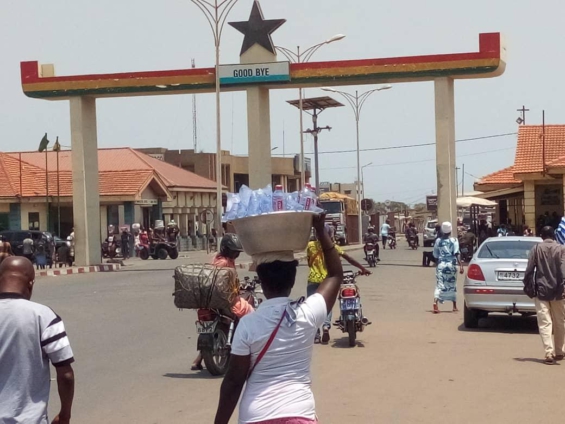
President Akufo-Addo has indicated that the country's land borders cannot be re-opened in view of the prevailing COVID-19 situation.
Addressing the country on December 15, the President explained that the re-opening of land borders may open the floodgates for a 4th wave, and therefore it is inappropriate to do so.
"As you know, the decision to close our borders, which are a source of livelihoods for many, was necessary because we wanted to limit the importation of the virus into the country. We are monitoring the level of the threat of the disease and ongoing vaccinations in our neighbouring countries, as soon as we are satisfied it is safe to do so, the borders will be open.
"Until then, I believe this is not the right time to reopen our land borders, especially as we are determined to prevent a 4th wave, and, as such, they will remain closed until further notice", Akufo-Addo stressed.
During his 27th COVID-19 address on Wednesday evening, the President also impressed on Ghanaians to continue to stick to the relevant COVID-19 safety protocols during the Christmas celebrations.
According to him, this will minimize the possibility of a surge in the number of infections, as it occurred during last year's Christmas celebrations.
"We should be guided by what transpired last Christmas, where there was a sharp spike in the number of COVID infection cases and deaths in the immediate months of January and February, 2021. We should avoid the repetition of such a scenario after this year's Christmas celebration", the President advised.
In addition, Akufo-Addo reiterated some measures by government in dealing with the pandemic. In this regard, he highlighted the expansion of infrastructure "including oxygen supply and reach, particularly with respect to testing and treatment centres, and the training of health professionals across the country, in the care of severe and critically ill persons".
He urged Ghanaians to avail themselves to be vaccinated, while observing the respective safety protocols prescribed by the Ghana Health Service and the World Health Organsiation.
However, a section of the populace have expressed the view that vaccination should not be made 'compulsory'.
The National Communication Officer of the NDC, Sammy Gyamfi is amongst the section of Ghanaians who believe that vaccination should not be imposed on citizens against their wishes and individual preferences.
Meanwhile, about 1,255 have died as a result of the pandemic, with about 973 persons presently battling with the virus.
Nonetheless, President Akufo-Addo indicated that, the current figures "represent some degree of good news", as compared to the impact of the pandemic in other jurisdictions.
Latest Stories
-
Ghana’s recovery supported by gold strength despite global oil price pressures – Standard Bank Research
4 minutes -
Kwaku Azar writes: A-G vs OSP
37 minutes -
Mfantsipim–Adisadel rivalry built excellence, not division – Sam Jonah
1 hour -
Vice President launches Mfantsipim’s 150 years of shaping Ghana’s greatest mind
1 hour -
I assure Otumfuo, Mahama will join him to commission KNUST Teaching Hospital by end of this year – Haruna Iddrisu
2 hours -
Barcelona dominate derby to extend La Liga lead
2 hours -
Gov’t to roll out free special education for persons with disabilities from July 1 – Education Minister
2 hours -
Importers and Exporters Association declares full support for Publican AI port system
3 hours -
“We used it to test our officiating officials’ readiness” – Bawah Fuseini after CAA Athletics event
3 hours -
Volleyball emerges as Ghana’s fastest rising sport
3 hours -
National Sports Fund needs strong leadership from the top – Administrator David Wuaku
3 hours -
JoySports Exclusive: Steve McLaren in talks with GFA after expressing interest in Black Stars job
3 hours -
Fire guts auto parts warehouse at Bubuashie, one fire officer injured
3 hours -
I owe my victory to coach Ofori Asare – Allotey after winning WBA Africa Gold Super Flyweight belt
4 hours -
Church of Pentecost supports over 2,000 BECE candidates in Obuasi with career guidance seminar
5 hours