

Audio By Carbonatix
Italy is to make it compulsory for all workers to have a Covid "green pass" - proof of vaccination, a negative test or recovery from the virus.
The measures are a first for Europe and some of the strictest in the world.
Anyone without a pass will reportedly face suspension from work and may have their pay stopped after five days.
The measure, due to come into force on 15 October, aims to boost vaccinations in a country that has been badly hit by the virus.
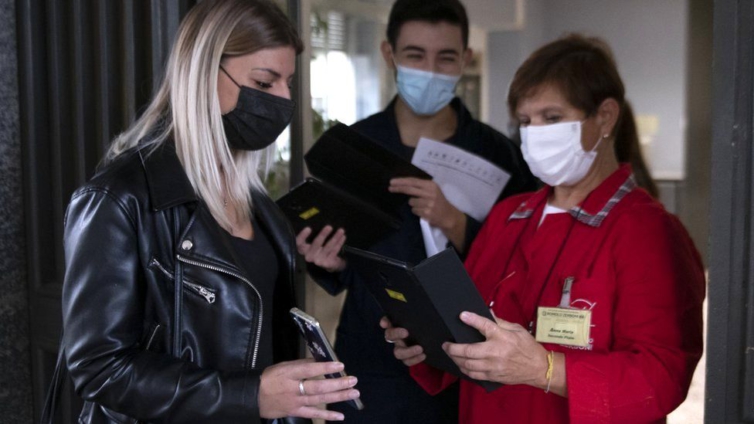
Green pass certificates for Covid-19, provided both digitally and on paper, are already required to access Italian train stations, cinemas, restaurants, gyms and swimming pools.
School staff are also required to show a pass and some teachers have reportedly been turned away from work.
On Thursday, the Italian government approved a new law to extend the requirements to all workplaces and employees across all sectors, including the self-employed.
Businesses and staff could face fines of up to €1,500 (£1,280) if people are found to be working without a valid green pass.
Announcing the decision, Health Minister Roberto Speranza said the new measures would improve safety and "make our vaccination campaign even stronger".
"The implementation of a pass such as the one we are bringing into force with this decree will, we are certain, help us push forward this vaccination campaign," he said.
Despite a vocal anti-vaccination minority, Italians have broadly backed the government's vaccination campaign.
Nearly 65% of Italians have now been fully vaccinated, but infections have been rising, driven by the Delta variant.
Italy has recorded more than 4.6 million cases of Covid-19 and over 130,000 coronavirus-related deaths since the start of the pandemic, according to Johns Hopkins University data.
The green pass was initially introduced to make travel within the EU more efficient, and several countries have since introduced requirements for people to show the certificate for different reasons.
France requires a health pass for access to restaurants, bars, planes and trains, while Austria and Cyprus are among other EU countries to have used similar schemes.
Latest Stories
-
Publish the assessment — NRGI demands transparency in Damang mining deal award to E&P
1 minute -
Tamale: Alhaji Hussein Fuzak funds construction of 3-storey classroom block at Ambariya Islamic School
29 minutes -
Gender Ministry holds staff durbar, welcomes new Chief Director
29 minutes -
Anti-LGBTQ+: Mahama prioritises sentiments of development partners over Ghanaian values – Ntim Fordjour
34 minutes -
CPA intensifies crackdown on fake diapers across public hospitals
55 minutes -
Deputy Defence Minister urges failed GAF applicants to check medical disqualification reasons
58 minutes -
Video: President Mahama’s speech at One Health Summit
1 hour -
Constitution review must protect Ghanaians values, not advance LGBTQ agenda — Haruna Mohammed
1 hour -
Foreign Affairs Ministry advises Ghanaians to take recommended vaccinations before traveling to Senegal
2 hours -
If you have fixed the economy, why hide behind basic needs to delay Anti-LGBTQ+ Bill? – Ntim Fordjour to Mahama
2 hours -
NACOC Central Regional Command partners with NSRA on drug awareness campaign
2 hours -
Galaxy, DPS and Lycee Français shine at part 2 of 2026 Ghana International School Festival
2 hours -
Project C.U.R.E. donates vital medical supplies to support GMTF’s ‘Heal Ghana’ agenda
2 hours -
Engineers and Planners Ltd secures Damang Mining Lease after grueling $500m competitive tender
2 hours -
I never went to university – Tommy-Annan Forson
2 hours