

Audio By Carbonatix
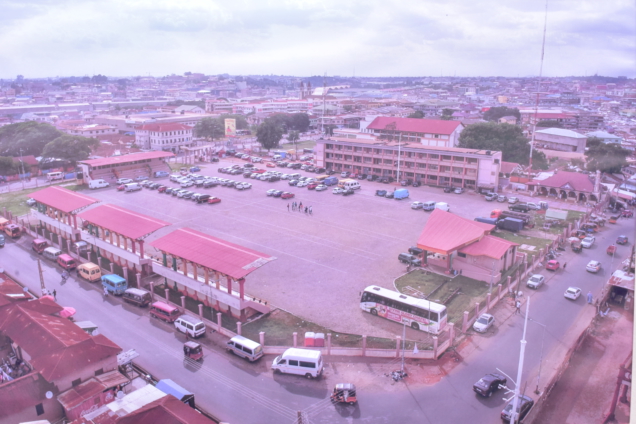
The paucity of grasses making their presence felt in between the concrete pavement bricks evokes the greenery that once adorned this park situated at Asem, Kumasi in the Ashanti region of Ghana.
This place, formerly known as Jackson Park has witnessed Ghanaian football stars like Baba Yara and Dogo Moro. Unfortunately, it is now a car-parking lot and an event centre.
Among the prominent structures around the park is a 70-year-old mosque. Muhammed Muftah has spent his entire life here.
“I started my life here as a child who was born here. My mother was born here but my father was not born here so I have lived my whole life here so I know much about the mosque. The people of Zongo really play football and they still do.
“And we can hear many of their names on the local and international level on television. We can mention names like Baba Yara, Dogo Moro, Salifu, they all started here.
“Even though I didn’t grow up to meet Baba Yara, my father did after Baba Yara played football in this same park. The people of Zongo like to play football hence they used this place as their pitch,” he recounted.

Football was a popular sport in colonial Kumasi just like horse racing and golf. The rise of the Asante Association Football in the 1920s necessitated the creation of a park. Unlike the other sports, there was no venue for football players and supporters to enjoy the game hence the government created an official venue for the game of football.
According to Manuel Jojo Manu-Osafo, PhD. Student, History Department, University of Ghana, a committee was set up to find a feasible location for the park.
Three places were considered but an old Islamic cemetery was selected.
“Football was a very popular sport and the officials decided to find a place for association football so a committee was set up on 6th August, 1935 to investigate and find out what location around Kumasi where football could be played.
“They found three places they felt would be good. The first is the current location of the Jackson Park which used to be a cemetery for the Muslims in the Zongo where they buried their dead and the land was going to be reclaimed if the plan was viable,” he said.
The F. W. Applegate committee which oversaw the creation of the park decided to name it after the then Chief Commissioner of Asante, Francis Jackson who died following an appendicitis operation.
To Jubilee Park As part of Ghana’s 50th anniversary in 2016, the Jackson Park was rehabilitated and named Jubilee Park.
Though stands were created, they weren’t meant for football fans. It became a place for durbars and funerals. Again, traders are at ease plying their activities here.
Professor Karen Lauterbach of the Centre of African Studies, University of Copenhagen was surprised to see a place void of trees and grass referred to as a park.
“When we first heard about Jackson park, a park for me meant a green space, but we found a parking space. It sparked an interest in how it meant for the people
“As a European, we have the tendency to think a park should look in a particular way, it has to be tress, it has to be green grass,” she said.

With this functional change, The University of East Anglia, University of Copenhagen and the Kwame Nkrumah University of Science and Technology are collaborating to explore how the transformation meant for people.
Exploring open space uses The quest has culminated in a research sponsored by the British Academy titled: “Old Park new futures: Documenting the uses of open spaces in an African city.”
Prof. Ben Jones of the University of East Anglia observed that the park which served as a pitch for footballers now serves as a hub for traders like coconut sellers to conduct their business.
He was fascinated about the cordial relationship between the traders and their supervisory bodies.
“We were able to do research on the coconut sellers and generally the literature on street vendors will say they are a very harassed population; they get cleared up and so this is a very fantastic puzzle.
“They are very close to all the people that will regulate them. But the proximity creates a relationship and an understanding. And I think they have been here since 2011 and they have created a home for themselves here,” he said.
He also mentioned that the existence of traders in the space with the Kumasi Metropolitan Assembly and the mosque promotes inclusivity.
“We found out that the city is inclusive. Not to say that everything is easy, obviously there are tensions and rivalries in the history of the park but what we do have here is the office of the KMA, the mosque and the traders,” he said.

Prof. Ben Jones of the University of East Anglia noted the cordial relationship between the traders and their supervisory bodies.
Professor Lauterbach, however, observes the significance of the new park to the people.
“Some people in a way miss that because it’s a certain space, you can relax after work but on the other hand, there’s something about the neatness of the place, the walls are well maintained. People can understand what a park is in many different ways,” she pointed out.
A principal Investigator on the project, Prof. George Bob-Milliar of the Kwame Nkrumah University of Science and Technology said: “In the 21st century city planners should be conscious of creating urban spaces that will be accessible to city dwellers.
“Life in the city is quite tough, having an open space allows others to entertain themselves.”


Latest Stories
-
Berekum Chelsea edge Aduana FC in Bono derby to boost survival hopes
4 hours -
‘They can’t control the team’ – Ernest Thompson doubts local coaches for Black Stars role
5 hours -
Ghana-born midfielder Seidu realises ‘dream’ with Atlético Madrid debut
5 hours -
GPL 2025/26: Bubakari strikes late to hand All Blacks vital win over Dreams FC
5 hours -
Fatal crash on Kintampo–Tamale highway claims four lives
5 hours -
2025–26 FA Cup Semifinal Draw: Chelsea, Man City Learn Wembley Opponents
5 hours -
GPL 25/26: Gold Stars back on top after beating Nations FC
6 hours -
GPL 2025/26: Heart of Lions roar back with victory over Vision FC in Kpando
7 hours -
Solomon Agbasi: Hearts keeper in stable condition after concussion
7 hours -
GPL 2025/26: Late Salim Adams penalty earns Medeama draw at Bechem
7 hours -
Hearts pip Young Apostles 1-0 to end 5-game winless run
7 hours -
Boakye Agyarko marks Easter Sunday with a call for Godly leadership ahead of nationwide campaign tour
8 hours -
Pepsi withdraws as UK festival sponsor after Kanye West backlash
8 hours -
Pope Leo calls for global leaders to choose peace in his first Easter Mass
9 hours -
Kpando MP highlights progress on road projects
9 hours