


Audio By Carbonatix
Three to four billion pounds of criminal money in Europe is being laundered through cryptocurrencies, according to Europol.
The agency's director Rob Wainwright told the BBC's Panorama that regulators and industry leaders need to work together to tackle the problem.
The warning comes after Bitcoin's value fell by half from record highs in December.
UK police have not commented on the programme.
Mr Wainwright said that Europol, the European Union Agency for Law Enforcement Cooperation, estimates that about 3-4% of the £100bn in illicit proceeds in Europe are laundered through cryptocurrencies.
"It's growing quite quickly and we're quite concerned," he said.
There many different types of cryptocurrencies but the best known is Bitcoin. They are intended to be a digital alternative to pounds, dollars or euros.
However, unlike traditional currencies, they are not printed by governments and traditional banks, nor controlled or regulated by them. 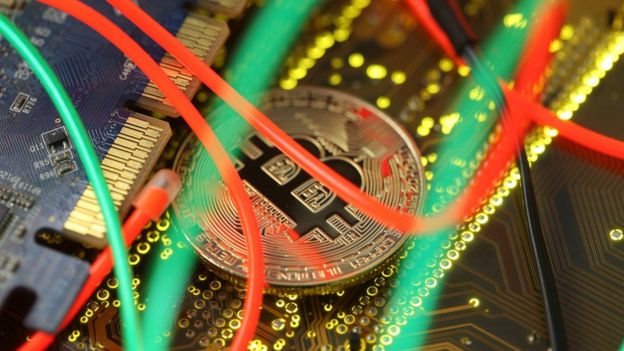
Instead, digital coins are created by computers running complex mathematical equations, a process known as "mining". A network of computers across the world then keeps track of the transactions using virtual addresses, hiding individual identities.
The anonymous and unregulated nature of virtual currencies is attracting criminals, making it hard for police to track them as it is difficult to identify who is moving payments.
'Money mules'
Mr Wainwright said: "They're not banks and governed by a central authority so the police cannot monitor those transactions.
"And if they do identify them as criminal they have no way to freeze the assets unlike in the regular banking system."
Another problem Europol has identified involves the method that criminals use to launder money.
Proceeds from criminal activity are being converted into bitcoins, split into smaller amounts and given to people who are seemingly not associated with the criminals but who are acting as "money mules".
These money mules then convert the bitcoins back into hard cash before returning it to the criminals.
"It's very difficult for the police in most cases to identify who is cashing this out," Mr Wainwright said.
He said that police were also seeing a trend where money "in the billions" generated from street sales of drugs across Europe is being converted into bitcoins.
He called on those running the Bitcoin industries to work with enforcement agencies.
"They have to take a responsible action and collaborate with us when we are investigating very large-scale crime," he said.
"I think they also have to develop a better sense of responsibility around how they're running virtual currency."
'Too slow'
Although British police have yet to respond to requests from Panorama, Parliament is seeking to step up regulations.
The Treasury Select Committee is looking into cryptocurrencies and details of EU-wide regulations to force traders to disclose identities and any suspicious activity are expected later this year.
Alison McGovern, Labour MP for Wirral South who is serving on the committee, has been calling for an inquiry into cryptocurrencies.
"I think that will draw the attention of the Treasury and the Bank [of England] and others to how we put in place a regulatory system," she said.
"I think probably hand on heart we have all been too slow, but the opportunity is not lost, and we should all get on with the job now."
Latest Stories
-
2026 Success Africa Summit: MTN’s Adwoa Wiafe challenges youth to act with purpose, not just pursue titles
2 minutes -
Nurse laureate launches Cancer Care Africa Foundation to tackle late diagnosis, workforce gaps
1 hour -
Ghana to lose GH¢18.15bn in revenue by 2027 from abolishing Covid levy, E-levy – CPS study
1 hour -
Reintroduce scrapped taxes to close revenue gap – Tax expert
2 hours -
GRA applauds CPS study, urges continuous policy scrutiny
2 hours -
Wear blue or green hat to survive – IBAG president says insurance industry ‘captured by politics’
2 hours -
AGI commends government’s move to resolve the power crisis in Volta and Oti Regions
2 hours -
Broker sector worse hit by state interference – IBAG president reveals
2 hours -
IBAG president alleges political interference driving kickbacks in insurance sector
3 hours -
Trump agrees to two-week ceasefire, Iran says safe passage through Hormuz possible
3 hours -
Dozens killed as Angola flood death toll rises
3 hours -
Russia confirms deaths of 16 Cameroonians fighting in Ukraine war, Yaounde says
4 hours -
Plan to scrap presidential elections puts Zimbabweans at loggerheads
4 hours -
Guinea-Bissau transporters strike over higher fuel prices
4 hours -
Iran ceasefire deal a partial win for Trump – but at a high cost
4 hours