

Audio By Carbonatix
Crop researchers at the Crops Research Institute of the Council for Scientific and Industrial Research (CSIR-CRI) are testing new technological devices to detect real–time disease infections on farmers’ fields.
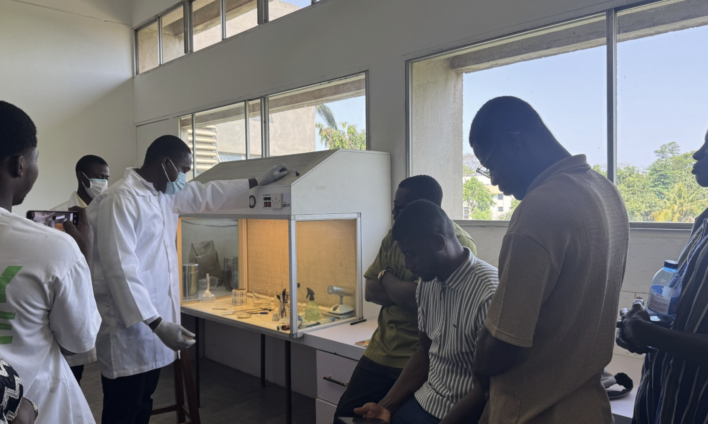
The institute, through the SporeSmart project, is therefore piloting the SporeSmart device technologies and accompanying Artificial Intelligence (AI)- based applications to ensure their effectiveness in detecting diseases in crop fields.
The goal is that by integrating AI-driven forecasting and sustainable biocontrol, the project delivers a scalable, climate-smart approach to Fusarium spp. management, supporting healthier harvests, reducing post-harvest losses, and boosting farmers' incomes.
It is being funded by UK Innovate and other research partners from the UK and Brazil.
Dr Kwesi Atta Aidoo Snr, a Research Scientist at CSIR-CRI and Country Lead for the Project at a stakeholders’ demonstration meeting at Fumesua in the Ashanti Region, explained that, the SporeSmart collector captured fungal spores within the environment so that, when it is sent to the laboratory it is able to detect the kind of disease that was likely to happen on the field.
According to him, Fusarium disease (a soil-borne fungus) remained a major constraint on the production of staple crops such as maize, rice, and tomatoes, with serious implications for yields, food safety, farmers’ incomes, and public health.
He said it was important to use advanced technologies such as the SporeSmart device to demonstrate how real-time field surveillance and data-driven insights could revolutionise plant disease management.
Dr Aidoo Snr said early detection at the field level not only reduces crop losses but also minimises indiscriminate pesticide use, lowers production costs, and supports environmentally responsible farming practices.
Touching on activities to date, he said a total of five SmartSpore collectors have been deployed between September 2025 and February 2026.
Over 2,000 spore images taken, comprising Fusarium spp and other plant pathogens.
Currently, the research team is experimenting with technology and hopes to pilot it on farmers’ fields.
Dr Aidoo Snr indicated that, for the commercial farmer, after piloting and validating the technology, the farmer could purchase and install it on the field.
The government, he indicated, could also invest in the technology and purchase devices to be managed by agricultural extension officers to render services to smallholder farmers.
Dr Mrs Patricia Acheampong, the CSIR-CRI Deputy Director, said per the project’s vision, the use of environmentally friendly and biologically based solutions aligned with the Institute’s goal of protecting ecosystems, ensuring food safety, and promoting climate-resilient agriculture for generations.
Mr Luke Murell, the Project Lead at MMVSense UK, highlighted the roadmap to scaling up the project and believed that, with the right financing and training of extension officers in the technologies, early disease detection would be enhanced.
Latest Stories
-
AGI commends government’s move to resolve the power crisis in Volta and Oti Regions
17 minutes -
IBAG president alleges political interference driving kickbacks in insurance sector
51 minutes -
Trump agrees to two-week ceasefire, Iran says safe passage through Hormuz possible
1 hour -
Dozens killed as Angola flood death toll rises
1 hour -
Russia confirms deaths of 16 Cameroonians fighting in Ukraine war, Yaounde says
2 hours -
Plan to scrap presidential elections puts Zimbabweans at loggerheads
2 hours -
Guinea-Bissau transporters strike over higher fuel prices
2 hours -
Iran ceasefire deal a partial win for Trump – but at a high cost
2 hours -
Oil slides below $100 after Trump announces two-week ceasefire
2 hours -
Madagascar declares state of emergency over energy situation due to Iran war
2 hours -
Ex-Meta worker investigated for downloading 30,000 private Facebook photos
3 hours -
World Bank says Nigerian economy to grow in 2026 but Iran war lifts inflation
3 hours -
Ringleader of suspected human trafficking network arrested in Ethiopia
3 hours -
Alexander-Arnold fails to ease Tuchel concerns as Kane stars
3 hours -
Amad backs Carrick for Manchester United job
3 hours