

Audio By Carbonatix
They may be tiny but they grow into a mighty army of pests. Fall army worms (FAW) continue to be a bane to corn farming and its production in Ghana after invading the country 8 years ago.
Originally native to the Americas, the invasive pests are reported to have contributed to over 80% of maize losses, resulting in economic damages in recent years.
Their thriving presence in Africa, according to entomologists, has been aided by the changing climatic conditions on the continent.
Fortunately, the Crops Research Institute of the Council for Science and Industrial Research has commenced an exploration and introduction of biological control mechanisms against the invasive pests in the Sekyere Afram Plains, Sekyere Central and Bosomtwe districts of the Ashanti region.
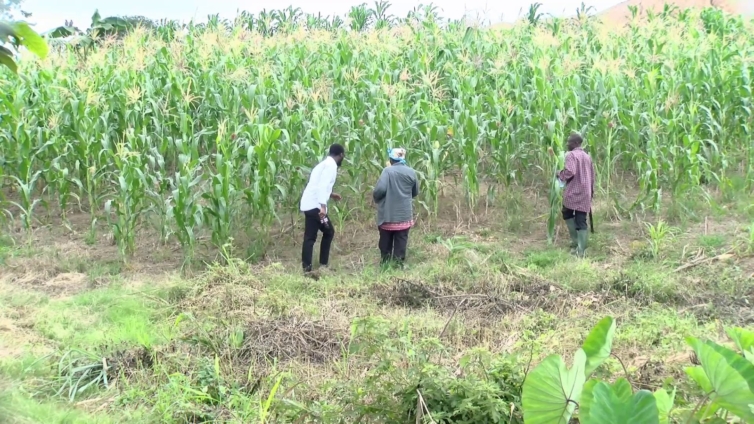
“The maize has grown so well. I have always wished I had a maize farm as healthy and maturing as this,” Kwame Kobi, a maize farmer, said while he walked through a maize plantation he would have preferred to have on his farmland – well matured pest-free maize farm.
For years, maize farmers across Ghana and by extension the African continent have had to battle a common enemy on their farms, the fall army worms.
Striped greyish-green caterpillars with dark-brown to black heads, the invasive pest has a strong preference for feeding on grasses, especially that of maize, rice, sorghum and other crops.

Kwame Kobi and his wife, Afia are farmers in the Abrankese community in the Bosomtwe District of the Ashanti region.
The couple are incurring losses after their 4-acre farm is constantly attacked by the pests.
“They destroy maize so bad. We have to apply a lot of chemicals. You’d never know they are in there until you begin to scatter the seeds. And the vendors sell at a cheaper price because of the heavy infestation,” Kwame Kobi said.
The insect lays its eggs on the plant leaf which grows into a larvae to feed on the whorl of the host plants.
The migration of the pests, originally native to the tropical and subtropical regions of the Americas, remains elusive to scientists.
It has rapidly invaded 47 African countries and 18 Asian countries since the first detection of invasion into Nigeria and Ghana in 2016.
Dr. Kofi Frimpong Annin, an Entomologist at the Crops Research Institute of the CSIR, explains the pests could have possibly invade the country through importation of infested crops.
He observes their growth is aided by the African sweltering climate conditions.

“According to literature, the eggs take 5 days to hatch, but we’ve observed that even within 3 days they begin to hatch,” he said.
FAW on maize yields
A 2017 research study estimated that maize yield losses in Africa due to fall armyworm would range between 8.3 and 20.6 million tonnes per year if management measures were not put in place.
In Ghana alone, the value of the 2018 annual maize crop loss to fall armyworm was estimated at US$177 million.
The Bosomtwe district is well known for its cultivation of fresh maize for instant purchase after harvesting.
But the district located on the outskirts of the Ashanti regional capital, Kumasi, has since the invasion of the pests recorded dwindling production of corn.

Fighting FAW with biological agents
Ridding off the insects has been a struggle for both scientists and farmers with synthetic insecticides being the main treatment management since their detection.
But this has been identified to have deleterious effects on the environment and humans as well as the pest resisting the potency of chemicals.
The Crops Research Institute of CSIR with funding support from Korea-Africa Food and Agriculture Cooperation Initiative (KAFACI) is exploring the use of biological agents to fight the fall army worms.
Lead for the project, Dr. Kofi Frimpong Annin explains three biological agents including insects, fungi and nematodes - otherwise known as soil worms - were adopted.

- The Parasitoids
A parasitoid is a natural enemy whose young stages (egg, larva etc) lives in another organism, eventually killing the host. This is a small hymenoptera insect called Telenomus remus - an egg parasitoid. It attacks the egg of the host in this case the Fall army worm and destroy its eggs. FAW eggs attacked by the Telenomus fail to hatch to the destructive FAW caterpillar.
Dr. Frimpong explains that: “Because many FAW eggs are destroyed when there are large numbers of Telenomus, very few FAW caterpillar emerges and thus destruction to maize is low. Telenomus population in the wild is low and therefore laboratory raised population arereleased to augment that in the wild. Thus, Telenomusare released in young maize farms, at a time where FAW lays many eggs on the maize”.
- Entomopathogenic Fungi (EPF)
EPF are fungi that attack and kill insects. For the first time in Ghana, two native EPFs have been isolated and identified to be effective against the FAW caterpillar. These EPF are Beauveriabassiana and Trichoderma ghanense with the former being more effective. These EPF are sprayed on the maize just like any insecticide and once they come in contact with FAW caterpillar it is mummified and killed.

- Entomopathogenic nematodes (EPN)
EPN are microscopic nematodes that live in the soil. They also penetrate and enter insects and consequently killing it. The native EPN called Metarhabditis rainai were isolated and identified to be effective against the FAW caterpillar. This can also be sprayed as bio-insecticide on maize.
There are calls for private collaborations to commercialize the projects to reach farmers across the country.
“The CRI therefore seeks partnership from private investors to produce and package it as bio-insecticide for commercial sales,” Deputy Director of the CRI, Professor Marian Quain, said.
Some farmers are eager to adopt the new technologies.
“We wish to have a farm as this. They should help us access some of these technologies to kill the insects because they are really troubling us,” Adwoa Agyeiwaa, a farmer, said.
Latest Stories
-
Armed men reportedly storm Adjen Kotoku Onion Market amid tensions
19 minutes -
Tecco Mensah writes: Why football fans must look beyond statistics
1 hour -
Police recover stolen Honda CR-V in Kumasi within 48 hours
2 hours -
Apetorku Gbodzi 2026 Festival opens in Dagbamete with development focus
2 hours -
President Mahama arrives in Lyon to co-chair One Health Summit
2 hours -
Beverly View Plus Hotel draws crowds amid coastal Easter rush in Volta
2 hours -
Maiden Zongo Festival held in Wa amid calls to tackle drug abuse among the youth
2 hours -
FDA warns of fake HIV test kits on Ghanaian market
3 hours -
Africa urged to build resilient health systems as donor support tightens
3 hours -
Easter gesture: Ablakwa settles medical bills for 85 North Tongu constituents
5 hours -
Africa must harness its population strength—Titus-Glover
5 hours -
Visa-free access doesn’t mean unlimited stay – Lom Ahlijah
5 hours -
From Golgotha to Kwahu: The Easter Migration of the Faithful and the Faithless
6 hours -
How the Ghanaian onion traders’ standoff with Nigeria unfolded and threatened local supply
6 hours -
No compensation for demolished structures on 24-Hour Economy market lands — Gov’t to structure owners
6 hours