

Audio By Carbonatix
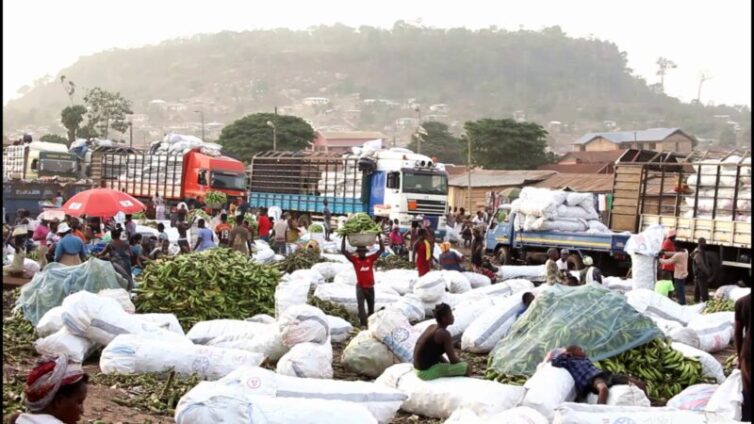
Plantains are one of Ghana’s main staples with about 4.7 million metric tons annual production capacity.
But the crop has in recent times seen production declines owing primarily to poor quality planting material, pests and diseases, erratic rain supply, and other labour challenges.
“When we purchase the plantain suckers, we chop them into smaller pieces, then we dig a hole to plant them and cover it up. That is how we plant it,” John Asamoah, a farmer, explains how he has cultivated his plantain in the past years, but has failed to yield bountiful harvests.

He is losing his investment as he only watches his 10-acre plantain farms die out gradually with poor harvests.
“When it starts to germinate, it’s not good, and we’re unsure of how to handle it. Since we lack knowledge about it, we just place it in the hole as it is. It's also quite challenging to grow because the soil is very tough. If you plant 600 suckers, at least 100 are likely to spoil,” he added.
But he is joining his fellow farmers from other parts of the region in an anxious quest for solutions to their dwindling plantain harvests.
Plantains are one of Ghana’s mainstay crops used in various local delicacies.
The country’s annual production of the crop is pegged at about 4.7 million metric tonnes with about 85 kilogram per capita consumption.

In many Ghanaian households, plantains are either consumed as ampesi, fried for your favorite plantain and beans and an essential component of fufu.
The crop has however seen dwindling production capacity recently owing to various farming challenges.
Pests and diseases and the lack of good quality planting material, suckers, are few of the major production constraints.
Senior research scientist at the Crops Research Institute, Dr. Beloved Dzomeku explains farmers are unknowingly transfer
“Some farmers harvests from their old fields and establish new farms without preparing the materials. So, they carry a lot of pests: nematodes and weevils to their new farms and with that some of them plant and harvest only once. From the second year, the farm is destroyed,” he said.
These challenges over time affect the livelihood of farmers.

But through a simple and clean cultivation technology, farmers can maximize their yields to enhance their income earnings.
John and his fellow farmers are being exposed to these indigenous farming techniques at the Crops Research Institute to end their days of woes in poor harvests.
Under the programme for seed system innovation for vegetatively-propagated crops in Africa (PROSSIVA), the suckers, which are the main planting material for plantains, are kept free from pests and diseases for healthy and bountiful harvests.
Through indigenous technology, farmers are required to peel the entire leaf sheaths of the bulb to expose the whitish part of the stem. A right-angled crosscut is made through the apex of the stem to destroy the process that only allows vertical growth and not lateral growth. The roots are also trimmed to clear any possible disease threats to the plant.

“They can take one sucker from their own farms, prepare and bury it in sawdust and generate several plants from one sucker. Every leaf has a bud which would grow into a plantlet. By the time you harvest your plantains, you will have about 12 suckers around the mother plant,” Dr. Dzomeku explains the process to obtain a clean seed.
Despite these agricultural technologies, Ghana’s reliance on seasonal rains is a bane to production.
Many plantain farms witnessed low production due to the reduced rainfall primarily fueled by the changing climate.
“In the past, I used to be able to get plantains and fill a one-and-a-half Kia every three months, but this year, I couldn't even fill an aboboyaa. It has rotted, so even if you cut it, it’s very small. Because of that, they don’t buy it when you take it to the market. It doesn’t even grow while it’s there,” John said.
In Ghana, the plantains are harvested for the markets in two separate seasons – the lean and the major season. The commodity is high-priced during the lean seasons between May and August, but market centres witness a glut of the crop during the last quarter of the year.
Dr. Dzomeku advises the use of supplementary irrigation systems to ensure all-year-round production.
The vegetatively-propagated crops sector is one of the horticultural sectors of the agric landscape which is rarely explored or invested in.
Experts in the space are calling for investment and want critical attention paid to the sector.
Acting Director of the CSIR-CRI, Dr. Ernest Baafi indicated that an investment is critical to maintain the country’s food indigeneity.
“We are appealing to government that as much as so much is being giving to ensure that resilient in our food system such that we can sustain our food security or get to our food sufficiency level that we want to get to,” he said.
With the adoption of these technologies supported by good rains and irritation systems, the farmers are optimistic to push the country as the leading plantain producers after Uganda and Rwanda.
Latest Stories
-
Edmond Boateng takes up secretary role at Honorary Consular Corps of Ghana
56 minutes -
Gambia appoints British barrister to prosecute gruesome Jammeh-era crimes
1 hour -
Girl group Flo on entering into their ‘bombastic, confident, strong’ era
1 hour -
Germany suspends military approval for long stays abroad for men under 45
2 hours -
Liverpool face uphill Champions League task after PSG thrashing in Paris
2 hours -
‘Ketamine Queen’ sentenced to 15 years in Matthew Perry overdose death
2 hours -
Nigeria begins mass trial of 500 terrorism suspects
2 hours -
Atletico Madrid stun 10-man Barcelona to seize Champions League semi-final advantage
2 hours -
Black Stars coach to be announced by next week – Sports Minister
3 hours -
Chiefs, queen mothers and principal elders of Odau group denounce ‘rebellious Etweresohene’, pledges allegiance to Okyenhene
3 hours -
KNUST library dress code sparks online backlash over strict rules
3 hours -
Cultural Diplomacy in Action: Ghanaian youth leaders present symbolic smock to U.S. Chargé d’Affaires
3 hours -
Ghana Card payment activation under review – NIA breaks silence on financial integration
3 hours -
Ofori-Atta’s ICE release on bail positive; he poses no risk – Amanda Clinton
3 hours -
Ken Ofori-Atta’s passport seized after bail, set to reappear in US Court on April 27
3 hours