

Audio By Carbonatix
The Council for Scientific and Industrial Research (CSIR) has introduced an early detection technology known as ‘Spore Smart Collector’ to help farmers identify crop diseases before they spread.
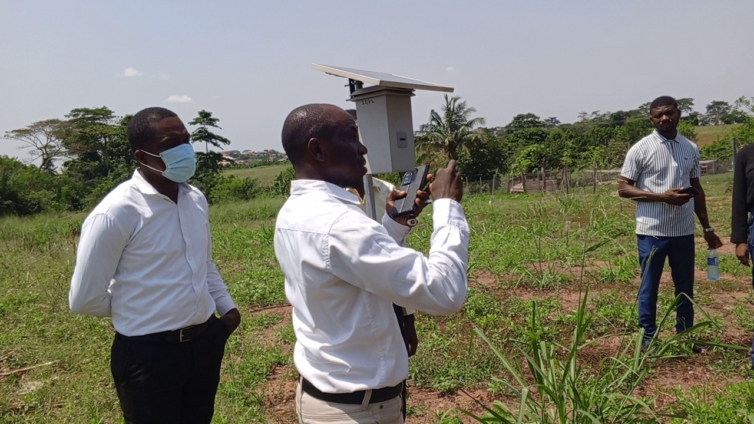
A demonstration meeting brought together farmers, Agricultural Extension Officers, Directors from the Ministry of Food and Agriculture (MOFA), and research scientists to discuss the benefits and possible rollout of the technology.
Country Lead and a Senior Research Scientist, Dr Kwesi Atta Aidoo Snr, explained that the SporeSmart Collector “captures fungal spores within the environment. So in the lab, we can detect the kind of disease that can happen in the field.”
He said the device collects fungal spores from the air on farms, and samples are sent to the laboratory for analysis. This allows experts to detect potential diseases early and advise farmers on preventive action before crops are affected.
Dr Aidoo also addressed concerns about the security of the device when installed on farms.
“Security-wise, we haven’t recorded anything yet in Ghana. For the commercial farmer, it will be in the field, which is being fenced, and there will be a security person or somebody in the field. For security-wise in terms of theft and all that, I don’t think there’s a problem because it’s already in Brazil on the field and they haven’t recorded any theft as yet and we hope that here in Ghana too we'll not record anything like that,” he added.
Luke Murrell of MMV Sense in the UK, who participated in the demonstration, highlighted key challenges that must be addressed before the technology can be expanded nationwide.
“One would be training. Because if we’re going to go from one small installation to many, many thousands of farms, there’s a big training activity that needs to be done, particularly with extension officers,” he said.
He also pointed to financing and building a sustainable service model as important steps for scaling up the project.
“One’s going to be financing the programme, financing the creation of a service. So I think it’s about finding the right partners, finding the right funding models, and a way to pay for this type of service,” he explained
Discussions have been held with the Ministry of Food and Agriculture on possible support, including private-public partnership models. For now, the focus remains on piloting the Spore Smart technology in selected farming communities before expanding it across the country.
Latest Stories
-
From Golgotha to Kwahu: The Easter Migration of the Faithful and the Faithless
24 minutes -
How the Ghanaian onion traders’ standoff with Nigeria unfolded and threatened local supply
26 minutes -
No compensation for demolished structures on 24-Hour Economy market lands — Gov’t to structure owners
34 minutes -
Financial Institutions must back local enterprises to spur growth – Deputy Minority Whip
56 minutes -
Photos: Gomoa Easter Carnival 2026 ends in a burst of colour and celebration
1 hour -
Gomoa Easter carnival ends in colour as fashion, music and celebrity appearances light up final night
1 hour -
Families pick Luv Fm Family Party to celebrate Easter Monday with music and more
2 hours -
Legal and procurement red flags in Ghana Gas insurance change — IMANI
2 hours -
Kaneshie footbridge rehabilitation to take up to 9 months — AMA
2 hours -
AMA confirms trading will be banned on Kaneshie footbridge after rehabilitation
2 hours -
IMANI flags procurement concerns in state insurance placements
2 hours -
Mahama’s push for visa-free Africa reflects Nkrumah’s Pan-African vision – Rashid Tanko-Computer
3 hours -
Redefining sweetness: Why our celebrations must heal, not harm
3 hours -
IMANI urges Mahama to reaffirm his 2014 directive on competitive state insurance placements
3 hours -
Maiden Katon Praise comes off at Accra Sports Stadium on April 17
3 hours