

Audio By Carbonatix
President of the Ghana Insurers Association, Seth Aklatsi, says the government’s debt exchange programme as proposed by the Finance Minister, threatens to entirely collapse the insurance industry in Ghana.
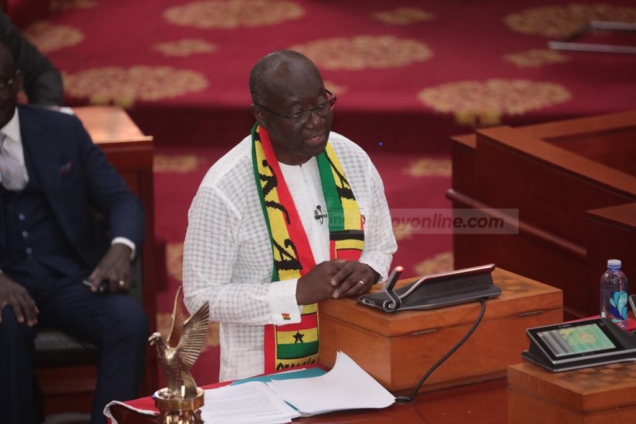
The programme, which was announced by Finance Minister, Ken Ofori-Atta will result in a slash in interest payments for domestic bondholders to zero percent in 2023 and five percent in 2024.
Again, existing domestic bonds as of December 1, 2022, will be exchanged for a set of four new bonds maturing in 2027, 2029, 2032 and 2037 – all in a bid to restore the nation’s capacity to service its debt.
Also, eligible domestic bondholders who fail to participate in the exercise may have their bonds transformed into liquid assets at a low cost.
Speaking on JoyNews’ PM Express Business Edition, Seth Aklatsi said with the terms and conditions provided under the debt exchange programme, the Finance Minister might as well collapse the insurance industry himself.
“What government is putting out, it might as well just come out to tell insurance companies ‘ok all of you, close your company, go home’ because then there isn’t an industry again if he goes ahead with this plan as it is,” he said.
Explaining the fine details of what is at stake, he said;
“Because here’s a business that we take the fractions in premium and we pay out the whole numbers. I earlier on explained that there is the life aspect where we actually know that definitely there is going to be a claim that is made. People take policies like guarantee.
“We take it that, George, maybe you took a policy 7 years ago, because you’re a big journalist we say that you took a policy with an endowment, maybe 1 million, seven years ago. You have been paying premiums for the past seven years where they have guaranteed that after 10 years you’re going to get 1million.
“Or touch wood, if you drop dead now we’ll pay your beneficiaries 1million. It’s based on an investment principle or an investment climate to say that maybe the discount rate or interest income will actually build up to that 1million.
“So if 7 years you’ve paid your premium with investors…and it’s not like we really had a choice, our regulator mandated that if we don’t invest in government of Ghana instrument then they’re not even recognizing your solvency within which is asked if you’re liquid enough to pay claims or not,” he said.
He continued, “Then, touch wood, you drop dead now, we haven’t gotten to the ten years for you to claim the 1 million. But that 1million will have to be paid now. Imagine we go back and tell your family that ‘okay because for the next year we’re not getting interest and then subsequently we’re getting 5%, we’re going to reduce that because we couldn’t have earned the 1 million or we couldn’t have certain returns for the 1 million.’ How are you going to take it? Would people go ahead to buy insurance?”
He stated that the above reasons would discourage others from investing in the insurance industry and this will lead to the rapid decline of the nation’s insurance industry.
He noted that particularly now that the country is going through an economic turmoil, it is important to protect the assets of insurance companies for Ghanaians who have invested in them to have something to fall back on in hard times.
“So effectively what government is doing now is that if there are no interests in that, accrued interest, then you might as well tell insurance companies that ‘ok for this period that we’re going through economic challenges we don’t have an industry called insurance again. So all of you close camp and then go home’
“The attendant unemployment and all the other benefits where I always sort of use a certain scenario where I jokingly get to tell people that it is poor people who actually buy fridge because if you’re poor that’s when you’ll go to the market to buy food stuff to come and store and cook it gradually. If you really have a lot of money, you go to the market every day, you cook everything fresh and effectively you will not need a refrigerator to keep anything.
“So is insurance. At the time that we’re talking about difficulty in our economy that is the most important time that our assets and our liabilities have to be protected. And we protect them by taking fractions as I earlier on said, and eventually paying out the whole numbers,” he said.
Latest Stories
-
‘We’ve become quite experienced in negativity’ – Liverpool’s Slot
3 hours -
Legendary manager Lucescu dies days after resigning
4 hours -
One dead as train travelling 99mph collides with lorry in France
4 hours -
Airlines cut flights and hike fares as fuel prices surge
4 hours -
Kane inspires Bayern to first-leg advantage over Real Madrid at Bernabéu
4 hours -
Wireless Festival cancelled after Kanye West blocked from coming to UK
4 hours -
Wa West MP commissions five boreholes for the benefit of his constituents
4 hours -
Havertz’s late strike hands Arsenal narrow first-leg advantage over Sporting
5 hours -
Damang mine award: Minority not against Ghanaian participation; we’re asking for fair process – Konadu
5 hours -
NPA to enforce stricter registration rules for petroleum tankers
5 hours -
Manhyia South MP laments decline in hospitality operations in his constituency
6 hours -
How a simple clean charcoal innovation could benefit Ghana’s climate future
6 hours -
NPA, COMAC launch Safety Week 2026 to promote risk management in petroleum sector
6 hours -
Stakeholder engagement resolves onion trade impasse
6 hours -
Gender Ministry holds staff durbar, welcomes new Chief Director
6 hours