

Audio By Carbonatix
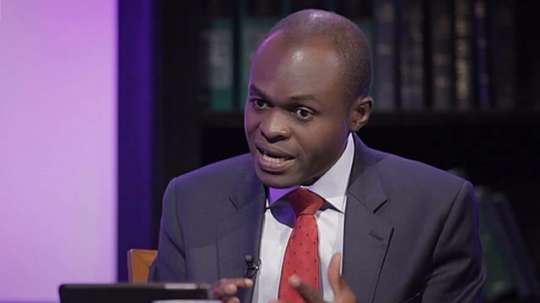
Private legal practitioner, Martin Kpebu has described government's debt exchange programme as a 'weapon of mass destruction'.
Kpebu's description comes in the wake of the adverse impact some critics and experts have predicted about the programme.
Speaking on Joy FM's midday bulletin on Wednesday, the maverick lawyer reiterated his resistance to the proposed policy.
According to him, he and other concerned citizens will continue to mount pressure on government to suspend the programme which they say will worsen the lives of individual bondholders.
"We're still standing by the 'no-no-no-no'. So we're asking government to respectfully exempt individual bondholders from this programme.
"As I've stated over and over, the programme, that's the domestic debt exchange programme is proven to a weapon of mass destruction", he stated.
Mr Kpebu continued, "It [debt exchange programme] is going to kill more citizens, it's going to destroy more businesses. It's going to destroy more schools and livelihoods and so on and so forth".
In an earlier interview on Joy FM's Newsnight, Martin Kpebu, who is the legal representative for the Individual Bondholders Association of Ghana, expressed displeasure at the delay by the Finance Ministry in calling for a stakeholder engagement.
According to him, the way the government had kept them in the dark with regard to the date for their meeting is disappointing.
“We are pained by the very slow manner in which government is dealing with this matter, too slow,” he said.
Meanwhile, NPP stalwart, Gabby Otchere-Darko, has underscored the relevance of government’s debt exchange programme in facilitating negotiations with the International Monetary Fund (IMF).
Ghana is currently in talks with the global lender for a deal to help salvage the country’s ailing economy.
If approved, the deal will help Ghana to properly balance its books and project better prospects for the economy.
But according to Mr Otchere-Darko, this can be possible if government’s domestic debt exchange programme is embraced by all and sundry.
In a tweet on Sunday, he therefore called on all individual bondholders to align with government towards a successful implementation of the said initiative.
“The debt exchange programme is voluntary for individual bondholders but a very necessary evil for our economy.
"Its success is critical to restoring macroeconomic stability, securing an IMF prog. It hits those of us holding bonds very hard. A straight no to it is no solution!”, he wrote.
Ghana’s return to the IMF marks the country’s 17th engagement with the Fund, since attaining independence in 1957.
The factors which have perenially led to Ghana-IMF interactions include the deprecation of the local currency, fiscal indiscipline, budget deficits and a host of other lapses in economic management.
In its current ongoing negotiation with the Fund, the depreciation of the local currency against other major trading currencies has been identified as one of the key triggers.
Also, the country’s debt stock and rising inflation have collectively contributed to its recent IMF engagement, which started in July 1, 2022.
But government has consistently maintained that these factors would not have resurfaced had it not been for the Russia-Ukraine war and the ravages of the COVID-19 pandemic.
Latest Stories
-
‘We don’t have time’ – Fianoo calls for Schäfer to lead Black Stars temporarily
34 minutes -
CAF will not favour any country – President Motsepe
39 minutes -
Otto Addo was appointed through the backdoor – Kudjoe Fianoo slams GFA
40 minutes -
UG Corporate Football League back from the Easter break
44 minutes -
CGI orders motorbike training at tactical school in Kyebi
2 hours -
Sachet water producers in Berekum defy gov’t directives, increase prices
2 hours -
Critical commodities stuck at port, CSOs warn of family planning crisis
2 hours -
Gender Ministry mourns victims of Volta Lake boat tragedy, deploys support for affected families
2 hours -
MPs undergo training on human trafficking and gender dimensions
2 hours -
Don’t expect instant relief – COMAC CEO warns fuel price drops will be gradual
2 hours -
GIS to unveil comprehensive plans to enhance officers’ welfare and infrastructure
2 hours -
Right move, wrong timing? – COMAC CEO questions govt’s delay on fuel price relief
2 hours -
IMF urges Central Banks to keep inflation in check
3 hours -
NRSA stands firm on Toyota Voxy ban despite transport operators’ opposition
3 hours -
H. Kwasi Prempeh raises concerns over Supreme Court’s handling of OSP constitutionality case
3 hours